
What is international law?
International law is, at its simplest, the body of rules and principles that governs relations between sovereign nations. It is not law in the way most people understand the term. There is no global police force to enforce it, no supreme court with binding authority over every nation, and no prison for rogue heads of state (or at least, not one they cannot simply ignore). Yet it is far from meaningless. It is the framework that governs diplomacy, trade, human rights, armed conflict, and the environment across a world of nearly 200 independent states.
The roots of international law stretch back centuries. The Peace of Westphalia in 1648 established the modern concept of state sovereignty, the idea that each nation is master within its own borders and that other nations have no right to interfere. From that foundation, a vast architecture of treaties, conventions, and customary practices emerged. Today, international law encompasses everything from the Geneva Conventions, which govern the conduct of war, to the Law of the Sea, which determines who controls the world’s oceans. It covers trade agreements, climate accords, nuclear nonproliferation treaties, and diplomatic immunity protocols.
Crucially, international law is both voluntary and obligatory in a way that confounds easy definition. Nations choose to sign treaties, but once signed, those treaties carry the force of legal obligation. Customary international law, practices so widely observed and so longstanding that they have acquired the status of law — binds even states that have never formally agreed to them. The prohibition on genocide, for instance, is considered a peremptory norm: a rule so fundamental that no nation can contract out of it, no matter what its domestic laws or political leadership may say.
The central paradox is enforcement. International law lacks the coercive mechanisms that give domestic law its teeth. Compliance depends heavily on reciprocity, reputation, and the self-interest of states in maintaining a stable international order. A country that flouts its obligations risks economic sanctions, diplomatic isolation, and the erosion of trust that underpins international cooperation. These are powerful incentives, but they are not always enough.
The rule of law in the international arena
The rule of law, as a concept, holds that no person or institution is above the law; that laws must be publicly known, equally applied, and independently adjudicated; and that rights and obligations are determined by legal principles rather than the arbitrary will of those in power. Applied domestically, this principle underpins every functioning democracy. Applied internationally, it is both the aspiration and the great unfinished project of the modern world.
The rule of law at the international level requires that states be accountable for their actions, that they cannot invade neighbours with impunity, commit atrocities against their own populations without consequence, or tear up treaties when inconvenient. It requires that disputes be settled through legal mechanisms rather than force, and that the weak have recourse against the strong.
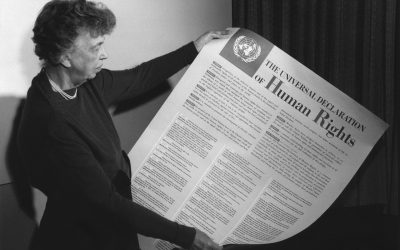
This is an ideal that the international community has pursued with enormous effort and uneven results. The post-World War Two settlement, the founding of the United Nations, the Nuremberg and Tokyo tribunals, and the Universal Declaration of Human Rights, were a determined attempt to replace the law of the jungle with the rule of law. It worked better than its critics predicted and less well than its architects hoped.
The United Nations: ambition and constraint
The United Nations was born in 1945 from the wreckage of two world wars and the grim determination that such catastrophes must never happen again. Its founding charter committed member states to settle disputes peacefully, to refrain from the threat or use of force against other states, and to cooperate in maintaining international peace and security.
At its best, the UN has been a remarkable achievement. It has served as a forum for diplomacy, defusing crises before they became conflicts. Its specialised agencies, the World Health Organisation, the World Food Programme, and the High Commissioner for Refugees have saved millions of lives. Its peacekeeping operations have stood between warring factions in dozens of countries. Its human rights framework, though imperfectly applied, has given individuals and civil society groups tools to hold governments to account.
At its worst, the UN has been paralysed by the structure of its own Security Council, the body charged with authorising collective action in response to threats to peace. The five permanent members, the United States, Russia, China, the United Kingdom, and France, each hold a veto. This was a deliberate design feature, reflecting the political reality of 1945: the great powers would only join an organisation that could not act against their fundamental interests. The consequence is that when a permanent member is itself the aggressor, or shields an ally who is the aggressor, the Security Council is rendered impotent.
Russia’s invasion of Ukraine in 2022 is the starkest recent example. Security Council resolutions condemning the invasion were vetoed by Russia itself — a permanent member exercising its veto to protect itself from the consequences of violating the very charter it had signed. The General Assembly, which has neither veto nor binding authority, passed resolutions condemning the invasion by overwhelming margins.
The moral weight was clear; the practical enforcement was absent.
China’s expansive territorial claims in the South China Sea, declared illegal by an international arbitration tribunal in 2016, were simply dismissed by Beijing, which refused to participate in the proceedings and announced it would not be bound by the ruling. The UN system had no mechanism to compel compliance.
These failures do not render the UN irrelevant. They reflect the fundamental tension at the heart of any international institution: member states, particularly powerful ones, will not permanently surrender their sovereign prerogatives. The UN can lead, shame, facilitate, and coordinate — but it cannot compel great powers, and this limitation defines the ceiling of what global governance can achieve in our current era.
NATO: the western alliance and its expanding role
The North Atlantic Treaty Organisation was founded in 1949 as a collective defence alliance among Western democracies, rooted in the principle that an attack on one member would be treated as an attack on all. Its original purpose was deterrence against Soviet aggression in Europe. For decades, it achieved that purpose without firing a shot.
After the Cold War, NATO’s rationale was questioned. Without a clear adversary, what was it for? The answer came gradually: NATO expanded eastward, admitting former Warsaw Pact nations and Baltic states that had been Soviet republics. It conducted operations in the Balkans to halt ethnic cleansing in Bosnia and Kosovo. It invoked its collective defence clause for the first time after the September 11 attacks and took the lead in Afghanistan.
Russia’s annexation of Crimea in 2014 and its full-scale invasion of Ukraine in 2022 resolved the question of NATO’s relevance with brutal finality. The alliance has galvanised, military spending among member states has increased dramatically, and Finland and Sweden — historically neutral nations — joined the alliance. NATO now faces the most serious threat to European security since the Second World War, managing the tension between supporting Ukraine and avoiding direct conflict with a nuclear-armed Russia.
NATO is not a UN body and is not bound by the UN Charter’s restrictions in the same way, though its members are. It operates as a regional security arrangement. Critics argue it provoked Russian aggression through its eastward expansion; its defenders argue that the nations it admitted sought membership precisely because they feared Russia — and that subsequent events validated their fears.
The alliance represents a form of collective security that works because it is backed by credible military force, nuclear deterrence, and the political will of its members. It is, in a sense, the rule of law enforced by a coalition of the willing, a less universal but more effective mechanism than universal institutions alone.
The Hague: courts, accountability, and justice
The Hague, a city in the Netherlands, has become synonymous with international justice. It hosts the International Court of Justice (ICJ), the principal judicial organ of the United Nations, which settles disputes between states and gives advisory opinions on questions of international law. It hosts the International Criminal Court (ICC), established in 2002, which prosecutes individuals for war crimes, crimes against humanity, and genocide. And it is home to a range of other international tribunals and arbitration bodies.
The ICJ adjudicates disputes between nations: border disagreements, treaty interpretations, and allegations of violations of international law. Its judgments are binding, but enforcement depends on the Security Council, which brings us back to the familiar veto problem.
The ICC is arguably the more revolutionary institution. For most of history, leaders who ordered massacres or aggressive wars faced consequences only if they lost, and only at the hands of the victors. The Nuremberg trials established the precedent that individuals, including heads of state, could be held personally accountable for crimes under international law. The ICC institutionalised this principle, creating a permanent court with independent prosecutors and global jurisdiction.
Its limitations are significant. The United States, Russia, China, and India — among the world’s largest powers — have not ratified the Rome Statute that created the ICC and therefore do not recognise its jurisdiction over their nationals. This creates a glaring gap: the nations most capable of committing large-scale atrocities include some that have effectively opted out. When the ICC issued an arrest warrant for Russian President Vladimir Putin in 2023 over the alleged deportation of Ukrainian children, it was a historic moment — the first sitting leader of a nuclear power to face such a warrant. It was also practically unenforceable as long as Putin did not travel to a member state.
Despite these constraints, the ICC and the broader system of international justice have changed the calculations of political leaders in important ways. The threat of prosecution is not merely symbolic; it has shaped negotiations, influenced military commanders’ decisions, and provided a measure of accountability that would otherwise be entirely absent. Slobodan Milosevic, Charles Taylor, and Radovan Karadzic all faced international justice. The principle that crimes against humanity will be prosecuted — however imperfectly — is now embedded in the international order.
Nations that have flouted international law
The history of international law is, in significant measure, the history of its violation. Among the most consequential examples in recent decades:
Russia has violated international law in ways that are both blatant and systematic. The annexation of Crimea in 2014 was an illegal act of territorial seizure in violation of the UN Charter and the Budapest Memorandum, under which Russia had explicitly guaranteed Ukraine’s territorial integrity. The full-scale invasion of Ukraine in 2022 was a war of aggression — the most serious violation of international law a state can commit. Russia has also been implicated in the use of chemical weapons on foreign soil (the Novichok poisonings in the United Kingdom), deliberate targeting of civilian infrastructure, and the forcible transfer of children from occupied territories. The ICC arrest warrant for Putin relates to this last allegation.
China has defied the 2016 arbitration ruling on its South China Sea territorial claims, continued its militarisation of disputed islands and reefs, and pursued a systematic campaign of repression in Xinjiang that multiple governments and human rights organisations have characterised as crimes against humanity, including the mass detention of Uyghurs. Its actions in Hong Kong have dismantled the “one country, two systems” framework enshrined in the Sino-British Declaration, a binding international treaty.
North Korea has repeatedly violated UN Security Council resolutions through its nuclear weapons and ballistic missile programmes, and conducted cyber attacks against foreign nations. It subjects its population to one of the most severe systems of political repression on earth.
Myanmar’s military junta launched a campaign of ethnic cleansing against the Rohingya Muslim minority that the International Court of Justice is adjudicating as a potential genocide. The 2021 coup reversed a democratic transition and unleashed a civil war of extraordinary brutality.
Syria’s Assad government used chemical weapons against its own civilian population — a clear violation of the Chemical Weapons Convention — on multiple occasions. International efforts to hold Assad accountable were blocked in the Security Council by Russian and Chinese vetoes.
Sudan’s warring factions — the military and the paramilitary Rapid Support Forces — have committed atrocities against civilians on a massive scale in the ongoing civil war, with evidence of ethnically targeted violence.
It would be incomplete not to note that Western democracies, too, have faced serious allegations of violating international law — the US invasion of Iraq in 2003 was widely condemned as illegal, and US drone strike programmes and detention practices have drawn sustained legal challenge. The rule of law requires universal application, or it loses its authority. This remains one of international law’s most unresolved tensions: the gap between what powerful states demand of others and what they are willing to submit to themselves.
Order without Empire
The history of human civilisation is, in one reading, a long struggle to replace force with law — to build systems in which disputes are resolved by rules rather than by whoever has the largest army. Domestic societies largely achieved this transition centuries ago, with varying degrees of success. The international community is still in the middle of it.
What exists today — the UN, the ICC, the network of treaties and conventions, the regional alliances — is fragile, imperfect, often contradicted, and regularly abused.
It is also something genuinely new in the history of nations: a framework that has prevented a third world war for eight decades, that has made conquest for territorial gain less common than at any point in recorded history, and that provides, however imperfectly, a language and a forum for the peaceful resolution of disputes.
The question of our moment is whether that framework can withstand the pressures being placed upon it: the aggressive revisionism of authoritarian great powers, the weakening of democratic solidarity, the proliferation of regional conflicts, and the erosion of trust in multilateral institutions. The answer is not yet determined. It will depend on the choices of governments, the pressure from civil society, and the degree to which ordinary citizens in every country understand what is at stake in the seemingly abstract business of international law.
It requires constant investment, constant vigilance, and the willingness to defend not just national interests but the rules-based system itself, even when doing so is costly. That willingness is being tested as rarely before.


Leave a Reply