• Skip to main content
  • Skip to after header navigation
  • Skip to site footer
Our history archive

Our History

Our History Archive, where history comes to life

  • Home
  • Colonisation
  • World History
  • Civil Rights
  • World cultures
  • Features
  • Wellbeing
  • Popular Culture

Sir Florizel Glasspole: A stalwart of Jamaican politics

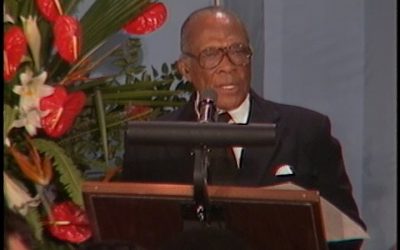
The Most Honourable Sir Florizel Glasspole
White House Television Office, Public domain, via Wikimedia Commons
Features
6 December, 2023

In the annals of Jamaican history, the name Sir Florizel Augustus Glasspole stands as a symbol of steadfastness, statesmanship, and unwavering dedication to the principles of democracy. Born in Kingston, Jamaica, on 25 September 1909, Glasspole’s life journey encompassed not only the corridors of power but also the heart of the labour movement that helped shape Jamaica’s socio-political landscape.

Early years and labour advocacy

Glasspole’s early life was marked by a pursuit of knowledge and a relentless drive for progress. Educated at the prestigious Wolmer’s Boys’ School, he ventured abroad to McGill University in Canada, where he honed his skills in electrical engineering. Yet, it was upon his return to Jamaica that he would truly make his mark.

In 1944, in tandem with the legendary Sir Alexander Bustamante, Glasspole co-founded the Bustamante Industrial Trade Union (BITU). This labour movement would become a powerful voice for the rights of workers in Jamaica, marking a turning point in the nation’s labour history. Glasspole’s dedication to the welfare of the working class earned him a reputation as a champion of their cause.


Governor-General and unifying figure

The Most Honourable Sir
Florizel Glasspole
White House Television Office, Public domain, via Wikimedia Commons

The zenith of Glasspole’s public service career came with his appointment as Governor-General of Jamaica in 1973, a role he would hold with distinction until 1991, spanning several terms of different Prime Ministers. During his tenure, Jamaica underwent significant changes, transitioning to a parliamentary republic in 1962. In this ceremonial role, Glasspole proved to be a unifying figure, maintaining stability and continuity during periods of political change.

Legacy and recognition

Sir Florizel Glasspole’s legacy endures as a testament to his statesmanship, dedication to democracy, and tireless efforts on behalf of the Jamaican people. In recognition of his contributions, he was knighted by Queen Elizabeth II in 1983, becoming Sir Florizel Glasspole. His unwavering commitment to the principles of democracy, justice, and the rule of law continues to resonate in the collective memory of Jamaica.

Sir Florizel Glasspole passed away on 25 March 2000. Still, his legacy as a leader, labour advocate, and statesman continues to be celebrated in Jamaica’s history and political tradition. In a nation marked by its rich history and vibrant culture, Sir Florizel Glasspole occupies a unique place—a beacon of unity, progress, and the enduring spirit of Jamaica’s political landscape.

Share this:

  • Share on Facebook (Opens in new window) Facebook
  • Share on X (Opens in new window) X
  • Share on Reddit (Opens in new window) Reddit
  • Share on Pinterest (Opens in new window) Pinterest
  • Share on WhatsApp (Opens in new window) WhatsApp


Related

You May Also Like…

More details Jesse Jackson surrounded by marchers carrying signs advocating support for the Hawkins-Humphrey Bill for full employment,

Keep hope alive: The rise, power, and legacy of Jesse Jackson

The revolutionary icon: Ernesto "Che" Guevara

Ernesto “Che” Guevara: : The revolutionary icon

Portrait of Bartolomé de Las Casas (c.1484 - 1566)

Bartolomé de las Casas and the birth of human rights

William Randolph Hearst

William Randolph Hearst: The king of Yellow Journalism


Reader Interactions

Leave a ReplyCancel reply

Sidebar

This Day In History

Events in History
On this day in 1965 Civil rights activists were brutally beaten by Alabama state troopers. This day is known as Bloody Sunday.
More details Jesse Jackson surrounded by marchers carrying signs advocating support for the Hawkins-Humphrey Bill for full employment,

Keep hope alive: The rise, power, and legacy of Jesse Jackson

The revolutionary icon: Ernesto "Che" Guevara

Ernesto “Che” Guevara: : The revolutionary icon

Portrait of Bartolomé de Las Casas (c.1484 - 1566)

Bartolomé de las Casas and the birth of human rights

Trending

  • The rise and fall of the Persian Empire
    The rise and fall of the Persian Empire
  • Operation Ajax and the shadow of empire: The 1953 Iranian coup
    Operation Ajax and the shadow of empire: The 1953 Iranian coup
  • Ten times America created a moral panic
    Ten times America created a moral panic
  • Understanding Sharia Law: Principles, practice, and global context
    Understanding Sharia Law: Principles, practice, and global context
  • The rise and fall of the Ottoman Empire: Six centuries of imperial power
    The rise and fall of the Ottoman Empire: Six centuries of imperial power
  • Holy Wars: The blood-soaked legacy of conflicts fought in the name of Christianity
    Holy Wars: The blood-soaked legacy of conflicts fought in the name of Christianity
  • The major branches of Islam: History, beliefs, and differences
    The major branches of Islam: History, beliefs, and differences
  • The Great Game: Britain and Russia's strategic rivalry in Central Asia
    The Great Game: Britain and Russia's strategic rivalry in Central Asia
  • Gil Scott-Heron: The voice of revolution in music and poetry
    Gil Scott-Heron: The voice of revolution in music and poetry
  • The First Red Scare: America's post-WWI fear of Communism and radical change
    The First Red Scare: America's post-WWI fear of Communism and radical change

Connect

  • YouTube
  • TikTok
  • Bluesky

ABOUT

CONTACT

PRIVACY POLICY

COOKIES

Copyright © 2026 · Our History · All Rights Reserved