
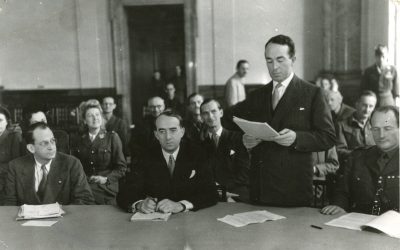
In the autumn of 1945, in the bombed-out city of Nuremberg, Germany, the world witnessed something it had never seen before: the leaders of a defeated nation standing trial before an international tribunal for crimes against humanity. The Nuremberg Trials were not merely a legal proceeding; they were a moral reckoning, a declaration that even in the chaos of war, there exist laws that bind all of humanity, and that those who violate them will be held accountable.
The trials, which ran from 20 November 1945 to 1 October 1946, prosecuted 24 of Nazi Germany’s most senior surviving officials. They gave rise to principles that would shape international law, human rights standards, and the concept of war crimes for generations to come.
Background and origins
World War II left an estimated 70 to 85 million people dead — the deadliest conflict in human history. Nazi Germany’s crimes were on a scale never before seen: the systematic murder of six million Jews in the Holocaust, the deaths of millions more in concentration camps, the brutal occupation of conquered nations, and the use of slave labour on an industrial scale.
As the war drew to a close in 1945, the Allied powers — The United Kingdom, France, the Soviet Union, and the United States — faced a question: what should be done with the surviving Nazi leadership? Some voices, including British Prime Minister Winston Churchill, initially favoured summary execution. Others argued that justice required a fair trial. American Secretary of War Henry Stimson was among those who insisted that a proper legal process was not only morally right but also strategically important, would distinguish the Allies from their enemies, and set a precedent for future international accountability.
On 8 August 1945, the four Allied powers signed the London Charter, establishing the International Military Tribunal (IMT) and its rules of procedure. The choice of Nuremberg was symbolically significant: it had been the site of massive Nazi rallies in the 1930s and the city where the infamous Nuremberg Race Laws had been passed in 1935.
The charges
The London Charter established four counts on which the defendants would be indicted. Each represented a category of conduct that the Allies agreed must never again go unpunished.
Count one: conspiracy to commit crimes
This charge alleged that the defendants had conspired together to commit the crimes outlined in the other three counts, a broad framing designed to capture the collective planning behind Nazi atrocities.
Count two: Crimes against peace
This charged the defendants with planning and waging a war of aggression in violation of international law and treaties — most notably the Kellogg-Briand Pact of 1928, which had renounced war as an instrument of national policy. This charge was among the most legally controversial, as critics argued that no such prohibition had existed in the way the Tribunal interpreted it.
Count three: War crimes
This covered violations of the laws and customs of war, including the murder and mistreatment of prisoners of war and civilian populations, the deportation of civilians for slave labour, and the wanton destruction of towns and cities not justified by military necessity.
Count four: Crimes against humanity
The most historically significant charge, this covered murder, extermination, enslavement, deportation, and other inhumane acts committed against civilian populations — including the systematic persecution of Jews, political opponents, and other groups. This was the first time in history that ‘crimes against humanity’ was codified and prosecuted in an international legal proceeding.
The defendants
Twenty-four men were indicted before the IMT, representing a cross-section of the Nazi leadership — political officials, military commanders, diplomats, industrialists, and propagandists. Adolf Hitler, Heinrich Himmler, and Joseph Goebbels were absent, having committed suicide before the war ended.
Among the most prominent defendants were:
Hermann Göring — Commander of the Luftwaffe and Hitler’s designated successor, Göring was the highest-ranking Nazi to stand trial. He was convicted on all four counts and sentenced to death, but swallowed a cyanide capsule the night before his scheduled execution.
Rudolf Hess — Hitler’s former deputy, who had made a bizarre solo flight to Scotland in 1941. He was convicted on counts one and two and sentenced to life imprisonment, which he served until his death in Spandau Prison in 1987.
Joachim von Ribbentrop — Germany’s foreign minister, who had negotiated the Molotov-Ribbentrop Pact with the Soviet Union. He was convicted on all four counts and hanged.
Albert Speer — Hitler’s chief architect and minister of armaments, who oversaw the use of slave labour. Unlike most defendants, Speer expressed remorse and distanced himself from the regime’s crimes. He received 20 years’ imprisonment.
Julius Streicher — Publisher of the virulently antisemitic newspaper Der Stürmer. Convicted for crimes against humanity through his role in inciting hatred and genocide, he was hanged.
The verdicts
The tribunal delivered its verdicts on 30 September and 1 October, 1946. Of the 22 defendants who stood trial (one, Robert Ley, had committed suicide before trial; another, Martin Bormann, was tried in absentia):
Sentenced to death by hanging (12): Göring, von Ribbentrop, Wilhelm Keitel, Ernst Kaltenbrunner, Alfred Rosenberg, Hans Frank, Wilhelm Frick, Julius Streicher, Fritz Sauckel, Alfred Jodl, Artur Seyss-Inquart, and Martin Bormann (in absentia).
Life imprisonment (3): Rudolf Hess, Walther Funk, and Erich Raeder.
Prison terms (4): Karl Dönitz (10 years), Baldur von Schirach (20 years), Albert Speer (20 years), and Konstantin von Neurath (15 years).
Acquitted (3): Hjalmar Schacht, Franz von Papen, and Hans Fritzsche.
The executions were carried out on 16 October 1946, by hanging in the Nuremberg prison gymnasium. The bodies were cremated and the ashes scattered in the Isar River to prevent the creation of any shrines to the Nazi dead.
The subsequent Nuremberg Trials
The main IMT trial was followed by twelve additional trials held before American military tribunals between 1946 and 1949. These so-called ‘subsequent Nuremberg trials’ prosecuted a wider range of perpetrators, including doctors who had conducted medical experiments on concentration camp prisoners (the Doctors’ Trial), judges and lawyers who had administered Nazi law (the Judges’ Trial), senior SS officers who had directed mass killings (the Einsatzgruppen Trial), and industrialists who had used slave labour (the Krupp and Flick trials).
Collectively, these trials prosecuted 185 defendants, resulting in 12 death sentences, dozens of prison terms, and several acquittals. They produced detailed documentation of the Nazi machinery of murder that remains an invaluable historical record.
Legacy and historical significance
The Nuremberg Trials were imperfect, as any human institution must be, but their legacy has proven enduring and profound.
The Nuremberg Principles
In 1950, the United Nations International Law Commission codified the ‘Nuremberg Principles’ — a set of guidelines for what constitutes a war crime. These principles established, among other things, that individuals can be held accountable under international law (not just states), that following orders is not an absolute defence, and that crimes against humanity are punishable regardless of whether they violate domestic law.
The Doctors’ Trial and Medical Ethics
The Doctors’ Trial, which prosecuted 23 German physicians for conducting deadly experiments on concentration camp prisoners, directly led to the creation of the Nuremberg Code — a set of ethical principles governing human experimentation. These principles were later incorporated into the Declaration of Helsinki and form the foundation of modern medical research ethics worldwide.
The architecture of international justice
Nuremberg inspired the creation of subsequent international criminal tribunals: the International Criminal Tribunal for the former Yugoslavia (1993), the International Criminal Tribunal for Rwanda (1994), and ultimately the permanent International Criminal Court, established in 2002 under the Rome Statute. Each of these institutions drew directly on the legal frameworks and precedents established at Nuremberg.
Criticism and controversy
The trials have not been without their critics. Some legal scholars argued that they represented ‘victor’s justice’ — that the Allies themselves had committed acts during the war (such as the strategic bombing of civilian populations) that might have qualified as war crimes under the same standards being applied to the Germans. Others contended that prosecuting ‘crimes against peace’ violated the principle of nullum crimen sine lege — that one cannot be convicted for actions that were not crimes under existing law at the time they were committed.
These objections, while raising genuine legal questions, have generally not diminished the broad consensus that the trials served a vital purpose in establishing accountability and creating a framework for international humanitarian law.
Conclusion
The Nuremberg Trials took place in the shadow of unprecedented catastrophe. They were born of the conviction that civilisation could not simply move on from the Holocaust and World War II without naming what had happened, holding those responsible to account, and establishing that such crimes must never again go unpunished.
American chief prosecutor Robert H. Jackson, in his opening statement before the tribunal, articulated the trials’ animating purpose: that the four great nations, flushed with victory and stung with injury, stayed the hand of vengeance and voluntarily submitted their captive enemies to the judgment of the law. This was, he said, one of the most significant tributes that Power has ever paid to Reason.
Whatever their limitations, the Nuremberg Trials represented a turning point in human history — the moment when the international community first declared, in formal legal terms, that there are acts so fundamentally contrary to human dignity that no political authority can authorise them, and no individual can escape responsibility for committing them. That principle, imperfectly realised as it remains, continues to animate efforts for international justice to this day.


Leave a Reply