
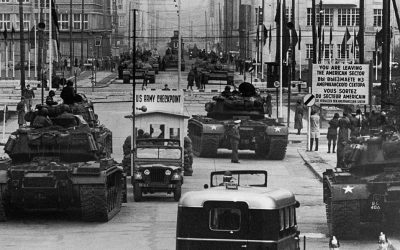
Throughout the 20th century, the United States positioned itself as the global guardian of freedom and democracy, a mantle it assumed with zeal during the Cold War. This period, marked by a profound ideological battle against Communism, saw the U.S. engaging in a series of conflicts, interventions, and policies aimed at curbing the influence of the Soviet Union and its allies. At the heart of this struggle was a belief in the inherent superiority of democratic capitalism over any form of government that threatened the liberties of individuals and nations alike.
The ideological battle against Communism
The United States’ aversion to Communism stemmed from its conviction that Communist regimes, with their centralised economies and authoritarian governance, posed a direct threat to the principles of freedom and democracy. A determination to resist the spread of Communism at all costs, a stance that led to the formulation of several strategic doctrines and interventions around the globe, shaped American policy.
George F. Kennan’s Containment policy laid the groundwork for the U.S. strategy, advocating a mix of military, economic, and political measures to counteract Soviet expansionism. This approach was reflected in the Truman Doctrine’s promise of support for nations resisting Communist subjugation and the Marshall Plan’s efforts to rebuild and stabilise war-torn Europe.
The Domino Theory and support for South Vietnam
The Domino Theory further influenced U.S. foreign policy, suggesting that the fall of one country to Communism would inevitably lead to the spread of Communist influence throughout a region. This theory justified the U.S.’s significant military involvement in Vietnam, starting with advisory and financial support and escalating to extensive combat operations following the Gulf of Tonkin Incident in 1964. The conflict in Vietnam, while intended to prevent the spread of Communism, revealed the complexities and challenges of military intervention in achieving political goals.
The My Lai Massacre and its aftermath
One of the most harrowing episodes of the U.S. involvement in Vietnam was the My Lai Massacre, where U.S. soldiers killed hundreds of unarmed Vietnamese civilians. This atrocity and the subsequent efforts to conceal it highlighted the moral and ethical dilemmas of the U.S.’s anti-Communist crusade. The public outcry and policy changes that followed underscored the need for greater accountability and ethical considerations in U.S. military engagements.
U.S. foreign policy and Presidential Doctrines
Throughout the Cold War, various Presidential Doctrines articulated the U.S.’s strategic approach to containing Communism. From the Truman Doctrine’s promise of support to nations threatened by Communism to the Nixon Doctrine’s emphasis on equipping allies to defend themselves, these policies underscored the U.S.’s commitment to maintaining a global order aligned with its interests and values.
The Cuban Missile Crisis
The Cuban Missile Crisis of 1962 was a defining moment in U.S.-Soviet relations, bringing the world to the brink of nuclear war. The crisis underscored the catastrophic potential of the nuclear arms race. It led to significant diplomatic efforts to de-escalate tensions, including the establishment of the “Hotline” and the Nuclear Test Ban Treaty of 1963. This episode demonstrated the critical importance of diplomacy and strategic communication in averting global catastrophes.
Other atrocities in the fight against Communism
In its global fight against Communism, the United States was involved in several other controversial actions that raised ethical and moral questions. These included the support of authoritarian regimes in Latin America, Asia, and Africa.
Operations such as those in Chile in 1973, which led to the overthrow of democratically elected President Salvador Allende, and support for the Contras in Nicaragua in the 1980s. The U.S. invasion of Grenada on 25 October 1983 is another instance. These operations sometimes led to long-term instability and human rights violations.
These actions, while anti-Communist, often suppressed political freedoms and violated human rights, highlighting the tensions between the U.S.’s anti-Communist objectives and its professed commitment to democracy and human rights.
Additionally, the U.S. engaged in covert operations aimed at undermining Communist movements, sometimes leading to long-term instability and conflict in the regions involved. These actions, while intended to contain the spread of Communism, often had unintended consequences, including the perpetuation of violence, the suppression of political dissent, and the undermining of democratic institutions.
Legacy
The United States’ role as a protector of freedom and democracy during the Cold War was characterised by a complex interplay of ideological conviction, strategic interests, and moral dilemmas. While the U.S. succeeded in many respects in countering the spread of Communism, how it pursued these ends has been subject to scrutiny and debate.
The legacy of this era continues to shape international relations, underscoring the challenges of upholding democratic ideals in a complex and often contradictory world. As we reflect on the Cold War’s legacy, the importance of ethical considerations, diplomacy, and strategic engagement in global affairs remains a pivotal lesson for the present and future.


Leave a Reply