
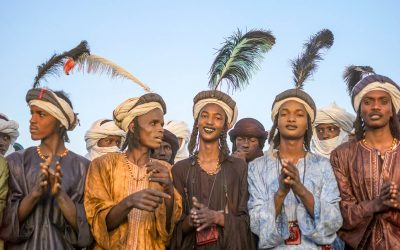
Nestled in the heart of West Africa, Niger is a country steeped in history and rich cultural heritage. From its early civilisations to its struggle for independence and its journey towards democratic governance, Niger’s history is a tapestry of triumphs, challenges, and resilience.
Early traces of civilisation

Niger has been home to human civilisations for over 600,000 years. Archaeological findings have provided valuable evidence of human presence in northern Niger during ancient times. The region was inhabited by a diverse population of Libyan, Berber, and Black peoples who had developed an agricultural and cattle-herding economy in the Sahara by 4000 BC. These early communities laid the foundation for the cultural tapestry that would shape Niger’s history.
While the written history of Niger begins with Arab chronicles from the 10th century AD, during the 14th century, the Hausa people established several powerful city-states along the southern border of present-day Niger. These city-states played a crucial role in the region’s development and became centres of trade and commerce. At the same time, the Songhai Empire, led by Askia Muhammad I, expanded its influence and subjugated the Hausa states, capturing the ancient Berber city of Agadez. Agadez’s strategic location on the caravan trade routes connecting Tripoli, Egypt, and the Lake Chad area made it a significant hub of economic activity.
One of the most prominent themes in the history of Niger is the interaction between the Tuareg and Tubu nomads of the Sahara Desert in the north and the sedentary agriculturalists of the south. These two contrasting ways of life and civilisations have shaped Niger’s cultural landscape. The Tuareg, also known as the Kel Tamasheq, have a rich nomadic heritage and have played a significant role in long-distance trade, mainly because of the copper mines in the kingdom of Takedda.
On the other hand, the agriculturalists in the south, such as the Songhai-Zarma, Hausa, and Kanuri, have established settled communities and have been engaged in farming for centuries. The Hausa, in particular, form a significant portion of Niger’s population.
Kingdoms and empires: Takedda and Bornu
In the 14th century, the kingdom of Takedda, controlled by the Tuareg, flourished as a hub of long-distance trade due to its copper mines. Copper served as a currency in Western Africa during this period. Archaeological evidence suggests the presence of Songhai-speaking agricultural communities in the region. Takedda was eventually succeeded by the sultanate of Agadez.
Meanwhile, the southeastern region of present-day Niger was a crucial part of the Kanuri empire of Bornu. Bornu’s power was founded on its control over salt-producing sites and long-distance trade routes, particularly between Lake Chad and the Fezzan via Kawar. However, the great drought in the 18th century devastated the environment, leading to the disappearance of agricultural communities and oases in the region.
Colonial administration: French conquest and resistance
European explorers began venturing into Niger in the 17th century, with Mungo Park, a Scot, being one of the first to explore the region in 1805-06. However, it was not until the late 19th century that French military expeditions into Niger gained momentum.
The French conquest of Niger began in 1899, with the local population fiercely resisting the brutal expedition led by French captains Paul Voulet and Charles-Paul-Louis Chanoine.
By 1900, the French had established military outposts encircling Lake Chad, marking the beginning of Niger’s colonial period. The region became part of the larger administrative unit called Haut-Senegal et Niger, with a military district of Niger being created in 1901.
In 1922, after a severe drought, famine, and the Tuareg uprising, the French established a regular administration under civilian control. By then, the power of the Tuareg had been weakened.
During the colonial era, Niger, like other territories in French West Africa, experienced significant changes. The spread of Islam, a rapid demographic increase, and the introduction of cash crop cultivation among the Hausa were notable transformations. The evolues, a small elite group trained in French schools, emerged as a new social class, representing the colonies in the French parliament. However, the Hausa region remained more resistant to European influence than the West.
Independence and political transitions
Niger’s colonial history mirrored that of other former French West African territories. It was governed by a governor appointed from Paris, with administration overseen by the governor-general in Dakar, Senegal. In 1946, the French constitution granted French citizenship to the inhabitants of all French territories, and Niger became an autonomous state within the French Community in 1958.
Independence for Niger came in 1960, with Djibo Bakary, a left-wing trade unionist, heading the first local executive. However, his successor, Hamani Diori, established a single-party dictatorship that lasted until he was overthrown in a coup in 1974. This marked the beginning of a military dictatorship, first led by Seyni Kountche and later by Ali Seibou.
In 1993, Niger held its first multiparty presidential elections, and Mahamane Ousmane of the Social Democratic Convention became the president. The early 1990s also witnessed a Tuareg rebellion in the northern part of the country, which eventually led to a cease-fire agreement in 1995. However, political stability remained elusive, and the country experienced further political upheavals, including military coups and transitional governments.
Transition to Democracy
Niger faced numerous challenges in the 21st century, including security threats from Islamic militant groups and the need for economic development. Adopting Islamic sharia law became a contentious issue, leading to conflicts between Islamic activists and those opposed to the strict religious code. Niger joined forces with neighbouring countries to combat these threats, forming alliances such as the G5 Sahel Joint Force.
Niger’s transition to democracy began with the election of Mahamadou Issoufou in 2011. Issoufou’s presidency focused on improving security, promoting economic development, and combating Islamic militant groups such as Boko Haram. Niger also faced internal discontent, with demonstrations in 2013 highlighting grievances related to living standards, media censorship, and alleged corruption.
In 2016, Issoufou won re-election in a runoff election, securing another term as president. His administration continued to face security challenges, particularly along the borders with Mali and Nigeria. However, efforts were made to enhance border security and accommodate refugees fleeing from Boko Haram.
Today, Niger stands at the crossroads of history, with a rich past and a promising future. The country continues to face numerous challenges, including poverty, security concerns, and environmental issues, but it also possesses immense potential for growth and development. As Niger strives to navigate the complexities of the modern world, it does so with a deep appreciation for its history and a determination to shape a brighter tomorrow.


Leave a Reply