
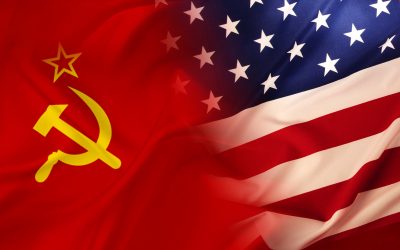
The Cold War was a period of intense political and military rivalry between the United States, the Soviet Union, and their respective allies from the end of World War II until the early 1990s. It was characterised by a prolonged nuclear standoff, espionage, propaganda, and fierce competition for global influence. Although a direct military conflict never occurred, several proxy wars were fought across the globe as part of this larger struggle.
Causes and origins
The origins of the Cold War can be traced back to the tense relationship between the US and the Soviet Union during World War II. While they were allies against Nazi Germany, ideological differences and mutual distrust led to tensions that would only become more pronounced in the aftermath of the war.
The primary cause of the Cold War was the fundamental disagreement between communism (led by the Soviet Union) and capitalism (led by the US) on how to reconstruct Europe after World War II. The newly emerged superpowers had contrasting visions for global order; Moscow aimed to establish regimes loyal to its ideology in Eastern Europe, while Washington sought a broader spread of democracy and open markets.
As a result, both countries embarked on an aggressive campaign to extend their influence worldwide through political, economic, and military means. The Berlin blockade in 1948-49, NATO’s formation in 1949, and the rapid development of nuclear arsenals further heightened tensions between the two superpowers.
Involvement
Two main players in the Cold War were undoubtedly the United States and the Soviet Union, but other nations were extensively involved too. The US aligned with Western Europe, Japan, South Korea, Australia, Canada, and other democratic countries under NATO or independent bilateral alliances. The Soviet Union forged its Eastern Bloc, composed of Eastern European nations that fell into their sphere during WWII.
Several non-aligned countries emerged as well during this time – Yugoslavia under Tito being one notable example – which tried to maintain independence in foreign policy decisions without endorsing either bloc.
The end of the Cold War
The Cold War began to disintegrate gradually in the mid-1980s due to various factors. Primarily, Soviet Union President Mikhail Gorbachev’s policies of Glasnost (openness) and Perestroika (restructuring) aimed at revitalising the Soviet economy and political system and inadvertently fueled reform movements across Eastern European countries.
The intensifying economic difficulties faced by the Soviet Union, the growing international pressure to respect human rights, and political shifts within East European nations led to various revolts against their Communist regimes. The fall of the Berlin Wall in 1989 was a symbolic moment marking the decline of Soviet influence in Eastern Europe.
American President Ronald Reagan also pursued an aggressive policy against Moscow by increasing military spending and supporting anti-Communist forces worldwide – further straining the Soviet economy and fueling discontent among its citizens.
The end of the Cold War was marked by the dissolution of the Soviet Union into fifteen independent states in December 1991. Consequently, Eastern Europe transitioned from Communist rule to democracy, leading to a new era of cooperation between former adversaries on various global issues.
The Cold War was an integral chapter in modern history which can be traced back to conflicting ideologies between communism and capitalism. It shaped global politics, economics, and culture for over four decades through a constant arms race, proxy wars, ideological rivalry, and espionage. Its end marked a significant shift in international relations and set the stage for new challenges in the post-Cold War era.


Leave a Reply