
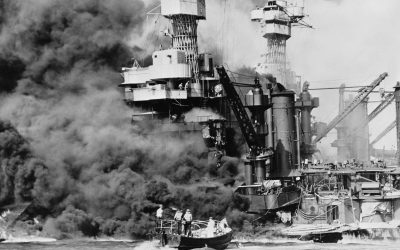
On the morning of 7 December 1941, the United States Navy base at Pearl Harbour, in Hawaii, was struck by a devastating surprise attack from the Imperial Japanese Navy Air Service. In less than two hours, the assault killed 2,403 Americans and wounded nearly 1,200 more. Much of the US Pacific Fleet was destroyed or damaged. The attack shattered any remaining American ambivalence about the Second World War. It propelled the United States into a conflict that would reshape the world.
Tensions in the Pacific
The road to Pearl Harbour was paved by years of growing hostility between Japan and the United States. Throughout the 1930s, Japan pursued an aggressive expansionist policy across Asia. It invaded Manchuria in 1931 and launched a full-scale war against China in 1937. The United States, unwilling to endorse this imperial ambition, responded with economic pressure. In 1940 and 1941, Washington imposed increasingly severe trade restrictions. This culminated in a near-total embargo on oil exports to Japan in July 1941.
For Japan, which imported the vast majority of its oil from the United States, this was a crisis. Without oil, its military machine would grind to a halt. Japanese military planners concluded that a war with America was inevitable. They decided that striking first, and hard, offered the only realistic path to securing the resources they needed in Southeast Asia. Admiral Isoroku Yamamoto, commander of the Combined Fleet, had lived and studied in the United States and harboured deep reservations about a war with America. Yet he devised the attack plan, believing that if war was coming, Japan’s best hope lay in crippling US naval power in a single, decisive blow.
Planning the Strike
The plan Yamamoto conceived was audacious. It called for a striking force of six aircraft carriers, supported by battleships, cruisers, destroyers, and submarines. This group would sail in secret across the vast North Pacific and launch a surprise air assault on the US Pacific Fleet at Pearl Harbour. The attack would destroy American battleships and carriers. Japan hoped to be free to seize the oil-rich Dutch East Indies, Malaya, and the Philippines, without effective interference.
The fleet, under the command of Vice Admiral Chuichi Nagumo, departed Japan’s Kuril Islands on 26 November 1941. It maintained strict radio silence and followed a remote northern Pacific route to avoid detection. In Washington, American and Japanese diplomats were still engaged in negotiations. Many US officials believed war was imminent, but most did not expect it to start at Pearl Harbour.
There were warnings. On the morning of 7 December, radar operators at Opana Point on the northern tip of Oahu detected a large formation of aircraft approaching. They reported the contact, but a duty officer assumed the blips were American B-17 bombers expected from the mainland and told them not to worry. A US destroyer, the USS Ward, had already sunk a Japanese midget submarine in restricted waters near the harbour entrance hours earlier. The full significance of this report did not reach the right people in time.
The attack
The first wave of Japanese aircraft—183 planes, including torpedo bombers, dive bombers, and fighters—lifted off from the carriers at 6am and arrived over Oahu shortly before 7.55am. The attack began without warning. Torpedo planes swept in low over the harbour, targeting battleships along Battleship Row. Dive bombers and high-level bombers struck airfields across the island. They destroyed American aircraft on the ground before any response.
The USS Arizona suffered the most catastrophic blow: a bomb penetrated her forward magazine, triggering an enormous explosion that sank the battleship in nine minutes and killed 1,177 of her crew. The USS Oklahoma capsized after being struck by multiple torpedoes, trapping hundreds of men inside. The USS West Virginia and USS California were also sunk. Other battleships and vessels were badly damaged.
A second wave of 170 aircraft arrived at 8.55am and continued the assault on airfields and the harbour. By the time the attack ended at approximately 9.55am, the damage was immense. Eighteen ships had been sunk or heavily damaged, and 188 American aircraft destroyed. Japanese losses were comparatively light: 29 aircraft and fewer than 100 men.
Yet the attack was not the complete success Japan had hoped for. The US Pacific Fleet’s three aircraft carriers, which would prove decisive in the naval war that followed, were at sea that morning and escaped unscathed. Vice Admiral Nagumo chose not to launch a third wave of attacks. This decision left Pearl Harbour’s critical fuel storage, dry docks, and repair yards intact. These installations proved essential to America’s rapid recovery.
Aftermath and consequences
The following day, President Franklin D. Roosevelt addressed a joint session of Congress. He called 7 December “a date which will live in infamy” and asked for a declaration of war against Japan. Congress obliged within hours. Only a single dissenting vote was recorded. Three days later, Germany and Italy declared war on the United States, drawing America fully into the Second World War.
The attack had the opposite of its intended strategic effect. It did not demoralise the American public or force a negotiated settlement. Instead, it galvanised the nation, unifying the public behind the war effort. The isolationist movement, previously a serious obstacle to US involvement, collapsed overnight, clearing the path for decisive action. American industry rapidly shifted to full war production. Within months, the country was producing ships, aircraft, and weapons at a pace Japan could not match, establishing clear industrial superiority.
Pearl Harbour also had profound consequences for Japanese Americans. Executive Order 9066, signed by President Roosevelt in February 1942, authorised the forced relocation and internment of over 110,000 people of Japanese descent living on the West Coast. This policy led to loss of property, disruption of families, and long-lasting trauma, marking one of the most shameful episodes in American civil liberties history.
In the longer sweep of the war, Pearl Harbour was the opening shot of a brutal four-year Pacific conflict. This would end only with the atomic bombings of Hiroshima and Nagasaki in August 1945 and Japan’s unconditional surrender. Yamamoto’s hope for a decisive early blow breaking American will proved tragically mistaken.
The attack on Pearl Harbour remains one of the most consequential events of the twentieth century. It marked a turning point by forcing the United States into World War II, ultimately shaping the global order that emerged after the conflict. Its consequences included the rise of America as a world power, the defeat of the Axis powers, and significant changes in international relations and domestic policy.


Leave a Reply