
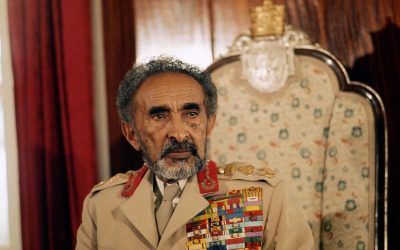
Emperor Haile Selassie ruled Ethiopia between 1930 and 1974. He steered his country into mainstream post-World War II African politics through his modernisation efforts. Ethiopia was admitted to the League of Nations and the United Nations under his leadership. Addis Ababa became the primary centre for the Organization of African Unity (now the African Union).
Haile Selassie I, was born Tafari Makonnen, on 23 July 1892, near Harer, Ethiopia.
Tafari was the great-grandson of Sahle Selassie of Shewa (Shoa) and the son of Ras Makonnen, the chief adviser to the emperor.
At an early age, educated at home by French missionaries, Tafari impressed Emperor Menilek II with his intellectual abilities and was promoted accordingly.
When he was governor of Sidamo and then Harer province, he pursued progressive policies, attempting to break the power of local nobility through central government development, such as establishing a salaried civil service.
As a result, he became a symbol of a politically progressive element in the population. His marriage to Wayzaro Menen, Menilek II’s great-granddaughter, occurred in 1911.
Upon Menilek II’s death in 1913, his grandson Lij Yasu, succeeded to the throne. His unreliability and close association with Islam made him unpopular with the majority Christian population of Ethiopia. Tafari emerged as the focal point of the Christian resistance, deposing Lij Yasu in 1916. In 1917, Zauditu, the daughter of Menilek II, became empress, and Ras Tafari became regent and heir apparent to the throne.
Ras Tafari’s progressive outlook attracted the modernist younger generation as opposed to Zauditu’s conservative outlook.
In 1923, he gained Ethiopian membership in the League of Nations. He became the first Ethiopian ruler to travel abroad the following year, visiting Jerusalem, Rome, Paris, and London.
In 1928 he took on the title of negus (“king”). Two years later, when Zauditu died, Tafari has crowned Emperor on 2 November 1930 and took the name of Haile Selassie (“Might of the Trinity”). His full official title was “His Imperial Majesty Haile Selassie I, Conquering Lion of the Tribe of Judah, King of Kings and Elect of God.”
In 1931 he introduced a new constitution, which strictly limited the powers of Parliament. During the late 1920s, Haile Selassie effectively became the Ethiopian government, establishing provincial schools, strengthening the police force, and gradually eliminating feudal taxation to help his people and increase the power of the government.
Haile Selassie’s authority continued to dominate the Ethiopian government. He amended the constitution in 1955 to give him the same power as before. A dissident army wing was opposed to his rule so seized control of Addis Ababa in December 1960, and it was only after a fierce engagement with loyalists that they were dislodged.
In 1963, Haile Selassie played a significant role in forming the Organization of African Unity. His rule in Ethiopia continued until 1974. A famine, worsening unemployment, and stagnating politics caused segments of the army to rebel.
Haile Selassie was deposed, and a Marxist military regime, the Derg, was established. Haile Selassie spent the rest of his life under house arrest in his palace. It was initially believed he died of natural causes, but later evidence suggested he was strangled by orders of the military government.
In 1935, Italy invaded Ethiopia, and Haile Selassie led the resistance, but he was exiled in May 1936. In a memorable speech he delivered to the League of Nations in Geneva on 30 June 1936, he appealed for assistance. Following World War II, he formed a force of Ethiopian exiles in Sudan with the help of the British. In January 1941, Ethiopian and British troops invaded and recaptured Addis Ababa. Haile Selassie was reinstated as Emperor, but he had to regain the previously held authority. Slowly and gradually, he modernised the Ethiopian government and society through social, economic, and educational reforms.
The Ethiopian government continued to be controlled mainly by Haile Selassie. The new constitution he granted in 1955 gave him the same power as the previous one. The first overt opposition to his rule emerged in December 1960, when dissident elements of the army seized control of Addis Ababa before being dislodged by loyalists.
Haile Selassie played a crucial role in establishing the Organization of African Unity in 1963.

History remembers Selassie as an important symbol to Rastaraians. After his coronation, a new movement in Jamaica proclaimed him to be the living God, and the movement was eventually named after him Ras Tafari. Selassie visited Jamaica on 21 April 1966, and thousands of Rastafari crowded Kingston airport to meet him.
The rule of his government in Ethiopia lasted until 1974, when famine, worsening unemployment, and political stagnation led segments of the army to revolt. As a result, Haile Selassie was deposed, and a Marxist-leaning military government named the Derg was established.
Haile Selassie spent the remainder of his life under house arrest in his palace and died on 27 August 1975. According to official sources, he died of natural causes, but later evidence indicated he had been strangled on the orders of the military government.


Leave a Reply