
South Africa’s history is a rich tapestry woven with threads of diverse cultures, conflict, and resilience. From the arrival of European colonisers to the country’s hard-won independence, South Africa’s journey is marked by significant events that have shaped its present and future.
Early colonisation
The arrival of the Dutch
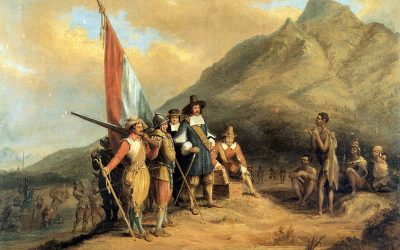
In 1652, the Dutch East India Company, under the leadership of Jan van Riebeeck, established a refreshment station at the Cape of Good Hope. This station was initially intended to supply fresh provisions to Dutch ships en route to the East Indies. However, the Cape’s strategic importance soon led to the expansion of the settlement.
The Dutch settlers, known as Boers, began to move inland, establishing farms and utilising the land for agriculture. Their arrival marked the beginning of significant changes for the indigenous Khoikhoi and San peoples, who were displaced from their lands and subjected to new socio-economic pressures.
Expansion and conflict
As the Dutch expanded their territories, conflicts with the Indigenous populations became inevitable. The Khoikhoi Wars (1659-1660 and 1673-1677) exemplified the resistance of the local populations to the settlers’ encroachments. The Dutch victory in these wars led to the further displacement of Indigenous communities and the establishment of a settler-dominated society.
British colonisation and the Great Trek
British occupation
In 1795, the British seized the Cape Colony from the Dutch during the Napoleonic Wars. Although briefly returned to the Dutch in 1803, the colony was permanently ceded to Britain in 1806. British rule brought significant changes, including the abolition of slavery in 1834, which disrupted the Boers’ economic model.
The Great Trek
Discontented with British rule and the abolition of slavery, many Boers embarked on the Great Trek during the 1830s and 1840s. This migration led to the establishment of independent Boer republics such as the Transvaal and the Orange Free State. The Great Trek was a significant event in South African history, symbolising the Boers’ determination to maintain their cultural identity and autonomy.
The discovery of diamonds and gold
The diamond rush
The discovery of diamonds in 1867 near the Vaal River sparked a rush of prospectors and fortune seekers to South Africa. The ensuing diamond boom led to rapid economic growth and the development of infrastructure in the Kimberley area. This period also saw increased tension between the British, who sought control over the lucrative diamond fields, and the Boers.
The gold rush
In 1886, the discovery of gold on the Witwatersrand triggered another economic boom, transforming Johannesburg into a bustling metropolis. The gold rush attracted a diverse population of miners, investors, and entrepreneurs, further complicating the socio-political landscape of the region. The wealth generated from gold and diamonds laid the foundation for South Africa’s industrialisation but also intensified conflicts over control of resources.
The Anglo-Boer Wars
The First Anglo-Boer War (1880-1881)
The first major conflict between the British and the Boers, known as the First Anglo-Boer War, erupted in 1880. The Boers, utilising guerrilla warfare tactics, secured a victory and regained independence for the Transvaal.
The Second Anglo-Boer War (1899-1902)
Tensions over control of resources and British imperial ambitions led to the outbreak of the Second Anglo-Boer War in 1899. This brutal conflict saw the use of concentration camps by the British and significant civilian casualties. The war ended with the Treaty of Vereeniging in 1902, which resulted in the British annexation of the Boer republics but promised eventual self-government.
Union of South Africa and apartheid
Formation of the Union
In 1910, the Union of South Africa was established, uniting the British colonies and Boer republics into a single entity under British dominion. The Union was a dominion within the British Empire, enjoying self-government while maintaining allegiance to the British Crown.
The rise of apartheid
In 1948, the National Party came to power and implemented the policy of apartheid, institutionalising racial segregation and discrimination. Apartheid laws segregated public facilities, restricted the movement of non-white populations, and disenfranchised black South Africans. This system entrenched white supremacy and led to widespread human rights abuses.
Resistance and the road to independence
Early resistance movements
Resistance to colonial rule and apartheid began early in South African history. Organisations such as the African National Congress (ANC), founded in 1912, played a crucial role in mobilising opposition to discriminatory policies. Leaders like Nelson Mandela, Oliver Tambo, and Walter Sisulu emerged as key figures in the struggle for equality and justice.
The Sharpeville Massacre
On 21 March 1960, a peaceful protest against pass laws in Sharpeville turned deadly when police opened fire on the demonstrators, killing 69 people. The Sharpeville Massacre was a turning point in the anti-apartheid movement, drawing international condemnation and increasing internal resistance.
The Rivonia Trial and imprisonment of Nelson Mandela
In 1963, Nelson Mandela and other ANC leaders were arrested and tried in the Rivonia Trial. Mandela’s famous speech from the dock, where he declared his willingness to die for the ideal of a free and democratic society, galvanised global support for the anti-apartheid cause. Mandela was sentenced to life imprisonment, spending 27 years behind bars.
International pressure and internal strife
Economic sanctions and global advocacy
By the 1980s, international pressure on the South African government had intensified. Economic sanctions, cultural boycotts, and diplomatic isolation were employed to force the regime to dismantle apartheid. Prominent figures and organisations worldwide advocated for the release of Nelson Mandela and an end to racial discrimination.
Internal protests and unrest
Within South Africa, resistance to apartheid continued to grow. The Soweto Uprising in 1976, where students protested against the imposition of Afrikaans as the medium of instruction, resulted in brutal crackdowns but ignited a new wave of activism. Trade unions, civic organisations, and grassroots movements intensified their efforts, leading to widespread civil unrest.
The path to independence
Negotiations and reforms
In the late 1980s, South Africa’s political landscape began to shift. President F.W. de Klerk initiated reforms, including unbanning political organisations and releasing political prisoners. In 1990, Nelson Mandela was released from prison, and negotiations for a new democratic South Africa commenced.
The end of apartheid
The negotiations culminated in the dismantling of apartheid and the establishment of a multiracial democracy. In 1994, South Africa held its first fully democratic elections, with Nelson Mandela elected as the country’s first black president. The transition marked the end of centuries of colonial rule and racial oppression.
Legacy
The history of South Africa from colonisation to independence is a story of struggle, resilience, and triumph. The journey from the arrival of European settlers to the establishment of a democratic nation is marked by significant events and figures who shaped the country’s history. Today, South Africa continues to confront the legacies of its past while striving to build a more inclusive and equitable society.


Leave a Reply