
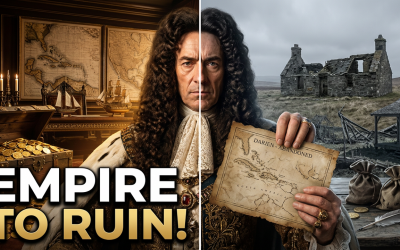
In the summer of 1698, five ships slipped out of the Scottish port of Leith, loaded with wigs, combs, mirrors, and wool blankets. Their destination was a stretch of jungle on the coast of Panama. The people aboard believed they were about to make Scotland one of the richest trading nations on Earth.
Instead, they were about to lose almost everything, and in doing so, help end Scotland’s existence as an independent nation.
This is the story of the Darién scheme, one of the great financial catastrophes in Scottish history, and the surprising role it played in the creation of Great Britain.
A small, poor, ambitious nation
To understand why Scotland took such an enormous risk, it helps to understand its position in the late 1600s. Scotland was independent, but poor. It had its own parliament, laws, and church, but had shared a monarch with England since 1603, when James VI of Scotland also became James I of England: one king, two separate countries.
While England built a global trading empire through ventures like the East India Company and colonies across North America and the Caribbean, Scotland was largely shut out. English trade laws, like the Navigation Acts, restricted foreign access to English colonial markets, and Scotland, legally a foreign country under these rules, usually lost out. Scottish merchants watched their southern neighbour grow wealthy from overseas trade and wanted a piece of it.
Enter William Paterson, a Scottish financier who had, a few years earlier, helped found the Bank of England. Paterson’s new idea was audacious: to found a Scottish colony at Darién, on the narrowest point of the Isthmus of Panama, barely 40 miles across. Goods from Asia could cross the Pacific, be hauled overland, and load onto ships bound for Europe on the Atlantic side — cutting out the long, dangerous voyage around the tip of South America. If it worked, Scotland could become a middleman for global trade itself.
Scotland bets everything
In 1695, the Scottish Parliament chartered the Company of Scotland Trading to Africa and the Indies to pursue Paterson’s vision. The plan needed serious capital, and this is where the story turns from ambitious to reckless.
England refused to help fund it. King William III, who ruled both nations, worried about provoking Spain, which considered Panama its own territory. English merchants, pressured by their own government and by an East India Company eager to avoid a Scottish competitor, pulled out entirely.
So Scotland turned inward, and responded with startling enthusiasm. Historians estimate that somewhere between a fifth and a quarter of all the liquid capital circulating in Scotland at the time went into this single venture. Nobles invested. Merchants invested. Ordinary tradespeople put in their life savings. Town councils invested public funds. This wasn’t a speculative side bet for the wealthy — it was, in a very real sense, the nation’s savings, staked on a jungle colony that no Scot had ever seen firsthand.
New Caledonia
In July 1698, the first expedition set sail: five ships and around 1,200 colonists. They landed on the Panamanian coast that November and named their settlement New Caledonia, with its main outpost called New Edinburgh.
Almost everything went wrong from the start.
The tropical climate was brutal for people accustomed to Scottish winters: thick heat, relentless humidity and torrential rain. Diseases the settlers had no immunity to, including malaria, dysentery, and yellow fever, swept through the colony almost immediately; men were dying at a rate of roughly ten a day within months. The soil proved poor for crops they knew how to grow, and the trade goods they had brought with such optimism — wigs, mirrors, combs, heavy wool blankets — had no market in a tropical setting with no established trade routes to plug into.
Spain, which considered the area its own territory, began mobilising forces to remove the colonists. And critically, England did nothing to help. King William, wary of war with Spain, ordered English colonies across the Caribbean and North America not to trade with, supply, or assist the Scots in any way. Stranded, sick, and running short of food, the colonists had nowhere to turn.
By July 1699 — less than eight months after landing — the survivors abandoned New Caledonia. Of the roughly 1,200 who had set out, only a few hundred made it home, and many of those died on the return voyage.
The cruellest twist came next: a second wave of about 1,300 settlers had already set sail before news of the collapse reached Scotland. They arrived to find the colony abandoned, and walked straight into the same disease, isolation, and now active Spanish military pressure. By April 1700, New Caledonia was finished for good. Of the roughly 2,500 people who had set out for Darién across both expeditions, an estimated 2,000 or more never returned home.
A nation in ruins
The human toll was devastating, but the financial toll is what reshaped Scottish history. With so much of the nation’s capital wiped out in a single failed venture, Scotland was left in genuine economic crisis. Landed families who had mortgaged estates to invest were ruined. Merchants who had committed their trading capital had nothing left to work with. Public confidence in Scotland’s ability to compete as an independent economic power was shattered.
That crisis forced an uncomfortable question into the open: if Scotland couldn’t sustain itself economically on its own, what were its options?
For years, England had periodically floated the idea of a full political union between the two countries — not merely sharing a monarch, but merging into one kingdom with one parliament. Scottish resistance to giving up independence had always been strong. But after Darién, that resistance began to weaken, especially among the nobles and merchants who had lost the most money in the scheme.
The price of union
Serious negotiations for union picked up in 1706, and the final deal included a financial provision historians still debate: a payment from England to Scotland known as “the Equivalent.”
Officially, the Equivalent — roughly £398,000 — compensated Scotland for agreeing to take on a proportional share of England’s national debt after union. On paper, it was simple bookkeeping between two merging treasuries. But a significant portion of that money flowed directly to the shareholders of the Company of Scotland, reimbursing them for their Darién losses.
Many historians view this as more than coincidence — effectively a bailout, timed to land in the hands of the very people whose support Parliament needed to pass the union. That doesn’t mean every vote was bought outright; there were genuine political, religious, and strategic reasons plenty of Scots supported closer ties with England. But it’s hard to ignore that some of the loudest voices against losing Scottish independence went quiet around the same time they were being made financially whole.
In 1707, the Acts of Union passed both parliaments. The Kingdom of Scotland and the Kingdom of England ceased to exist as separate states, replaced by the Kingdom of Great Britain, governed by a single parliament in Westminster. Scotland retained its own legal system, church, and educational institutions — but its political independence was gone.
What’s left
Today, almost nothing physically remains of New Caledonia; the jungle reclaimed the site centuries ago. But its consequences didn’t fade so easily. A single failed colonial venture — undercapitalised, poorly planned, and abandoned by the one ally that could have saved it — helped push an entire nation into surrendering its political independence.
Would the Union of 1707 have happened without Darién? Perhaps eventually — the economic and political pressures were already building. But few historians dispute that Darién was the shove that sent Scotland over the edge. A scheme built to make Scotland rich ended up, in a bitter and roundabout way, making Scotland British.


Leave a Reply