
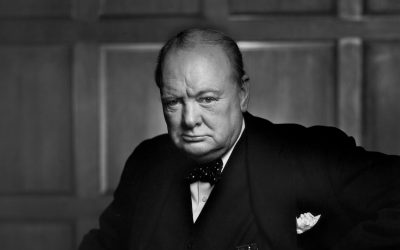
Few political figures loom as large or as divisive as Winston Churchill. In Britain, he is the bulldog prime minister who refused to surrender to Nazi Germany, the voice on the radio promising that the nation would “never surrender,” the embodiment of wartime grit. His statue stands in Parliament Square, his speeches are memorised in classrooms, and polls routinely rank him as the “greatest Briton.”
But step outside that heroic framing and the story becomes far more complicated. Around the world, and increasingly within the UK, Churchill is not only remembered as the man who saved Britain, but also as an imperial hardliner whose policies and beliefs caused suffering on a vast scale. To some, he is a defender of democracy. To others, he is the face of Empire, famine, and racial hierarchy.
That tension is what makes Churchill less a simple hero and more a deeply controversial figure, and why arguments about him keep resurfacing, from history books to protests to culture wars.
The wartime legend
Churchill’s reputation rests first and foremost on 1940.
When France collapsed, and much of Europe fell to Hitler, Britain stood alone. Many in the political establishment favoured negotiating with Germany. Churchill did not. As prime minister, he rallied the country with speeches that mixed defiance and poetry: “We shall fight on the beaches… we shall never surrender.”
Those words mattered. Morale mattered. And leadership mattered.
Under his watch, Britain endured the Blitz, rebuilt its military, and held the line long enough for the United States and the Soviet Union to join the fight. Without that stubborn refusal to compromise, historians argue, Nazi Germany might have dominated Europe.
It’s not hyperbole to say Churchill helped shape the outcome of the Second World War, for millions, that alone secures his place as a hero.
Yet history doesn’t stop in 1945, and neither does Churchill’s record.
The Empire in the room
Churchill was not just a wartime leader. He was a lifelong imperialist.
Long before he became prime minister, he served across Britain’s colonies, India, Sudan, and South Africa. He believed, deeply and unapologetically, in the superiority of the British Empire. He saw it not as exploitation but as civilisation.
That belief shaped his policies — and his prejudices.
He opposed Indian self-rule, calling independence movements irresponsible and dangerous. He described some colonised peoples in language that today is unmistakably racist. He once referred to Indians as a “beastly people with a beastly religion,” and he consistently resisted any weakening of imperial control.
These weren’t offhand remarks. They reflected a worldview. For Churchill, democracy applied primarily to Britons, not necessarily to those Britain ruled.
The Bengal Famine
Nowhere is Churchill’s legacy more fiercely debated than the Bengal Famine of 1943.
Between two and three million people died in British-ruled India as food shortages, inflation, and wartime disruption spiralled into catastrophe. Crops failed, prices soared, and starving families flooded cities.
Historians still debate how much blame lies with Churchill personally, but his government’s decisions undeniably worsened the crisis.
Grain shipments were diverted from India to feed British troops and to replenish stockpiles. Requests for relief were delayed or denied. Shipping that could have carried food was reserved for other wartime priorities.
Churchill reportedly dismissed the crisis with callous remarks, at one point asking why Gandhi hadn’t died yet if there was truly a famine.
Defenders argue that wartime logistics were strained and that Japan’s invasion of Burma cut off supplies. Critics counter that political choices, not just scarcity, caused mass death.
For many Indians, this is not an academic debate. It is lived memory. And it makes Churchill far harder to celebrate.
Violence at home
Even within Britain, Churchill’s record is not spotless.
As Home Secretary in 1910, he authorised troops to be deployed during labour unrest in Wales. During the Tonypandy strikes, his decision to deploy forces against miners left a legacy of resentment that still lingers in parts of the country.
Later, he supported harsh tactics against Irish independence movements and backed the use of controversial counterinsurgency methods in the Middle East.
These actions reveal a consistent pattern: when faced with unrest, Churchill often chose force. He could be stirring and democratic in rhetoric — but ruthless in practice.
Why the debate won’t go away
Churchill’s statue was covered during Black Lives Matter protests. University buildings bearing his name spark arguments. Social media battles erupt every time his record is reassessed. This isn’t simply “rewriting history.” It’s a clash between two truths.
Yes, Churchill helped defeat Hitler. That matters enormously.
But yes, he also defended Empire, expressed racist views, and presided over policies that contributed to immense suffering.
Both things can be true at once.
The older British narrative focused almost exclusively on the first. Modern scholarship insists we also reckon with the second.
Hero, villain, or something harder?
The temptation is to simplify: either Churchill was a flawless hero or an irredeemable villain. History rarely works like that.
Churchill was brilliant, charismatic, and strategically shrewd. He was also elitist, imperialist, and often indifferent to the lives of colonised peoples.
He could inspire a nation and ignore a famine.
Perhaps the most honest view is the most uncomfortable: Churchill was a man of his time who shaped history for the better in some respects and for the worse in others.
The danger isn’t criticising him. The danger is pretending that greatness excuses everything. Because if we only remember the speeches and forget the consequences, we’re not studying history, we’re building myths.
And myths rarely tell the whole truth.


Leave a Reply