
The Sephardic Jews, originating from the Iberian Peninsula (Spain and Portugal), represent one of the two major Jewish ethnic divisions, the other being the Ashkenazi Jews of Eastern and Central Europe. The term “Sephardic” comes from “Sepharad,” a Biblical location identified by many as Spain. Their history is marked by periods of prosperity and persecution, contributing to a rich cultural tapestry that includes unique religious practices, languages, and cuisine.
Origins and Golden Age
The presence of Jews in the Iberian Peninsula dates back to Roman times, with a significant Jewish population flourishing under both Muslim and Christian rule. The period under Muslim rule, particularly in Al-Andalus (Muslim Spain), is often called a “Golden Age” for Jewish culture. This era, spanning from the 8th to the 12th centuries, saw Jewish scholars, poets, scientists, and philosophers making significant contributions to the intellectual and cultural life of the region.
The expulsion
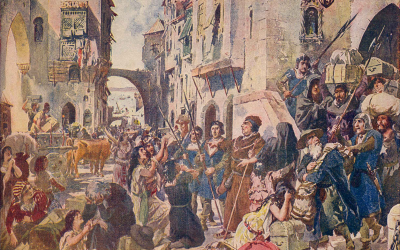
The year 1492 marks a pivotal moment in Sephardic history with the Alhambra Decree issued by Catholic Monarchs Ferdinand and Isabella of Spain. This edict ordered the expulsion of all Jews who refused conversion to Christianity. A similar fate befell the Jews of Portugal in 1497 under King Manuel I. These expulsions led to a massive diaspora, with Sephardic Jews fleeing to North Africa, the Ottoman Empire, and parts of Europe such as the Netherlands and Italy.
Settlements and diaspora
The Ottoman Empire welcomed the Sephardic exiles, leading to thriving Jewish communities in cities like Salonika (Thessaloniki), Istanbul, and Sarajevo. In these new homes, Sephardic Jews enjoyed relative autonomy and continued to practice their religion and customs. Other significant communities formed in North Africa (Morocco, Algeria, Tunisia) and later in the Americas.
Language: Ladino
One of the most distinctive aspects of Sephardic culture is Ladino (Judeo-Spanish), a Romance language that preserves elements of 15th-century Spanish mixed with Hebrew, Turkish, Greek, and other languages. Ladino became the lingua franca of Sephardic Jews in the Ottoman Empire and is still spoken by some communities today, although it is considered endangered.
Religious practices

Public domain, via Wikimedia Commons
While adhering to the same basic principles as other Jewish traditions, Sephardic Judaism has its own liturgical rites, known as the Sephardic rite. This includes specific prayer melodies, Hebrew pronunciation, and holiday customs. Sephardic rabbis, such as Maimonides (Rambam), have also influenced Jewish thought and Halakhic (Jewish legal) literature.
Cuisine
Sephardic cuisine reflects the Mediterranean and Middle Eastern influences of their diaspora regions, incorporating spices, fruits, and flavours not typically found in Ashkenazi food. Dishes such as couscous, boureka (baked pastry), and albondigas (meatballs) highlight the Sephardic table, along with a variety of pastries and sweets like baklava and buñuelos (doughnuts).
Sephardic communities today
Today, Sephardic Jews live all over the world, with significant populations in Israel, France, the United States, Turkey, and Morocco, among other countries. In Israel, the Sephardic heritage is a part of the national mosaic, contributing to the country’s cultural and religious life. Sephardic Jews have also been influential in politics, business, and the arts, both in Israel and internationally.
Recognition and preservation
There has been a growing interest in preserving Sephardic culture and history in recent years. Spain and Portugal have even offered citizenship to the descendants of Sephardic Jews expelled during the Inquisition, acknowledging the historical wrongs and celebrating the contributions of Sephardic Jews to the Iberian Peninsula and beyond.
The history of Sephardic Jews demonstrates their resilience, adaptability, and the enduring strength of their cultural and religious identity. From their origins on the Iberian Peninsula to their diasporic communities worldwide, Sephardic Jews have preserved unique traditions that contribute to the mosaic of Jewish culture.


Leave a Reply