
A 32-year-old black man from Antigua named Kelso Cochrane was brutally murdered in a racist attack in the early hours of 17 May 1959.
After receiving treatment at Paddington Hospital for a fractured thumb, Kelso Cochrane was walking home shortly after midnight when a gang of white youths surrounded him, called him derogatory names, beat him up and stabbed him through the heart outside of the Earl of Warwick pub on Golborne Road, Kensington. He was only a few hundred yards from the flat he shared with his fiancee in Notting Hill. The youths ran off when three men went to help him.
These men took him to the hospital, where he died an hour later.
First racially motivated killing after Windrush
Kelso Cochrane’s murder is marked as the first racially motivated killing after the Windrush generation migrated to Britain but the police at the time treated it as a robbery gone wrong and general hooliganism.
Detective Superintendent Ian Forbes-Leith was the man leading the investigation. He told a newspaper at the time: “We are satisfied that it was the work of a group of about six anti-law white teenagers who had only one motive in view – robbery or attempted robbery.”
Kelso’s wallet was reported in the press as empty, alluding to a robbery gone wrong, but his fiancee Olivia said he had emptied it prior to leaving home that evening.
Even though the pathologist ruled it out, the Sunday People newspaper also claimed Kelso had been drinking.
At the time, Mosley’s British Union Movement was active in Notting Hill and North Kensington. Peter Dawson, a member of the Union Movement, later claimed in an interview with the Sunday People that a group member had been responsible for the killing. Not long after, Mosley organised a public meeting on the spot where Kelso Cochrane had been killed.
Mr Cochrane’s murderers were never caught. This reverberated through North Kensington’s Caribbean community and Britain at large.
Trinidadian journalist and activist Claudia Jones led Mr Cochrane’s funeral arrangements. More than 1,200 people, both black and white, attended Kelso’s funeral. It was like a state occasion.
As a result of Kelso’s death, black Britons like Jones became even more motivated to fight against racism and injustice. Shortly after Mr Cochrane’s murder, Jones, along with Amy Ashwood Garvey, formed the Inter-racial Friendship Co-ordinating Council (IRFCC).
Hostility towards the Windrush migrants
Britain had welcomed the Caribbean migration in the wake of the war, yet hostility bubbled beneath the surface. Many recent arrivals settled in North Kensington, an area famous for low rents and unscrupulous landlords. Here, fascist politician Oswald Mosley focussed his energies, arguing for the repatriation of Caribbean people and urged the local white working-class population to “Keep Britain White”.
In 1958-59 under the banner of “Keep Britain White” attacks on the Black communities of Notting Hill, began with the intention to drive them out of their homes. These attacks resulted in the Notting Hill riots and in the murder of Kelso Cochrane less than a year later.
Kelso Cochrane’s death led the British Government to set up an investigation into race relations led by Amy Ashwood Garvey. This would result in improved community relations and a better understanding of the diverse communities living in North Kensington.
Kelso Cochrane honoured with A Blue Plaque
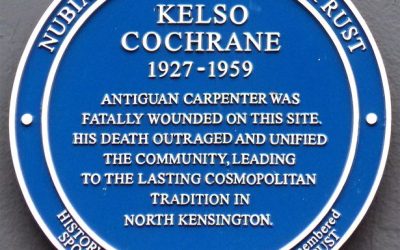
The Nubian Jak Community Trust installed a Blue Plaque on the Grove Inn Restaurant & Bar, on the corner of Golborne Road and Southam Street, W10, 50 years to the day that North Kensington resident Kelso Cochrane was violently murdered.
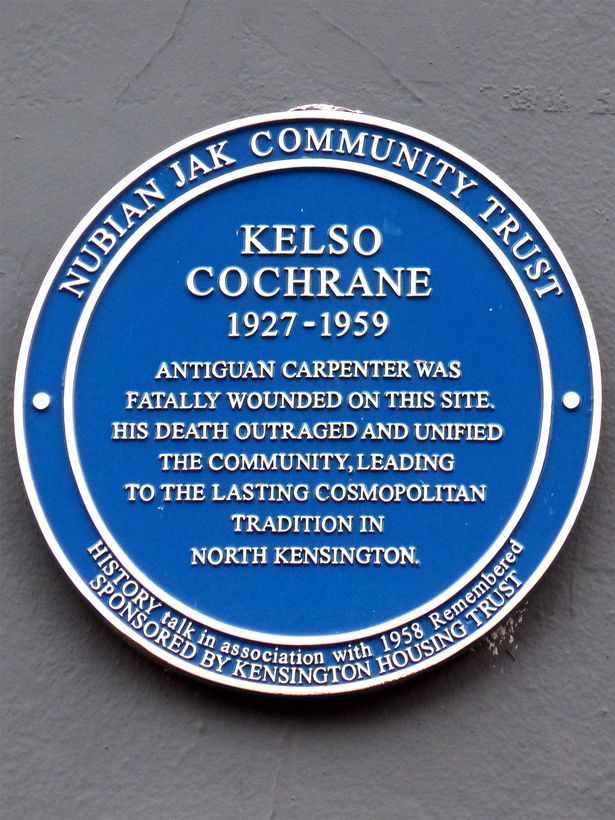
On Sunday, 17 May 2009, the commemorative plaque was unveiled by His Excellency Dr Karl Roberts, High Commissioner of Antigua and Barbuda, the Mayor of the Royal Borough of Kensington & Chelsea, Councillor The Hon Joanna Gardner, and Jak Beula, Chair of the Nubian Jak Community Trust.
The unveiling was part of a year-long program to remember the Notting Hill Riots of 1958 by the 1958-9 Remembered Steering Group and celebrate the community’s achievements since then.
Kelso Cochrane House

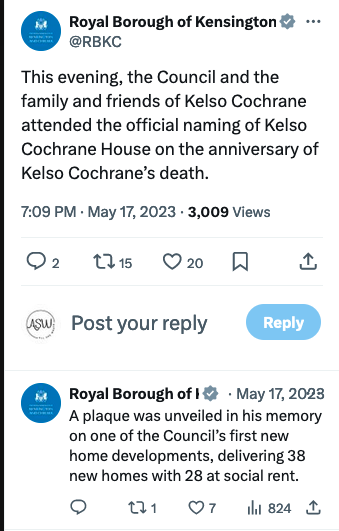
On 17 May 2023, the London Borough of Kensington and Chelsea named a new block of flats after Mr Cochrane and unveiled a plaque in his memory.


Leave a Reply