
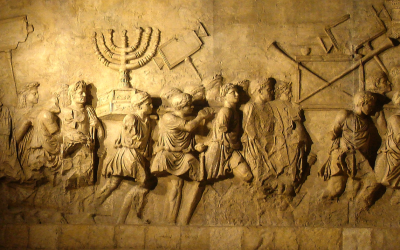
The Jewish–Roman wars, a series of conflicts between 66 and 136 CE, were more than mere military confrontations. They were deeply intertwined with cultural identity, religious freedom, and the fight for autonomy. These wars dramatically altered the landscape of the Eastern Mediterranean, reshaping the destinies of both the Jewish people and the Roman Empire.
Background
Under Roman rule since the 1st century BCE, Judea’s transition from semi-autonomy to a Roman province was fraught with tension. Roman taxes, legal systems, and cultural practices clashed with Jewish traditions and religious beliefs, creating a breeding ground for dissent. Roman disregard for Jewish sensitivities, coupled with economic exploitation, set the stage for rebellion. These uprisings were not just battles over territory but represented a profound struggle to preserve a way of life.
The First Jewish–Roman War (The Great Revolt, 66–73 CE)
The Great Revolt began as a response to Roman oppression but quickly escalated into a significant uprising. Early Jewish successes surprised the Roman military, leading to a fierce counterattack led by Vespasian and Titus. The Siege of Jerusalem in 70 CE, culminating in the destruction of the Second Temple, was a devastating blow to Jewish religious and national identity. The subsequent fall of Masada in 73 CE symbolised the tragic end of the revolt. The aftermath saw Judea ravaged, its population decimated, and its economy in ruins. The destruction of the Second Temple necessitated a transformation in Jewish religious life, marking the beginning of the Rabbinic period and a shift towards a more diasporic identity.
The Kitos War (115–117 CE)
The lesser-known Kitos War represented a widespread diaspora uprising against Roman rule, stretching from Cyrenaica to Egypt and Cyprus. While not centralised like the Great Revolt, it demonstrated the enduring spirit of resistance among the Jewish people. The rebellion’s suppression led to further Jewish displacement and a reshaping of the Jewish communities across the Eastern Mediterranean. This war underscored the challenges the Roman Empire faced in governing diverse ethnic and religious groups, highlighting the tensions between imperial ambitions and local identities.
The Bar Kokhba Revolt (132–136 CE)
The Bar Kokhba Revolt, led by Simon Bar Kokhba, was perhaps the most significant challenge to Roman authority. Initially successful, the rebellion eventually succumbed to the overwhelming Roman military might. The aftermath was brutal: widespread destruction, considerable loss of life, and a harsh crackdown on the practice of Judaism. The failure of the revolt led to substantial changes in the region, including the renaming of Judea to Syria Palaestina in an attempt to erase Jewish ties to the land. The Bar Kokhba Revolt marked a turning point, leading to a greater emphasis on the Jewish diaspora and the development of a more portable, rabbinic form of Judaism.
Cultural and religious impact
The Jewish–Roman wars had a profound impact on Jewish culture and religion. The destruction of the Second Temple and the suppression of the Bar Kokhba Revolt led to significant religious transformations, including the development of the synagogue as a central place of worship and the compilation of the Mishnah (the foundational document of rabbinic Judaism). These conflicts also solidified the Jewish diaspora, spreading Jewish communities further across the Roman Empire and beyond and reshaping Jewish identity in the process.
The Jewish–Roman wars were transformative, with far-reaching consequences beyond their immediate aftermath. They reshaped Jewish society, religion, and identity and challenged the Roman Empire’s ability to govern its diverse provinces. These conflicts underscore the complexity of ancient history, highlighting the enduring struggle for cultural preservation, religious freedom, and political autonomy.


Leave a Reply