
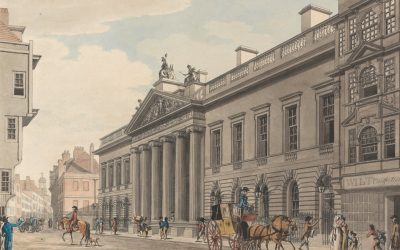
The British East India Company, once the largest corporation in history, has profoundly impacted the modern global economy. This influential trade organisation, which operated for over two centuries, managed to amass massive wealth and power, all while shaping the political landscape of several nations, including India and China.
Founding and early years
The British East India Company, formally known as the Governor and Company of Merchants of London Trading into the East Indies, was incorporated by a royal charter on 31 December 1600. Initially created to break the monopoly on the East Indian spice trade held by Spain and Portugal, the company quickly expanded its operations to include a variety of goods, such as cotton, silk, indigo, saltpetre, tea, and opium.
Royal Charter and monopoly
Granted by Queen Elizabeth I, the royal charter authorised a group of London merchants to hold exclusive overseas trading rights with the East Indies—an extensive region stretching from Africa’s Cape of Good Hope to Cape Horn in South America. Although the British East India Company held a monopoly in that no other British subjects were legally allowed to trade within its territory, it faced strong competition from other European powers, such as the Spanish, Portuguese, and the Dutch East India Company, which was founded in 1602.
Focus on trade and expansion
Seeking profits from the lucrative spice trade, the company initially focused on establishing trading outposts in strategic locations throughout the East Indies. However, it quickly diversified its portfolio by adding various commodities to its trading list, including textiles, jewellery, and other exotic goods. The company’s expansion across the region was met with resistance from local rulers and rival European traders who had already established trading posts in the area.
Growth and influence
At its peak, the British East India Company was the largest corporation of its kind and wielded immense economic and political power. The company was larger than several nations and effectively acted as the de facto emperor of large portions of India, one of the most productive economies in the world at that time.
Economic impact
The company’s trading activities flooded England with a wide range of affordable goods, such as tea, cotton textiles, and spices. This influx of exotic products enriched the company’s London investors with returns as high as 30 per cent, but it also fueled the growth of consumer culture in England as people developed a taste for fashionable items and patterns from the East Indies.
Political involvement
As the company’s influence grew, it began to involve itself in the politics of the regions in which it operated. Local rulers and kings, including the powerful Mughal Empire in India, courted the company’s representatives, extracting bribes and seeking the company’s military support in regional conflicts. The company’s political weight also allowed it to negotiate one-sided contracts with Indian rulers, granting it lucrative taxation powers and expanding its territorial control.
The company’s transformation and the empire-building era

By the late 18th century, the British East India Company’s grip on trade began to weaken, prompting it to shift its focus to empire-building. At one point, the company commanded a private army of 260,000 soldiers, twice the size of the British army. This formidable force enabled the company to conquer territories, intimidate competitors, and coerce Indian rulers into submission.
Key turning points
One central turning point in the company’s transformation from a trading enterprise to an empire-building corporation was the Battle of Plassey in 1757. The company’s military leader in Bengal, Robert Clive, managed to secure a decisive victory against the Nawab of Bengal, who commanded an army of 50,000 soldiers—outnumbering Clive’s forces by a significant margin. This victory granted the British East India Company broad taxation powers in Bengal, one of India’s wealthiest provinces. As a result, the company shifted its business model from profitable trade to tax collection, further solidifying its status as a powerful political force.
Government intervention
As the company’s power and influence grew, the British government began to take notice. In 1773, the Regulating Act was passed, establishing government control of political policy through a regulatory board responsible to Parliament. In 1784, Prime Minister William Pitt the Younger’s India Act further cemented the British government’s role in ruling over the company’s land holdings in India. This shift marked the beginning of the end for the British East India Company’s commercial and political dominance.
Decline and dissolution
By the mid-19th century, the company’s commercial monopoly had been broken, and it had lost its role as a managing agency for the British government of India. Several factors contributed to the company’s eventual decline, including opposition to its monopoly, government intervention, and the growing influence of free-market ideals championed by thinkers such as Adam Smith. Ultimately, the British East India Company ceased to exist as a legal entity in 1873.
The Opium Wars and controversy
One of the darkest chapters in the company’s history was its involvement in the opium trade in China. To finance its tea trade, the company smuggled opium into China, sparking the Opium Wars of the 19th century. These conflicts led to British control of Hong Kong and exposed the company’s morally dubious practices in the pursuit of profit.
Legacy and impact on the modern global economy
The British East India Company’s influence as a ruthless and trailblazing corporate entity continues to shape the modern global economy despite its dissolution over a century ago. Understanding the global political structure and the development of the capitalist economic system is impossible without acknowledging the role the company played in shaping the world we know today. The company’s impact can still be felt in the global economy, international trade, and the geopolitical landscape.


Leave a Reply