• Skip to main content
  • Skip to after header navigation
  • Skip to site footer
Our history archive

Our History

Our History Archive, where history comes to life

  • Home
  • Colonisation
  • World History
  • Civil Rights
  • World cultures
  • Features
  • Wellbeing
  • Popular Culture

The Boston Tea Party

The Boston Tea Party
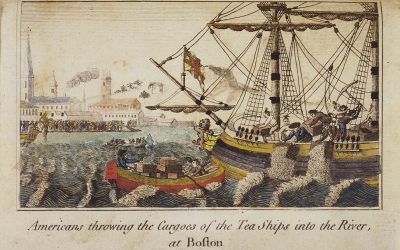
W.D. Cooper, Public domain, via Wikimedia Commons
World history
14 December, 2012

On a cold December night in 1773, a group of American colonists made a bold move that would forever change the course of history. Disguised as Mohawk Indians, they boarded three British ships anchored in Boston Harbor and dumped 342 chests of tea into the water. This act of defiance, known as the Boston Tea Party, was a significant turning point in the American struggle for independence and has since become a symbol of resistance against unjust authority.

The prelude to rebellion

The roots of the Boston Tea Party stretch back to the conclusion of the French and Indian War in 1763. The British Parliament, seeking to offset the high costs of the war, imposed a series of taxes on the American colonies. Acts like the Stamp Act of 1765 and the Townshend Acts of 1767 met with resistance from the colonists, who felt these taxes were imposed without their consent. The slogan “No taxation without representation” became a rallying cry for those who believed it was unfair for them to be taxed by a government in which they had no political voice.

The Tea Act and colonial backlash

In 1773, the British Parliament passed the Tea Act, which granted the British East India Company a monopoly on selling tea in the colonies. This act, meant to bail out the financially troubled company, allowed it to sell tea at a lower price than smuggled tea, undermining American merchants and smugglers. The act reignited the flames of colonial anger. Colonists saw the Tea Act as yet another example of Britain’s tyrannical rule, ignoring colonial interests and rights.


The night of the Boston Tea Party

In response to the Tea Act, a group of colonists was organised under the leadership of Samuel Adams, a prominent political activist. On 16 December 1773, after officials in Boston refused to return three shiploads of taxed tea to Britain, a group of colonists took matters into their own hands. Disguising themselves as Mohawk Indians, they boarded the ships and threw the chests of tea into the Boston Harbor. The deliberate choice of Mohawk disguises was symbolic, representing an American identity distinct from their British oppressors.

The aftermath and legacy

The Boston Tea Party had immediate and far-reaching consequences. It provoked a fierce response from the British government, leading to the Intolerable Acts of 1774. These acts closed Boston Harbor until the tea was paid for, altered the Massachusetts charter to limit town meetings, and allowed royal officials accused of crimes to be tried in Britain or another colony. These harsh measures further alienated the colonists and set the stage for the American Revolution.

The Boston Tea Party is remembered for its immediate impact and its enduring legacy in American history and culture. It was a dramatic demonstration of the power of collective action against perceived injustice. The event has been celebrated and mythologised in American history, symbolising the spirit of resistance against tyranny and the birth of American independence.

The Boston Tea Party was more than just a protest; it was a defining moment that crystallised the growing rift between the American colonies and Great Britain. It demonstrated the colonists’ willingness to take drastic measures to defend their rights and freedoms. This event was a critical step on the path to the American Revolution and the creation of a new, independent nation.

Share this:

  • Share on Facebook (Opens in new window) Facebook
  • Share on X (Opens in new window) X
  • Share on Reddit (Opens in new window) Reddit
  • Share on Pinterest (Opens in new window) Pinterest
  • Share on WhatsApp (Opens in new window) WhatsApp


Related

You May Also Like…

More details Merida - Palacio de Gobierno - Murals by Fernando Castro Pacheco: The Spanish bishop Diego de Landa is burning figures of Mayan deities

The forgotten fire: A history of the Darfur Genocide

The Japanese occupation of Beiping (Beijing) in China

The rise and fall of the Japanese Empire

Rescuers and residents searching the rubble of the destroyed Shajareh Tayyebeh elementary school in Minab

The fracturing of the international order in an age of impunity

US ambassador to the UN, Eleanor Roosevelt, holding the Universal Declaration of Human Rights in 1949

The role and limitations of international law in world affairs


Reader Interactions

Leave a ReplyCancel reply

Sidebar

This Day In History

No Events

World history recent posts in

More details Merida - Palacio de Gobierno - Murals by Fernando Castro Pacheco: The Spanish bishop Diego de Landa is burning figures of Mayan deities

The forgotten fire: A history of the Darfur Genocide

The Japanese occupation of Beiping (Beijing) in China

The rise and fall of the Japanese Empire

Rescuers and residents searching the rubble of the destroyed Shajareh Tayyebeh elementary school in Minab

The fracturing of the international order in an age of impunity

US ambassador to the UN, Eleanor Roosevelt, holding the Universal Declaration of Human Rights in 1949

The role and limitations of international law in world affairs

Trending

  • The rise and fall of the Persian Empire
    The rise and fall of the Persian Empire
  • Mexican culture: A living mosaic of civilisations, faith, and tradition
    Mexican culture: A living mosaic of civilisations, faith, and tradition
  • The British Empire: An overview of empire and colonisation
    The British Empire: An overview of empire and colonisation
  • The 1972 Munich Olympics massacre
    The 1972 Munich Olympics massacre
  • Holy Wars: The blood-soaked legacy of conflicts fought in the name of Christianity
    Holy Wars: The blood-soaked legacy of conflicts fought in the name of Christianity
  • The history of South Africa: From colonisation to independence
    The history of South Africa: From colonisation to independence
  • The Arab slave trade
    The Arab slave trade
  • The forgotten fire: A history of the Darfur Genocide
    The forgotten fire: A history of the Darfur Genocide
  • History of Canada - From colonisation to independence
    History of Canada - From colonisation to independence
  • The rise and fall of the Ottoman Empire: Six centuries of imperial power
    The rise and fall of the Ottoman Empire: Six centuries of imperial power

Connect

  • YouTube
  • TikTok
  • Bluesky

ABOUT

CONTACT

PRIVACY POLICY

COOKIES

Copyright © 2026 · Our History · All Rights Reserved