
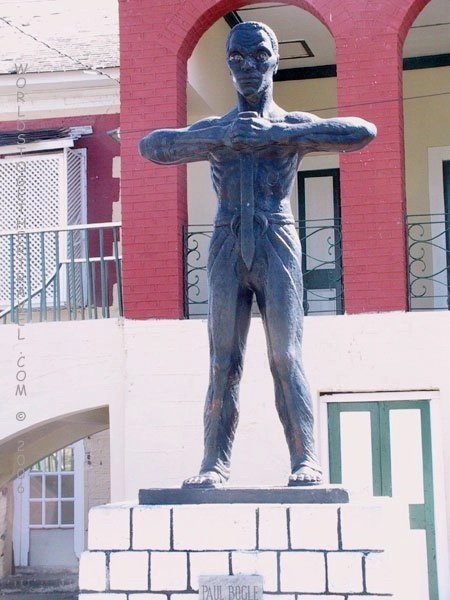
Paul Bogle is one of Jamaica’s National Heroes. It is believed he was born free about 1822. Bogle was a Baptist deacon in Stony Gut, a few miles north of Morant Bay, and was eligible to vote at a time when there were only 104 voters in the parish of St. Thomas. He was a firm political supporter of George William Gordon a local landowner and politician who became instrumental in getting Paul his position as Baptist deacon.
The community of Stony Gut was made up of small farmers and Bogle himself owned 500 acres of land. Paul Bogle grew up in a time of transition in Jamaica. Although slavery had been abolished in 1834 the power still remained in the hands of the white population. Black Jamaicans could vote but in reality, the requirement to be able to read and write and the high fee for voting excluded most of them from being able to vote. In the elections of 1864 black Jamaicans out-numbered white by 32 to 1 but very few actually had the opportunity to vote.
In 1865 the black population of Jamaica had almost nothing to show for their almost 30 years of emancipation from slavery. The majority had no land or work and wages were dismally low. Drought and flood had severely affected the small provision grounds that some managed to cultivate. Imported goods were unaffordable as prices were drastically inflated as a result of the American Civil War.
In addition to its religious functions, Bogle’s chapel became a centre for political activity and, some believe, military training. Bogle began to organise demonstrations against injustices in the legal system.
In August 1865, Paul Bogle and some of his followers marched over 50 miles from Stony Gut to Spanish Town, the capital of Jamaica at that time. The then Governor, Eyre refused to meet with them. The protesters headed back to Stony Gut, and began to plan their own court system, appointing magistrates and other officials. Hearing of these plans, the police had two of Bogle’s men arrested on spurious charges.
Morant Bay rebellion
On 7 October Bogle and a group of his supporters marched to the Morant Bay courthouse, where the two men were being tried. They surrounded the courthouse and attempted to disrupt the proceedings with a loud, but peaceful protest. A skirmish with the police ensued, providing just the excuse the authorities needed to issue a warrant for Paul Bogle’s arrest.
On 10 October the police tried to arrest Bogle at Stony Gut. The villagers prevented the arrest from taking place. The police fled back to Morant Bay bearing the news that Bogle’s group planned to march on the town the next day. The Custos (the governor’s representative in the parish) called out the Volunteer Militia and requested additional military assistance from the governor.
On 11 October Bogle and about 400 supporters marched into Morant Bay. They raided the police station for arms and attacked the courthouse where the local council was having a meeting. The ensuing violence left the Custos and 17 other officials and soldiers dead, along with 7 of Bogle’s supporters.
Troops sent by the governor arrived the next day. Black soldiers of the First West India Regiment, under white officers, arrived by ship. Then white soldiers from Newcastle in St. Andrew arrived on foot. Even some Maroons, to the disgust of the black population, joined in the vicious fight against Paul Bogle’s men.
As the protests spread violently through St. Thomas, the authorities feared that they would soon affect the whole island. Martial Law was declared on 13 October basically giving the army freedom to do whatever they liked. The rebellion and protesters were brutally crushed but Paul Bogle escaped to the hills.
Governor Eyre used the uprising as an opportunity to eliminate his chief political critic, George William Gordon. Gordon, who had been in Kingston during all the events leading up the rebellion, was arrested and charged with treason and complicity with the protesters. He was sentenced to death and hanged on 23 October.
Death of Paul Bogle
Bogle was captured and hanged on 24 October 1865 but his forceful demonstration achieved its objectives. It paved the way for the establishment of just practices in the courts and it brought about a change in official attitude, which made possible the social and economic betterment of the people.


Leave a Reply