
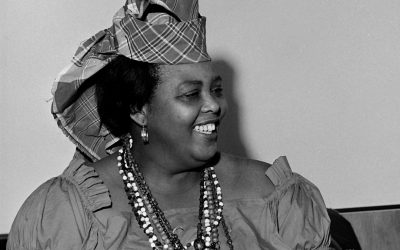
On Wednesday, Jamaican poet and folklorist Louise Simone Bennett-Coverly, who became the voice of the island’s culture at home and abroad, died in Toronto. She was 86 years old.
Jamaica Information Service announced her death without giving a cause. After collapsing late Tuesday night, she was hospitalised in Toronto.
As a social commentator who used Jamaican patois liberally and created the Jamaican catchphrase “Walk good,” she was extremely talented on stage, on radio, on television, and movies. She was also a presenter on the BBC’s Caribbean Service.
Louise Bennett, known as Miss Lou to her fans worldwide, was born on North Street in Kingston on 7 September 1919, the only child of Cornelius Bennett, a baker, and Kerene Robinson, a dressmaker. Her father died when she was young, and her mother essentially raised her.
Bennett was educated in Jamaican schools, and while she loved literature, she once described herself as “an average student.”
She made her first public appearance on Christmas Day, 1936, reciting a Jamaican dialect poem at a concert. The promoter Eric Winston Coverly, better known as Chalk Talk, who became her husband in 1954, presented her with two guineas as a prize. Those funds helped her purchase new shoes.
Because Ms Bennett spoke Jamaican patois instead of Oxford English, she was ostracised by educated Jamaicans.
Initially, The Gleaner refused to publish her poems but later hired her for a regular Sunday column, which was successful.
Many of her published verses originated in print or radio journalism. Her monologues often commented on social and political issues. In her radio broadcasts, she invented the character of Aunty Roachy to ridicule the authorities with wit, often concluding her performance with local proverbs.
She performed in her first Christmas pantomime in 1943, and she and the stage actor Ranny Williams became a leading couple in Jamaican theatre. They wrote “Anancy and Beeny Bud” (1958) “, Jamaica Way” (1959) and “Carib Gold” (1960). (Anancy, the famous trickster of African and Caribbean folklore, was one of her favourite subjects.)
In 1945, Bennett received a British Council Scholarship and became the first black student at the Royal Academy of Dramatic Art in London. She worked with British repertory companies after graduating. She hosted a BBC radio program, “Caribbean Carnival,” in 1945 and 1946.
After returning to Jamaica in 1947, she found it difficult to earn a living. She returned to England in 1950, where she hosted another Caribbean show on the BBC, “West Indian Night.”.
She worked at Macy’s after moving to New York in 1953. The folk musical, “Day in Jamaica,” that she and Mr Coverly directed, debuted at St. Martin’s Little Theater in Harlem and then travelled to Episcopal churches in New York, New Jersey, and Connecticut.
In Greenwich Village, she sang folk songs with Alma John, a well-known black broadcaster. She married Mr Coverly in May 1954, and they returned to Jamaica in 1955.
She was appointed drama officer for the Jamaica Social Welfare Commission in 1956 and was its director from 1959 to 1963. While at the commission, she reconnected with her studies of Jamaican folklore and oral history.
In addition to teaching drama and folklore at the University of the West Indies, she was briefly employed by the Jamaica Broadcasting Corporation in 1959 but left to pursue a freelance career.
“Jamaica Labrish” (1966) is perhaps her most famous book of poetry and folklore. “Dialect Verses” (1942) was her first publication. Additionally, she recorded several albums, including “Jamaica Folksongs” (Folkways) in 1953 and “Yes Me Dear” (Island Records Jamaica) in 1981.
Bennett was one of Jamaica’s most popular radio personalities in the 1950s and 1960s, with programmes such as “Laugh With Louise,” “Miss Lou’s Views,” and “The Lou and Ranny Show.” In the 1970s, Jamaican children looked forward to her Saturday morning children’s television program, “Ring Ding.”
In 1960, she was made a Member of the British Empire (M.B.E.) for her contributions to Jamaican literature and theatre.
A children’s theatre was named after her in the 1970s; it was refurbished in 1987 to commemorate her 50th anniversary. The Jamaica Information Service produced a film about her in 1979, “The Hon. Miss Lou.”
Lousie Bennett and Mr Coverly spent several years living in Canada. Because the Jamaican government refused to grant duty concessions for the expensive drugs he needed, they had to sell their home and possessions. She said at the time that Jamaica was wherever she was.
Her husband died at the age of 91 after she nursed him through years of illness. Her son, Fabian Coverly, and three stepgrandsons survive her.


Leave a Reply