
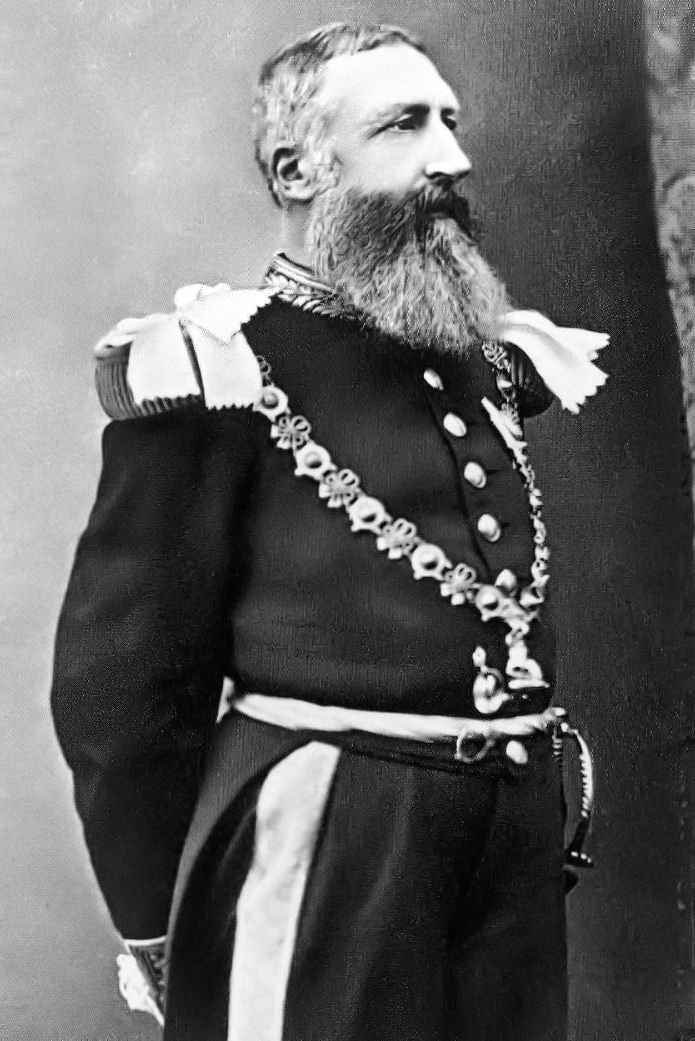
Leopold II was the second King of the Belgians from 1865 to 1909. Born on 9 April 1835 in Brussels, he was the eldest surviving son of Leopold I, the first King of the Belgians, and his second wife, Louise-Marie of Orleans. Although Leopold II played a significant role in the development of the modern Belgian state, his rule was marked by widespread atrocities committed against his colonial subjects in the Congo Free State.
Early life and ascension to the throne
Leopold was born into a relatively young Belgium, with the country being only about five years old at the time of his birth. As the eldest surviving son of Leopold I, he became the heir to the Belgian throne after the death of his older brother, Louis Philippe. Leopold received the title of Duke of Brabant in 1846. He served in the Belgian army, eventually reaching the rank of lieutenant-general by the time he ascended to the throne in 1865.
Leopold II succeeded his father following the latter’s death on 10 December 1865. At the age of 30, he took the oath of office on 17 December 1865 and embarked on a 44-year reign, the longest in Belgian history. During his reign, Leopold focused on strengthening Belgium’s defences and expanding its economy, with a particular interest in acquiring colonies.
Marriage and family
In 1853, at the age of 18, Leopold married Marie Henriette of Austria, a cousin of Emperor Franz Joseph I of Austria and granddaughter of the late Holy Roman Emperor Leopold II. The couple had four children, three daughters and one son, Prince Leopold, Duke of Brabant. However, their marriage became unhappy, and they eventually separated after the birth of their last daughter, Clementine.
Leopold had numerous mistresses throughout his life, the most famous of which was Caroline Lacroix, a 16-year-old French prostitute he met in 1899. The two remained together until his death ten years later. Despite their unofficial relationship, Leopold lavished Lacroix with gifts and a noble title, which ironically lost him more popularity in Belgium than any of his crimes in the Congo.
Domestic reign and political developments
Leopold’s reign saw several significant political developments in Belgium. The Liberals and Catholic parties clashed over issues related to suffrage and education, with the Frere-Orban Law of 1879 creating free, secular, compulsory primary schools supported by the state while withdrawing support from Roman Catholic primary schools. The Catholic Party regained power in 1880 and restored state support to Catholic schools in 1884.
In addition to his focus on education, Leopold concentrated on developing the country’s defences. He was aware that Belgian neutrality, maintained during the Franco-German War (1870-71), was threatened by the increasing strength of France and Germany. As a result, he persuaded the Belgian parliament to finance the fortification of Liege and Namur in 1887.
Leopold II and the Congo Free State
Leopold II’s desire to establish Belgium as a colonial power led to his interest in the Congo River basin. In 1876, he hosted an international conference of explorers and geographers at the royal palace in Brussels. A few years later, he hired explorer Henry Morton Stanley to help him claim the Congo, which would eventually become the Congo Free State.
Leopold implemented a forced-labour system in the Congo, which was quickly copied by other European colonial powers. This brutal practice resulted in a catastrophic decline in the Congo’s population, with estimates ranging from 1 million to 15 million deaths. The forced-labour system primarily focused on collecting ivory and harvesting rubber, leading to widespread abuse, torture, and murder.
International outcry and the end of Leopold’s rule in the Congo
Leopold’s administration of the Congo Free State was characterised by atrocities and systematic brutality. Reports of these abuses, along with pressure from the Congo Reform Association and other international groups, eventually led to the Belgian government taking over the administration of the Congo in 1908. The Congo Free State was reconstituted as the Belgian Congo, but Leopold made the Belgian government pay him for his prized possession.
Legacy and impact
Leopold II’s legacy is a complex and controversial one. While he did much to establish Belgium as an economically and militarily stable power in Europe, he is chiefly remembered for the nightmarish practices that were carried out in his name. He was the architect of one of history’s greatest if lesser-known, crimes against humanity.
The widespread atrocities committed in the Congo Free State under his rule cast a dark shadow over his legacy. Leopold II remains a controversial figure in history, with his contributions to Belgium’s development often overshadowed by the untold suffering and death that occurred under his watch in the Congo.


Leave a Reply