
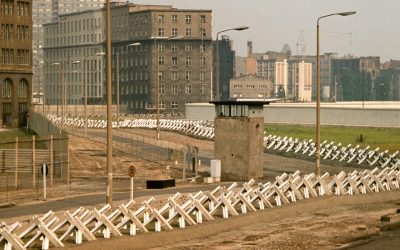
The Berlin Wall, a potent symbol of the Cold War, was a physical and ideological barrier that divided East and West Berlin from 1961 to 1989. It was not merely a wall but a comprehensive border system representing the broader divide between the communist Eastern Bloc and the capitalist West during this period.
A historical overview
The Berlin Wall was erected in 1961 by the German Democratic Republic (GDR), also known as East Germany. It marked a clear divide between East and West Germany during the tense period of the Cold War between the United States and its Western allies and Soviet Union-controlled Eastern Bloc countries.
Following World War II, Germany was divided into four occupation zones controlled by the Soviet Union, the United States, the United Kingdom, and France. The situation was particularly unique in Berlin, which lay within the Soviet zone of occupation but was similarly divided into four segments. In time, political tensions stirred as the Soviets aimed to drive out foreign influence from their portion of Germany.
Why was the wall built?
The Berlin Wall resulted from escalating tensions between East and West German governments. In 1961, East Germany was suffering from an increasing number of citizens fleeing to West Germany due to economic disparity and political repression. Skilled workers were particularly inclined to leave, causing the East German economy to suffer.
The wall’s construction aimed to curb this “brain drain” and essentially create a physical barrier between the two Germanys. East German authorities argued that it would protect their citizens from Western fascists seeking to subvert their socialist state.
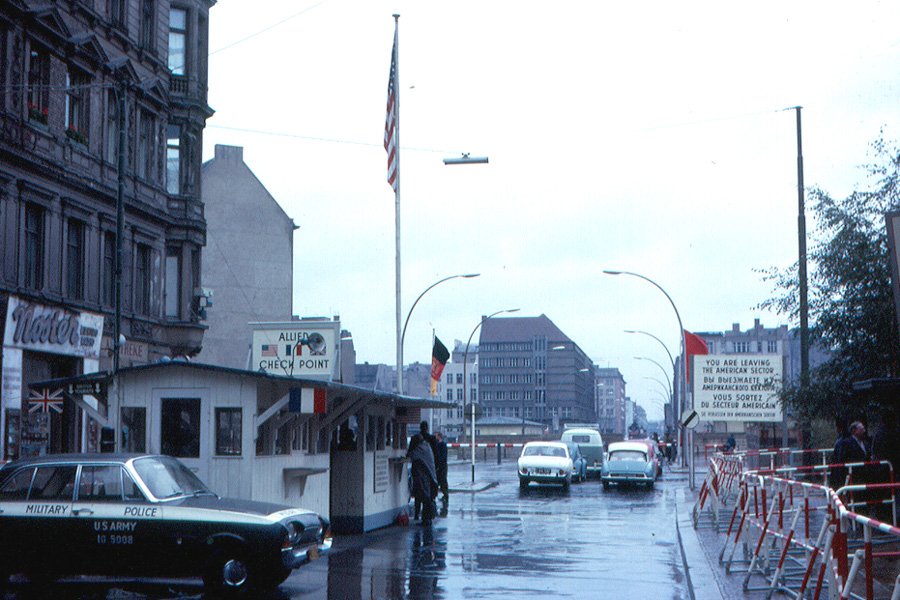
On 13 August 1961, the construction of the Berlin Wall began. Consisting primarily of concrete walls and barbed wire fences spanning nearly 96 miles (155 kilometres) along with numerous watchtowers manned by border guards, it served as an imposing barrier. Families found themselves separated overnight, unable to visit their loved ones or return to their homes in the West. West Berlin became an island of freedom and democracy surrounded by an East German sea of repression.
Several checkpoints, such as the famous Checkpoint Charlie, were established for diplomats and restricted traffic between the two sides.
The wall’s impacts
The Berlin Wall became a symbol of oppression and a stark representation of the “Iron Curtain” and tensions between the West and the Soviet-controlled East.
It stood as a barrier not only to physical freedom but also to the freedom of ideas, politics, and economic prosperity. Over the years, numerous individuals risked their lives attempting to escape over or under the barrier – many succeeded, while around 140 others met with tragic ends.
The fall of the Berlin Wall
By the late 1980s, under Mikhail Gorbachev, the Soviet Union had relaxed its policies, leading to political and social changes in the Eastern Bloc. The gradual end of the Cold War led to growing calls for freedom in East Germany. With pressure mounting internally and internationally, East German authorities announced on 9 November 1989 that their citizens would be allowed to travel across the border.

(Noir, CC BY-SA 3.0, via Wikimedia Commons)
This announcement led to masses of people gathering near the wall and chipping away at it with hammers and other tools, creating makeshift crossings between East and West Berlin. As a result, the wall’s demolition officially began on 13 June 1990, concluding with the reunification of Germany on 3 October 1990.
The history of the Berlin Wall marks a critical period when ideologies clashed on a global stage. Its destruction serves as a reminder that barriers can be broken down and that unity can triumph over division. Today, remnants of this once-menacing structure can be found in various Berlin museums or displayed around the city as open-air memorials, reminding us never to repeat history’s darker chapters.


Leave a Reply