• Skip to main content
  • Skip to after header navigation
  • Skip to site footer
Our history archive

Our History

Our History Archive, where history comes to life

  • Home
  • Colonisation
  • World History
  • Civil Rights
  • World cultures
  • Features
  • Wellbeing
  • Popular Culture

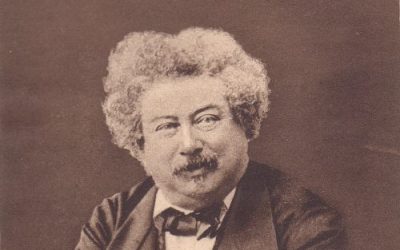
Alexandre Dumas

Alexandre Dumas
World history
31 March, 1999

You’ve seen the movies and maybe you’ve read the books but did you know that The Three Musketeers and The Count of Monte Cristo were written by a decendent of an enslaved woman? Yes. That’s right, Alexandre Dumas (1802-1870) was of mixed heritage.

On 24 July 1802, Alexandre Dumas was born to Marie Louise Labouret and General Thomas-Alexandre Davy de la Pailleterie in Villers-Cotterêts, France. Dumas is the family name adopted from Alexandre’s grandmother; an enslaved Haitian named Marie-Césette Dumas. The Marquis Alexandre Antoine Davy de La Pailleterie was his grandfather. Thomas-Alexandre took the name Dumas when he enlisted in Napoleon’s army, where he earned the dubious nickname “Black Devil.”

Thomas-Alexandre rose to the rank of general at the age of 31. It was the highest rank of any Black man in a European army. In 1797, he distinguished himself at the battle of Adige when he surprised and defeated an Austrian battery. 


A disagreement with Napoleon over the Egypt campaign led Thomas-Alexandre to leave the armed forces. He spent nearly two years in prison and died shortly after being released. Marie Louise Labouret worked hard to provide an education for her son after her husband passed away. The young Dumas attended Abbé Grégoire’s school for a while before taking a job as an assistant to a local notary.

A literary career

Dumas moved to Paris in 1822 and immersed himself in literature. During the 1830 revolution, he worked as a scribe for the Duc d’Orléans (later known as Louis Philippe) and began to write comedy and drama plays.

In addition to essays, short stories, and novels, Dumas wrote plays and travelogues. Also interested in crime and scandal, he wrote eight volumes of essays on infamous cases in history, such as those of Lucrezia Borgia and Cesare Borgia, and other names more relevant to his time, such as Karl Ludwig Sand. He gained widespread success with his novels, The Count of Monte Cristo and The Three Musketeers, which were initially serialized. 

The Three Musketeers was one of three novels in his D’Artagnan Romances; the others were Twenty Years After and The Vicomte of Bragelonne: Ten Years Later. Among his most well-known works is “The Man in the Iron Mask” from Le Vicomte de Bragelonne.

As a result of his literary success, Dumas purchased land and built the Château de Monte Cristo in Port Marly, Yvelines, France. The author spent much of his time writing and entertaining at this house (now a museum) before debt forced him to sell it. In 1851, he fled first to Belgium and then to Russia to avoid creditors. During his exile, Dumas continued to publish books, including travel books on Russia.


Legacy and death

Dumas had a son, also named Alexandre, with Marie Laure Catherine Labay. His son followed in his footsteps carving out a literary career of his own. In 1840, Dumas married actress Ida Ferrier, but he continued his affairs with other women. He had at least one daughter, Marie Alexandrine, out of wedlock, and he dated younger women much younger than him in his old age.

Dumas died in Puys, France, on 5 December 1870. He was buried in the cemetery of Villers-Cotterêts. In 2002, Dumas’ body was reburied at the Panthéon in Paris. It rests alongside other French literary greats like Victor Hugo, Émile Zola and Jean-Jacques Rousseau.

Share this:

  • Share on Facebook (Opens in new window) Facebook
  • Share on X (Opens in new window) X
  • Share on Reddit (Opens in new window) Reddit
  • Share on Pinterest (Opens in new window) Pinterest
  • Share on WhatsApp (Opens in new window) WhatsApp

Related

You May Also Like…

More details Merida - Palacio de Gobierno - Murals by Fernando Castro Pacheco: The Spanish bishop Diego de Landa is burning figures of Mayan deities

The forgotten fire: A history of the Darfur Genocide

The Japanese occupation of Beiping (Beijing) in China

The rise and fall of the Japanese Empire

Rescuers and residents searching the rubble of the destroyed Shajareh Tayyebeh elementary school in Minab

The fracturing of the international order in an age of impunity

US ambassador to the UN, Eleanor Roosevelt, holding the Universal Declaration of Human Rights in 1949

The role and limitations of international law in world affairs


Reader Interactions

Leave a ReplyCancel reply

Sidebar

This Day In History

No Events

World history recent posts in

More details Merida - Palacio de Gobierno - Murals by Fernando Castro Pacheco: The Spanish bishop Diego de Landa is burning figures of Mayan deities

The forgotten fire: A history of the Darfur Genocide

The Japanese occupation of Beiping (Beijing) in China

The rise and fall of the Japanese Empire

Rescuers and residents searching the rubble of the destroyed Shajareh Tayyebeh elementary school in Minab

The fracturing of the international order in an age of impunity

US ambassador to the UN, Eleanor Roosevelt, holding the Universal Declaration of Human Rights in 1949

The role and limitations of international law in world affairs

Trending

  • The rise and fall of the Persian Empire
    The rise and fall of the Persian Empire
  • History of Canada - From colonisation to independence
    History of Canada - From colonisation to independence
  • The forgotten fire: A history of the Darfur Genocide
    The forgotten fire: A history of the Darfur Genocide
  • Mexican culture: A living mosaic of civilisations, faith, and tradition
    Mexican culture: A living mosaic of civilisations, faith, and tradition
  • Operation Ajax and the shadow of empire: The 1953 Iranian coup
    Operation Ajax and the shadow of empire: The 1953 Iranian coup
  • The life and legacy of Louise Bennett: A Jamaican poet whose words still resonate
    The life and legacy of Louise Bennett: A Jamaican poet whose words still resonate
  • The British Empire: An overview of empire and colonisation
    The British Empire: An overview of empire and colonisation
  • The rise and fall of the Ottoman Empire: Six centuries of imperial power
    The rise and fall of the Ottoman Empire: Six centuries of imperial power
  • The history of South Africa: From colonisation to independence
    The history of South Africa: From colonisation to independence
  • European colonisation of Southeast Asia
    European colonisation of Southeast Asia

Connect

  • YouTube
  • TikTok
  • Bluesky

ABOUT

CONTACT

PRIVACY POLICY

COOKIES

Copyright © 2026 · Our History · All Rights Reserved