
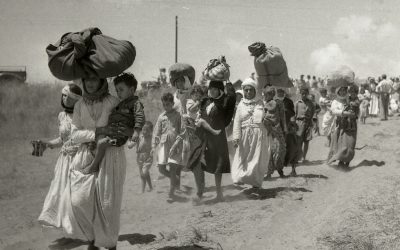
Each year on 15 May, Palestinians around the world pause to mark one of the most defining moments in their history — a day of mourning, remembrance, and renewed calls for justice.
What Is Nakba Day?
Nakba Day is commemorated annually on 15 May. The word nakba means “catastrophe” in Arabic, and it is the term used by Palestinians to describe the mass displacement and dispossession that began in 1948, when the State of Israel was established. The date was chosen because 14 May 1948 was the day Israel declared independence — meaning 15 May was the first full day of what Palestinians experienced as the destruction of their homeland.
The day was first observed informally in 1949, and was officially inaugurated as a day of remembrance by Palestinian leader Yasser Arafat in 1998. In 2023, the United Nations marked Nakba Day for the first time in its history, a significant moment of international recognition. Since then, it has been formally observed annually at the UN.
What happened in 1948?
To understand Nakba Day, it is necessary to understand the events it commemorates — events whose scale and consequences shaped the Middle East for generations.
Before 1948, Palestine was a multi-ethnic, multi-cultural society, home to Arab Muslims, Arab Christians, and Jews. To understand what happened, it is necessary to trace a chain of events that began three decades earlier — with a British promise made without consulting the people most affected.
The Balfour Declaration (1917)
During the First World War, Britain was eager to secure Jewish support for the Allied cause and strategic control over the Middle East. On 2 November 1917, British Foreign Secretary Arthur James Balfour wrote a short letter to Lord Walter Rothschild, a leader of the British Jewish community, declaring that the British government would look favourably upon “the establishment in Palestine of a national home for the Jewish people.” This letter, just 67 words long, became one of the most consequential political documents of the twentieth century — the Balfour Declaration.
Its language contained a telling imbalance. While the Declaration promised a Jewish national home, it referred to the Arab population — who made up roughly 90% of Palestine at the time — not by name, but only as “the existing non-Jewish communities.” It stipulated that “nothing shall be done which may prejudice the civil and religious rights” of those communities, but said nothing at all about their political or national rights. Critics within the British government foresaw the trouble this would cause. Lord Curzon, who later became Foreign Secretary, warned at the time that such a policy would “lead to decades of Arab-Jewish hostility.” He was right.
The League of Nations Mandate (1920–1923)
After the war, the newly created League of Nations — the forerunner to the United Nations — established a system of “mandates” over former Ottoman territories, ostensibly to guide them toward independence under the tutelage of more powerful states. Britain was assigned the Mandate for Palestine at the San Remo Conference in April 1920, and the mandate was formally confirmed by the League of Nations Council in July 1922, with the mandate coming into force in September 1923.
Crucially, the Mandate’s text incorporated the Balfour Declaration into its preamble, making Britain’s commitment to a Jewish national home a matter of international law. Britain was thus legally obligated to facilitate Jewish immigration and institution-building in Palestine — even as the Arab majority of the population was excluded from political representation and grew increasingly alarmed at the demographic changes taking place. Jewish immigration increased substantially through the 1920s and 1930s, driven by persecution in Europe and later by the Holocaust. By 1947, Jews made up approximately one-third of Palestine’s population, many of them recent arrivals, yet they still owned less than 7% of the land.
By 1947, exhausted by the Second World War and unable to manage escalating violence between Jewish and Arab communities, Britain announced it was abandoning the Mandate and turning the question of Palestine over to the newly formed United Nations.
UN Resolution 181: The Partition Plan (1947)
On November 29, 1947, the UN General Assembly passed Resolution 181, recommending the partition of historic Palestine into two independent states, one Jewish, one Arab, plus an international zone for Jerusalem. The vote was 33 in favour, 13 against, and 10 abstentions. Britain, the departing Mandate power, abstained.
The proposed division was widely seen as deeply inequitable. Although Arabs made up approximately 67% of the population of Palestine and Jews around 33%, Resolution 181 allocated roughly 55% of the land to the proposed Jewish state and only 42% to the proposed Arab state. This disparity was compounded by the fact that Jews owned less than 7% of the land at the time. The plan gave the Jewish state control of the most fertile agricultural regions, while the Arab state was left with a less connected, less developed territory.
The Jewish leadership, though not entirely satisfied, accepted the plan as a basis for statehood. The Arab states and Palestinian leadership rejected it, arguing that it was fundamentally unjust, that an outside body had no right to partition a land overwhelmingly inhabited by one people and award more than half of it to a minority of recent immigrants. Violence broke out almost immediately after the vote was announced.
The war and its aftermath
What followed was a war that irrevocably transformed Palestine. Between 1947 and 1949, military operations and Zionist paramilitary forces, the Haganah, Irgun, and Lehi, attacked Palestinian cities and villages across the territory. On May 14, 1948, as soon as the British Mandate expired at midnight, the Jewish People’s Council gathered in Tel Aviv and declared the establishment of the State of Israel. The British army departed, leaving a power vacuum in its wake. The following day — May 15, 1948 — neighbouring Arab states intervened militarily, triggering the first Arab-Israeli war.
By the time fighting ceased, the human toll was staggering. Approximately 750,000 Palestinians, over 80% of the Arab population living in what became the State of Israel, were expelled from their homes or fled in fear. More than 500 Palestinian villages and towns were destroyed or depopulated. Thousands of Palestinians were killed in dozens of massacres, including one of the most infamous: the massacre at Deir Yassin on April 9, 1948, near Jerusalem, where more than 110 men, women, and children were killed by Zionist militias.
Village wells were poisoned, properties looted, and many sites renamed, measures specifically designed to prevent Palestinian refugees from returning. Around 160,000 Palestinians remained within the newly created state, rapidly becoming a minority, cut off from their communities and, for a time, subject to military administration.
Why is it remembered?
For Palestinians, the Nakba is not merely a historical event — it is the foundational trauma of their collective identity.
The loss was total in a way that is difficult to fully comprehend. Families fled with little more than house keys and land deeds, expecting to return within days or weeks. Most never did. Vibrant cities — Jaffa, Haifa, Tiberias — were emptied of their Palestinian communities. The educated middle classes, merchants, farmers, artists and professionals, were scattered across the Middle East and beyond, becoming refugees in camps in Lebanon, Jordan, Syria, Gaza, and the West Bank.
The dispossession was not only physical but cultural. A way of life, centuries of accumulated connection to a specific land and place, was severed almost overnight. The Nakba traumatised Palestinians in every conceivable way, and this intergenerational trauma has never been allowed to heal, because the core injustice — displacement without resolution — has never been addressed.
Every year, descendants gather, carrying the keys to houses that no longer exist or are now occupied by others. They carry photographs, embroideries, olive branches. They recite the names of the villages that were destroyed. For the Palestinian diaspora spread across the world, Nakba Day is one of the most important shared moments of cultural identity — a refusal to be forgotten.
The ongoing legacy
Nakba Day is not simply about looking backwards. For Palestinians, the events of 1948 were not a closed chapter but the beginning of an ongoing process of dispossession.
As early as December 1948, the UN General Assembly passed Resolution 194, calling for Palestinian refugees to be permitted to return to their homes, and for compensation to be paid for lost or damaged property. More than seven decades later, despite countless subsequent UN resolutions, this right of return has not been realised.
Today, the Palestinian refugee population stands at over five million registered refugees, according to UNRWA, the UN relief agency for Palestinian refugees — among the largest refugee populations on earth. Millions live in refugee camps in Lebanon, Jordan, Syria, and the Palestinian territories themselves. An estimated 8.36 million Palestinians, including survivors and their descendants, are considered refugees or displaced persons in total.
Inside the occupied West Bank and East Jerusalem, Palestinians continue to face the confiscation of land, home demolitions, and settlement expansion. The situation in Gaza has become a humanitarian catastrophe of another order entirely. Since October 2023, the territory has been under an intensified blockade and sustained military assault, causing mass displacement and a severe humanitarian crisis — events that many Palestinians explicitly describe as a continuation of the original Nakba, not a separate chapter.
This is why Nakba Day, especially in recent years, has carried an acute additional weight. For many people marking the 78th anniversary in May 2026, the commemoration is not merely an act of historical memory but a description of an ongoing present.
More than suffering
Nakba Day is also, importantly, a celebration of Palestinian identity, culture, and resilience, a determination not to be defined solely by victimhood or loss.
Palestinians are, as advocates often stress, talented writers and dancers, gifted embroiderers, leading academics and scientists, and generous hosts. Their culture, the food, the dabke dance, the poetry, the embroidery patterns specific to individual villages, has been carefully preserved across generations of displacement, as acts of both love and resistance.
The commemoration is thus a dual act: mourning what was lost while affirming that Palestinian identity, culture, and the claim to justice have survived. “Israel tried, since 1948 until today, to destroy us as a people, as a group, and they failed at it. Our people are still there, resilient,” Palestinian writer Muhammad Shehada said at this year’s commemoration.
A day the world is beginning to hear
For decades, the Nakba was largely absent from mainstream international discourse. In Israel, even acknowledging the event publicly has long been politically sensitive. The UN’s decision to formally mark the day from 2023 onwards represented a significant shift — a recognition by the international community that the Palestinian experience of 1948 deserves a place in the world’s shared memory.
Each May 15, that memory is kept alive — not because Palestinians are trapped in the past, but because the past has never truly ended. The house keys still exist. The land records are still held. The longing for return, passed from grandparents to children to grandchildren born in exile, remains. And so the day continues to be marked, with grief and pride, with olive branches and with flags, until a just resolution is found.
Nakba Day falls on 15 May each year.


Leave a Reply