
For a nation of islands, Japan has always had an uneasy relationship with its horizons. The same sea that protected it for centuries eventually became the highway for its soldiers, traders, and warships to travel outward. In less than a century, Japan transformed itself from a feudal backwater, forcibly opened at gunpoint, into one of the most formidable military empires in human history. In two blinding flashes over two cities, it watched that empire evaporate almost overnight. The story of the Japanese Empire is one of the most dramatic arcs in modern history. It is a story of extraordinary national will, catastrophic hubris, and the terrible cost paid by millions of people across Asia and the Pacific.
The sleeping kingdom wakes
For more than two centuries, Japan deliberately sealed itself off from the world. Under the Tokugawa shogunate, which ruled from 1603 until the mid-nineteenth century, the country practised sakoku — a policy of strict isolation. Foreign trade was heavily restricted. Christianity was suppressed. Any Japanese citizen who left the country faced execution upon return. Japan existed, as one historian put it, like a carefully tended garden behind very high walls.
The walls came down in 1853. Commodore Matthew Perry of the United States Navy sailed four steam-powered warships—ships the Japanese called kurofune, or “black ships”—into Edo Bay and demanded that Japan open its ports to American trade. The humiliation was profound; Japan had no answer to the black ships. The result: unequal treaties with Western powers. Japan ceded its trading rights and legal jurisdiction over foreign nationals on its territory.
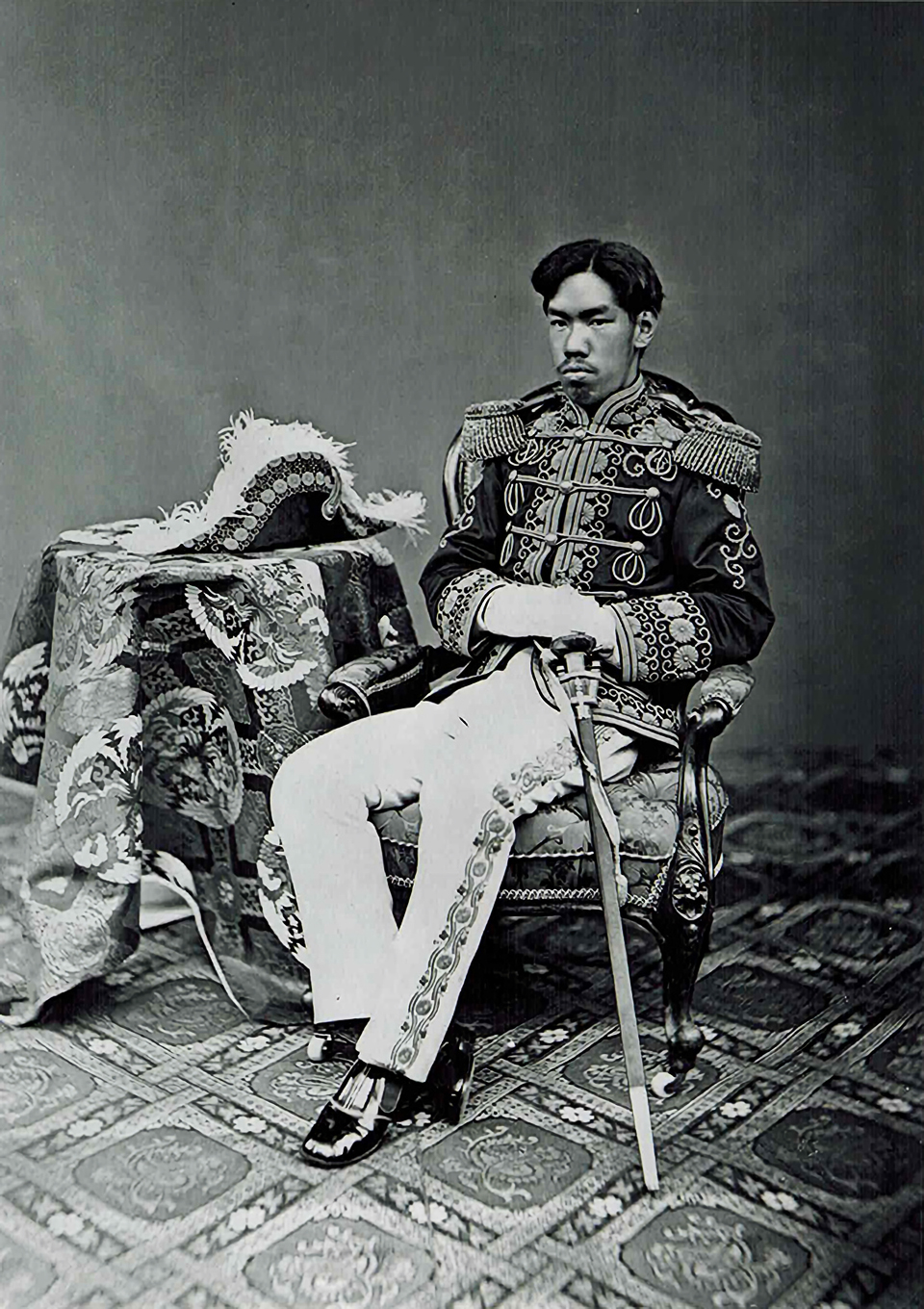
But humiliation, in Japan’s case, proved catalytic rather than fatal. The shock of Perry’s arrival destabilised the Tokugawa government and energised reformers who believed Japan had two choices: become like China, carved up and subordinated by Western powers, or transform itself so completely that it could meet the West on equal terms. In 1868, a coalition of powerful regional lords overthrew the shogunate and restored imperial rule under the young Emperor Meiji. This event, known as the Meiji Restoration, was the catalyst for everything that followed.
What came next was one of the most remarkable modernisation drives in history. The new Meiji government sent delegations across the world to study Western institutions, industries, and armies. It abolished feudalism, built railroads, and established universal education. The government created a modern conscript army modelled on Prussian lines and a navy modelled on the British. Western experts were imported wholesale — German physicians, French legal scholars, British engineers. Japan didn’t just borrow from the West. It reverse-engineered Western civilisation with a focused intensity that still astonishes.
By the 1890s, Japan was more than just modernised. It was also industrialising and militarising.
First Blood: The wars that built an empire
Japan’s imperial ambitions first manifested in 1894, when it went to war with the Qing Dynasty of China over influence in Korea. The First Sino-Japanese War lasted less than nine months. It ended in a stunning Japanese victory. China was forced to cede Taiwan, the Pescadores Islands, and the Liaodong Peninsula. In a single conflict, Japan announced itself as the dominant power in East Asia.
Even more dramatic was the Russo-Japanese War of 1904–05. Russia and Japan both coveted Manchuria and Korea. When diplomacy failed, Japan launched a surprise attack on the Russian fleet at Port Arthur. Over the following year and a half, Japanese forces defeated Russian armies in Manchuria. In the decisive Battle of Tsushima, Japan virtually annihilated Russia’s Baltic Fleet after it had sailed halfway around the world to its destruction. It was the first time in the modern era that an Asian nation had defeated a major European power. The reverberations were felt from Cairo to Calcutta. Theodore Roosevelt brokered the peace and later awarded Japan the Liaodong Peninsula and effective control over Korea. Japan formally annexed Korea in 1910.
The victory had an intoxicating effect on the Japanese military and public alike; it seemed to confirm Japan’s path. Rapid modernisation, aggressive expansion, a willingness to strike first—these were not merely viable. To many, they now felt divinely ordained. The emperor’s divine status, never just a political fiction in Japan, took on a martial glow.
World War I brought further gains with minimal cost. Japan entered the Allied side, seized German colonial possessions in the Pacific and China, and emerged from the war a recognised great power with a permanent seat on the League of Nations council. At home, the 1920s brought a brief democratic flowering — sometimes called “Taisho democracy” — with competitive elections, a free press, and a cosmopolitan urban culture. Jazz clubs opened in Tokyo. Marxist intellectuals debated in Kyoto coffeehouses. It seemed, briefly, possible that Japan might become a liberal nation.
The military takes the wheel
The Great Depression killed that possibility. Japan’s economy depended heavily on textile exports to the United States. When American markets collapsed and trade barriers rose, Japan suffered. Unemployment surged. Rural poverty became severe. Political parties, widely seen as corrupt and ineffective, lost credibility. Into the vacuum stepped the military. This did not happen through a formal coup, but through a gradual, violent seizure of the political agenda.
Young ultranationalist officers, many from rural backgrounds, burned with resentment. They saw civilian politicians as corrupt and believed Japan still suffered humiliation at the hands of Western powers. These officers assassinated political moderates, intimidated governments, and took unilateral military action abroad, daring Tokyo to contradict them. In 1931, the Kwantung Army, Japan’s force in Manchuria, staged a false flag explosion on the South Manchurian Railway and used it as a pretext to invade and occupy all of Manchuria. They created a puppet state called Manchukuo. When the League of Nations condemned the action, Japan simply walked out. The civilian government in Tokyo, intimidated and complicit, went along.
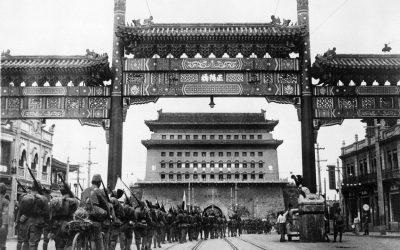
The logic of expansion, once started, proved almost impossible to stop. In 1937, a skirmish near the Marco Polo Bridge outside Beijing triggered full-scale war with China. The conflict quickly became brutal beyond measure. The fall of Nanjing in December 1937 was followed by six weeks of mass murder, rape, and looting by Japanese troops. They killed an estimated 200,000 Chinese civilians and prisoners of war. The “Rape of Nanjing” became the defining symbol of Japanese imperial violence. This trauma still shapes Chinese-Japanese relations nearly ninety years later.
Japan’s ideology had, by this point, calcified into something extraordinary and toxic. At its centre was the concept of kokutai — the “national polity.” This held that Japan was a uniquely sacred nation. The emperor was seen as a living god, and the Japanese people were racially and spiritually superior to their Asian neighbours. These neighbours were to be “liberated” from Western colonialism and guided by Tokyo in a new order called the Greater East Asia Co-Prosperity Sphere. In practice, the Co-Prosperity Sphere meant the subordination of every occupied territory to Japanese economic and military needs. Savage occupation regimes often enforced this.
The Pacific War
Japan’s entry into the broader world war came on 7 December 1941, with the attack on Pearl Harbour — a raid so audacious and successful that it temporarily stunned American public opinion and destroyed much of the US Pacific Fleet in a single Sunday morning. Within weeks, Japanese forces were sweeping through Southeast Asia with startling speed: Malaya, the Philippines, the Dutch East Indies, Burma, Singapore. The fall of Singapore in February 1942, in which 85,000 British and Commonwealth troops surrendered to a smaller Japanese force, was one of the greatest military defeats in British history. Churchill called it “the worst disaster and largest capitulation in British history.”
At its greatest extent, the Japanese Empire covered roughly eight million square miles and encompassed hundreds of millions of people. The territory stretched from the Aleutian Islands in the north to the jungles of New Guinea in the south. It reached from Burma in the west to the mid-Pacific in the east. Japan achieved in little more than six months what European powers took centuries to build.
But the empire was already overextended. Japan’s strategic planners had gambled that a swift, overwhelming offensive would convince the United States to negotiate a settlement, rather than wage a costly war to recover distant Pacific islands. They profoundly misread American political psychology. Instead of suing for peace, the United States mobilised its enormous industrial economy for total war.
The turning point came at Midway in June 1942. American naval intelligence, having broken Japanese codes, set a trap that resulted in the destruction of four Japanese fleet carriers — the core of the force that had attacked Pearl Harbour. Japan never replaced those ships or the experienced aircrew. From that point, the initiative passed inexorably to the Allies.
The island-hopping campaign that followed was a war of extraordinary savagery on both sides. Japanese soldiers, indoctrinated to believe that surrender was a disgrace worse than death, fought to the last man on island after island — Guadalcanal, Tarawa, Saipan, Iwo Jima, Okinawa. American casualty rates, while severe, were dwarfed by Japanese losses. On Saipan, thousands of Japanese civilians killed themselves and their children rather than surrender, many at the urging of officers who told them American soldiers were monsters. On Okinawa — the bloodiest battle of the Pacific War — roughly 110,000 Japanese troops and somewhere between 40,000 and 150,000 Okinawan civilians died, alongside 12,000 Americans.
Meanwhile, American bombing campaigns reduced Japanese cities to ash. Conventional incendiary raids on Tokyo in March 1945 killed an estimated 80,000 to 100,000 people in a single night — more, arguably, than either atomic bomb. Japan’s cities were largely wooden; they burned with terrible efficiency.
The final act
By the summer of 1945, Japan’s situation was militarily hopeless. Its navy was destroyed, its air force gutted, its cities in ruins, its supply lines cut. Yet the imperial government could not agree on surrender. The military leadership, in particular, refused to accept any terms that would end the emperor’s sovereignty or bring about the occupation of the home islands. They prepared for a final battle, Ketsu-Go, stockpiling thousands of kamikaze aircraft and training civilians with bamboo spears to resist an American invasion they knew was coming.
On 6 August 1945, a single American B-29 called the Enola Gay dropped an atomic bomb on Hiroshima. Approximately 70,000 people died instantly; tens of thousands more would die in the following months from radiation sickness. Three days later, a second bomb destroyed Nagasaki. The Soviet Union, honouring a commitment made to the Allies at Yalta, declared war on Japan and swept through Manchuria in days.
On 15 August 1945, the Japanese people heard the voice of their emperor for the first time. Speaking in a formal court dialect many of his subjects barely understood, Hirohito announced that Japan had accepted the Allied terms for surrender. He did not use the word “surrender.” He spoke instead of the war having “developed not necessarily to Japan’s advantage.” The understatement of the century.
The formal surrender was signed on the deck of the USS Missouri in Tokyo Bay on 2 September 1945. General Douglas MacArthur presided. The war in Asia was over. Six years and an estimated twenty to thirty million lives, the vast majority of them Asian civilians killed under Japanese occupation, had been lost.
What was left behind
The American occupation that followed was transformative and deeply strange. MacArthur, wielding near-absolute authority, dismantled the military establishment, broke up the industrial conglomerates (zaibatsu) that had powered the war machine, redistributed agricultural land, and imposed a new constitution, drafted largely by American lawyers in a week, that renounced war as a sovereign right, guaranteed civil liberties, and stripped the emperor of all but ceremonial power.
Emperor Hirohito, whose precise role in wartime decision-making remains historically contested, was retained on his throne as a stabilising symbol. This had enormous consequences: it provided continuity and legitimacy for the occupation, but it also meant that Japan never fully reckoned with imperial responsibility, as Germany was forced to reckon with Nazism. War crimes trials at Tokyo resulted in the execution of several wartime leaders, but the emperor sat above accountability, and many of the institutions and families that had benefited from the empire retained their positions in postwar society.
Japan’s Asian neighbours — China, Korea, the Philippines, Indonesia, Vietnam — carry wounds that have never fully healed. The question of how honestly Japan has acknowledged its wartime conduct is still politically charged, still capable of derailing diplomatic relations, still debated in classrooms and parliaments across the region.
The Japanese Empire lasted, in its full form, barely half a century. From the Meiji Restoration to the surrender aboard the Missouri is less than eighty years — a single long human life. In that span, Japan went from feudal isolation to a global empire to a nuclear target to an occupied nation. The speed of it all, the furious compressed energy of it, remains almost incomprehensible.
What drove it was not simply militarism or racism, though both played their parts. It was also something more recognisable: the anxiety of a proud people who looked at the world’s ordering power and concluded, perhaps correctly, that the only options were domination or subjugation. They chose domination and discovered, at catastrophic cost to themselves and to the tens of millions they killed and oppressed, that this was no choice at all.
The sun, it turned out, did set.


Leave a Reply