
How tenuous is peace?
The honest answer is: considerably more tenuous than most people in the comfortable West assumed for most of the past several decades.
The post-Cold War era generated an optimistic consensus. The democratic peace theory holds that democracies don’t fight each other.
Globalisation was said to make war too economically costly to contemplate. Nuclear deterrence prevented great power conflict. The liberal international order, buttressed by the US-led alliance system and the United Nations framework, seemed stable enough to take for granted. History, it was fashionable to suggest, had ended.
It had not. And the years since have demonstrated with brutal clarity that the architecture of international peace, painstakingly constructed after the carnage of two world wars, is neither self-maintaining nor impervious to the ambitions of those who see it as an obstacle rather than a foundation.
The accumulation of crises
The fractures began accumulating long before they became impossible to ignore. Russia’s annexation of Crimea in 2014 was the first forcible redrawing of a European border since 1945 — treated, in retrospect, with a leniency that encouraged further aggression. The full-scale invasion of Ukraine in 2022 was a war of conquest of a kind that the post-war order was explicitly designed to prevent. It continues. It has killed hundreds of thousands of people, displaced millions more, and reintroduced the spectre of nuclear blackmail into mainstream geopolitical discourse.
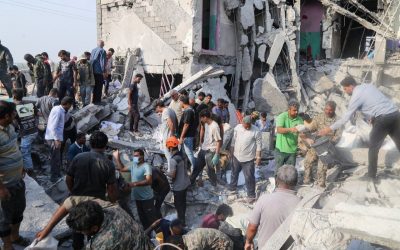
In the Middle East, the Israeli-Palestinian conflict, never resolved by decades of diplomacy and the systematic attacks on Gaza by Israel, erupted with catastrophic violence following the Hamas attacks of October 2023. The conflict in Gaza drew in regional actors, threatened to ignite a broader regional conflagration, and exposed deep and perhaps irreconcilable divisions in the international community over the application of humanitarian law. What followed from Gaza would, within two years, reshape the entire Middle Eastern order in ways few had anticipated.
In Asia, the question of Taiwan remains the most dangerous potential flashpoint in the world. China has been explicit about its intention to achieve “reunification” and has never renounced the use of force. The United States has longstanding commitments to Taiwan’s defence. A conflict there would draw in two nuclear powers with the world’s largest economies — with consequences too grave to contemplate, and yet too plausible to dismiss.
Sub-Saharan Africa has seen a wave of coups, military takeovers, and the collapse of state authority, particularly across the Sahel. Myanmar remains under the grip of a brutal military junta that seized power in 2021 and has waged war against its own population ever since. Yemen has endured one of the worst humanitarian disasters of the modern era. Sudan descended into catastrophic civil war in 2023, with atrocities reported on a scale that has drawn comparisons to the Darfur genocide of the previous decade.
These crises share a common thread: the erosion of the expectation that force cannot simply be used to achieve political ends. But what has most dramatically accelerated that erosion in the opening months of 2026 has been the conduct of the United States itself — historically the anchor of the rules-based international order it now appears determined to dismantle.
Venezuela: A kidnapping by another name
On 3 January 2026, the United States bombed Venezuela and seized its sitting president.
In a military operation involving over 150 aircraft launched from twenty airbases, US Delta Force troops descended on Nicolás Maduro’s compound in Caracas in the early hours of the morning. Maduro and his wife, Cilia Flores, were taken from their beds and airlifted to a US aircraft carrier in the Caribbean before being flown to New York, where both were arraigned in a Manhattan federal court on narcotics and weapons charges. The operation killed at least 80 people, including 32 members of the Cuban military and intelligence personnel. Venezuelan Vice President Delcy Rodríguez, sworn in as acting president in the aftermath, called it what it plainly appeared to be: a kidnapping.
The Trump administration characterised the raid as a law enforcement action, arguing that the criminal indictment of Maduro and his wife provided constitutional authority for the operation. Legal experts were unconvinced. As former State Department attorney Brian Finucane observed, the suggestion that an operation involving more than 150 military aircraft constitutes a law enforcement matter is, at best, a strained argument. Under international law, any enforcement operation on another state’s territory requires that state’s consent. No such consent was sought or given. The operation violated Venezuela’s territorial integrity, constituting a clear breach of Article 2(4) of the UN Charter.
Maduro, whatever one thinks of his record, held head-of-state immunity under international law, immunity that the United States elected to ignore.
The Security Council convened in emergency session. Condemnation from Russia, China, and much of the Global South was swift. But the United States, as a permanent member, faced no binding resolution. The UN Secretary-General urged restraint and warned of a grave threat to international peace. The structural paralysis of the Security Council — the same paralysis that had shielded Russia after Ukraine — now shielded the United States.
The Brookings Institution noted the uncomfortable precedent with precision: Democratic Senator Mark Warner asked aloud whether this meant any large country could indict the ruler of a smaller adjacent nation and simply remove them. The question was not rhetorical. Chatham House analysts observed that Russia would now use US actions as justification for its own violations, and that China might invoke Venezuela in its rhetoric regarding Taiwan. Having spent decades arguing that international law applied universally, the United States had provided its adversaries with precisely the argument they had long sought.
Trump, at a press conference at Mar-a-Lago, described the operation as one of the “most stunning, effective and powerful displays of American military might and competence in American history.” He announced that the United States would “run” Venezuela until a transition could be arranged. He declared his intention to take control of its vast oil reserves, the largest proven reserves in the world.
The closest historical parallel is the US invasion of Panama in 1989, when American forces seized General Manuel Noriega and put him on trial in US courts. But Panama’s population is a fraction of Venezuela’s, the geopolitical context was entirely different, and even then, the operation attracted widespread international condemnation. Venezuela represents a qualitative escalation: a brazen assertion that American domestic law can reach across sovereign borders, backed by overwhelming military force, with consequences for any nation that Washington decides requires correction.
Greenland: A NATO ally under threat
If Venezuela demonstrated what the Trump administration was willing to do to an adversary, its conduct toward Greenland demonstrated what it was willing to threaten against a friend.
Since returning to power in 2025, Donald Trump had repeatedly expressed his determination to bring Greenland — an autonomous territory within the Kingdom of Denmark, a founding NATO member — under American control. His first-term interest, initially dismissed as a curiosity, had hardened into something that the Danish and Greenlandic governments could only describe as an existential threat to their sovereignty.
The crisis escalated sharply in the days following the Venezuela operation. Emboldened by Maduro’s capture, Trump doubled down on his annexation demands, refusing to rule out military force and threatening a 25% tariff on European Union goods unless Denmark ceded the island. He told reporters that Greenland was “imperative for national and world security” and that there was “no going back.” His senior aide, Stephen Miller, publicly stated that it was Washington’s “formal position” that Greenland should become part of the United States. He dismissed the prospect of military resistance with the observation that “nobody is going to fight the US militarily.”
Greenland’s Prime Minister Jens-Frederik Nielsen was unequivocal: “No more pressure. No more hints. No more fantasies about annexation.”
Denmark’s Prime Minister Mette Frederiksen stated plainly that a US attack on Greenland would mean the end of NATO — and that a country cannot simply annex another, regardless of the security argument offered. Six European nations issued a joint statement defending Greenland’s sovereignty. Greenlandic politicians requested a NATO mission to protect their island from its own alliance partner.
The implications were profound and dizzying. NATO’s entire architecture rests on Article 5 — the mutual defence guarantee that an attack on one member is an attack on all. For the most powerful member of that alliance to threaten military force against a fellow member is not merely a violation of the alliance’s letter; it is an assault on its entire raison d’être. The Danish prime minister’s warning that such an attack would end NATO was not hyperbole. It is difficult to imagine an alliance surviving the spectacle of its dominant member seizing territory from a partner state.
Trump ultimately backed off the immediate military threat, announcing at Davos on 21 January 2026 that he would not use force or impose tariffs at that time. But the threats were not retracted. The appointment of a Special Envoy to Greenland, the public statements from senior officials, and the explicit linkage drawn between Venezuela and Greenland made clear that the matter was far from resolved. The Greenlanders, for their part, were left in the surreal position of seeking protection from a NATO that their principal aggressor happened to lead.
Iran: A region on fire
The most dramatic rupture came on 28 February 2026.
The United States and Israel launched coordinated joint strikes against Iran — codenamed Operation Roaring Lion by Israel and Operation Epic Fury by the US Department of Defence. The assault targeted Iran’s nuclear and ballistic missile programmes, its military command structure, its leadership compound, and multiple sites across twenty-four of Iran’s thirty-one provinces. The stated aim was regime change.
The strike came at the end of a period of intensive, if ultimately fruitless, diplomacy. Negotiations over Iran’s nuclear programme had been proceeding in Oman and Geneva. As recently as 25 February, Iran’s Foreign Minister had described a “historic opportunity” for a deal as “within reach.” Oman’s mediating foreign minister had said he was “confident” that peace was achievable and that Iran had agreed never to stockpile enriched uranium sufficient for a bomb — a concession he described as “completely new.” On 27 February, the IAEA confirmed, however, that Iran had concealed highly enriched uranium in an underground facility and could not certify that the programme was exclusively peaceful. Trump had issued a ten-day ultimatum that expired on the date of the strikes.
The opening salvos hit Tehran, Isfahan, Qom, Karaj, and Kermanshah. Among the targets was the compound of Supreme Leader Ayatollah Ali Khamenei, who was killed in the assault — a fact confirmed by Iranian state media in the early hours of 1 March, after initial denials. Iranian President Masoud Pezeshkian described Khamenei’s death as a “declaration of open war on Muslims.” Iran declared forty days of national mourning.
The retaliation was immediate and extensive. Iran launched what it named Operation True Promise IV, striking at Israeli cities and at US military installations across the region. By the early days of March, Iran had targeted bases in Bahrain, Iraq, Jordan, Kuwait, Oman, Qatar, Saudi Arabia, and the United Arab Emirates. An Iranian drone struck the British Akrotiri air base in Cyprus. Preliminary casualty figures indicated at least 787 dead in Iran from the joint strikes, with eleven killed in Israel, six US service members, and eight in Gulf states — though the situation remained rapidly evolving and the figures were expected to rise significantly.
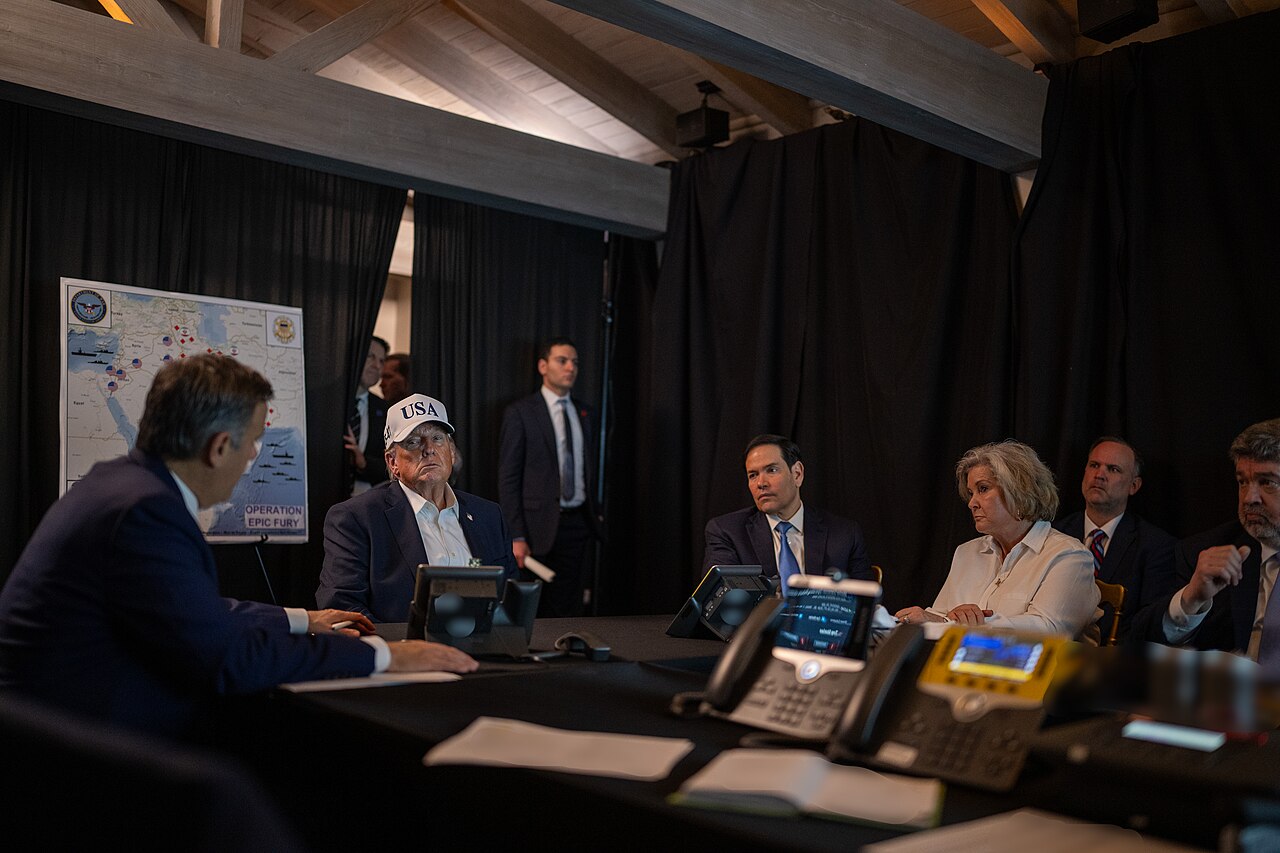
The UN Secretary-General António Guterres convened an emergency Security Council session and cited Article 2 of the UN Charter explicitly, reminding the council that all member states are obligated to refrain from the use of force against the territorial integrity of any state. He called on all parties to pull the region “back from the brink.” Iran’s ambassador described an “unprovoked and premeditated aggression.” The Council was paralysed; the United States exercised its veto, and no binding resolution was passed.
The legal and moral questions are complex and deserve honest engagement rather than reflexive condemnation or endorsement. Iran’s nuclear programme represented a genuine threat: the IAEA’s discovery of hidden highly enriched uranium and the inability to certify peaceful intent provided a substantive basis for concern. Iran’s support for regional proxy forces — Hamas, Hezbollah, the Houthis — had destabilised the entire Middle East for decades. The killing of Khamenei eliminated a leader who had presided over the violent suppression of domestic protests that cost, by some estimates, tens of thousands of Iranian lives.
But the manner in which the operation was conducted: the assassination of a head of state, the strikes across multiple sovereign territories, the targeting of civilian-proximate infrastructure, the decision to act while diplomacy was still nominally in progress, raises questions that will reverberate through international law for years. The Council on Foreign Relations noted that the joint decision to attack appeared to have been taken during Netanyahu’s visit to Washington two weeks prior, and that the objective had been explicitly extended from nuclear degradation to regime change. Regime change, the forcible replacement of a foreign government, has no basis in the UN Charter.
The pattern and its consequences
What connects these events — Venezuela, Greenland, Iran — is not simply that force has been used or threatened, but the explicit abandonment of any pretence of legal justification. Previous administrations, even when acting in legally dubious ways, typically constructed an international legal argument, however strained: humanitarian intervention, collective self-defence, Security Council authorisation. The current administration has largely dispensed with that architecture, asserting instead that American power is its own justification.
The consequences for the international order are profound. Every norm that is violated with impunity is weakened. Russia has already incorporated the Venezuela operation into its defence of the Ukraine invasion; China has noted it in discussions of Taiwan; North Korea will draw its own conclusions about the fate of leaders who cannot deter the United States. The message being transmitted to every medium-sized nation on earth is not subtle: sovereign immunity is a courtesy the powerful extend to other powerful nations, and withdraw from the weak when it becomes inconvenient.
This is not to say the international order was pristine before. It was not. The US invasion of Iraq in 2003 — widely condemned as illegal — killed hundreds of thousands and destabilised an entire region. The broader pattern of American intervention in Latin America stretches back well over a century. The application of international law has always been imperfect and inconsistent.
What has changed is the degree of explicitness. In 2003, the United States at least attempted to secure Security Council authorisation (and failed). It constructed, however unconvincingly, a legal argument. Today, that effort is not made. The Trump administration has asserted that the president has “inherent constitutional authority” to use military force without congressional authorisation and that this authority is “not constrained by international law.” This is not a legal position; it is the repudiation of legal constraint as a category.
The fragility of order
Peace is not simply the absence of shooting. It is the presence of a functioning order, a shared set of expectations, institutions, and norms that make conflict costly and cooperation rewarding. That order has never been perfect, but it has been real. It has prevented a third world war for eight decades. It has made conquest for territorial gain less common than at any point in recorded history. It has given weaker states recourse against stronger ones, at least in theory, and sometimes in practice.
That order is now under more severe strain than at any point since the Cold War — arguably more, because the challenge now comes from within as well as without. When Russia invades Ukraine, it challenges the order from outside. When the United States bombs Venezuela and threatens Greenland, it challenges the order from within the institution designed to uphold it. When a permanent member of the Security Council explicitly claims to be unconstrained by international law, it not only violates the rules: it attacks the legitimacy of the rules themselves.
The Greenlandic prime minister, responding to Trump’s threats, asked for respect, for recognition that his people are not objects to be acquired, that their future is theirs to determine. It is a modest request. It is the minimum that the international order was designed to guarantee. The fact that it needs to be made at all, and that the response has been a discussion of tariffs and military options, captures the distance the world has travelled from the ambitions of 1945.
Whether the order can be repaired, or whether we are watching its terminal unravelling, is the defining question of this era. The institutions survive: the UN meets, the ICC issues warrants, the treaties remain on the books. But institutions are only as strong as the political will behind them, and that will is being tested as it has rarely been before.
The architects of the post-war settlement understood something that their successors seem to have forgotten: that the alternative to imperfect international law is not a better system. It is no system at all. It is the world that produced 1914 and 1939 — a world governed entirely by the calculations of the powerful, in which the weak have no recourse and the strong have no restraint.
That world is not as distant as it seemed.


.jpg)
Leave a Reply