
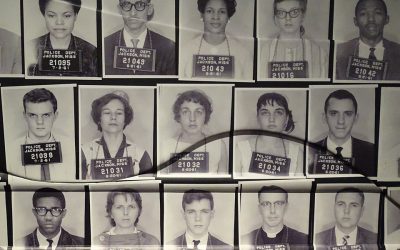
The Freedom Riders were a group of brave civil rights activists who embarked on a series of bus trips through the American South to challenge the entrenched system of racial segregation in interstate transportation. Their peaceful actions ignited a national conversation about civil rights and the federal government’s role in enforcing the law of the land.
The background of the Freedom Riders
The Freedom Riders were inspired by earlier efforts to desegregate transportation, most notably the Journey of Reconciliation in 1947, organised by the Congress of Racial Equality (CORE). However, the Freedom Riders’ campaign sprang from a particular moment in history: the Supreme Court had just ruled in Boynton v. Virginia (1960) that segregated seating on buses crossing state lines was unconstitutional. Even after this legal win, many Southern states kept enforcing segregation, ignoring federal law.
The Freedom Riders, a group of Black and white activists, decided to test the federal government’s commitment to civil rights in 1961. By riding together in mixed-racial groups on buses travelling from Washington, D.C., to the Deep South, they wanted to expose the federal government’s failure to enforce the Supreme Court’s rulings against segregation.
The first Freedom Ride and its impact
On 4 May 1961, the first group of 13 Freedom Riders—seven African Americans and six whites—set out from Washington, D.C., on a Greyhound bus bound for New Orleans. The group included seven Black Americans and six white individuals. They had a simple but dangerous plan: to use “white-” restrooms and lunch counters during their trip. As they travelled further into the South, they faced violent opposition.
In Anniston, Alabama, one of the buses was firebombed, and a mob beat riders. In Birmingham and Montgomery, Alabama, the riders were brutally attacked by angry crowds while local law enforcement turned a blind eye—or worse, collaborated with the attackers.
The violence against the Freedom Riders drew national attention and forced the Kennedy administration to take action. Attorney General Robert F. Kennedy was initially reluctant to intervene, but he later sent federal marshals to protect the riders and urged the Interstate Commerce Commission (ICC) to enforce stricter rules regarding desegregation.
The bravery and determination of the Riders
Despite the brutal violence and death threats, the Freedom Riders stood firm in their mission. The courage of the first group inspired more volunteers to join the movement. During the summer of 1961, over 400 Freedom Riders took part in the campaign. They faced arrests, beatings, and jail time. Their dedication exposed the deep racial hatred in the South and showed the urgent need for the federal government to step in on civil rights.
The legacy of the Freedom Riders
The Freedom Riders played a key role in urging the federal government to take a more active stance in protecting civil rights. Their efforts led the ICC to issue new rules in September 1961 that banned segregation in interstate transit terminals. Their bravery and sacrifice were vital to energising the wider civil rights movement and laid the groundwork for future laws, including the Civil Rights Act of 1964.
Their actions challenged the status quo and demonstrated the power of nonviolent protest and civil disobedience in bringing about social change. The Freedom Riders left a legacy of dedication to justice and equality. They serve as a reminder that ordinary people can bring about significant changes.
The Freedom Riders weren’t just people on a bus; they sparked a big change in American society. They stood up to unfairness even when it was risky, paving the way for future civil rights activists and leaving a lasting impact on U.S. history.


Leave a Reply