• Skip to main content
  • Skip to after header navigation
  • Skip to site footer
Our history archive

Our History

Our History Archive, where history comes to life

  • Home
  • Colonisation
  • World History
  • Civil Rights
  • World cultures
  • Features
  • Wellbeing
  • Popular Culture

The Jim Crow laws

Jim crow segregation
John Vachon, Public domain, via Wikimedia Commons
World history
23 September, 2007

The Jim Crow laws were an umbrella term for state and local laws which legalised racial segregation. African Americans were to be marginalised by these laws – which existed for about 100 years, from the post-Civil War era until 1968 – by denying them the right to vote, hold jobs, get an education and other opportunities. Jim Crow laws often led to arrests, fines, jail sentences, violence, and even death for those who defied them.

In 1865, after the 13th Amendment abolished slavery in the United States, Jim Crow laws started to emerge.

There were strict local and state laws that outlined when, where, and how formerly enslaved people could work and for how much. In the South, Black Codes served as a legal means of putting Black citizens into indentured servitude, controlling where they lived, and how they travelled, taking away their voting rights and seizing children for labour.
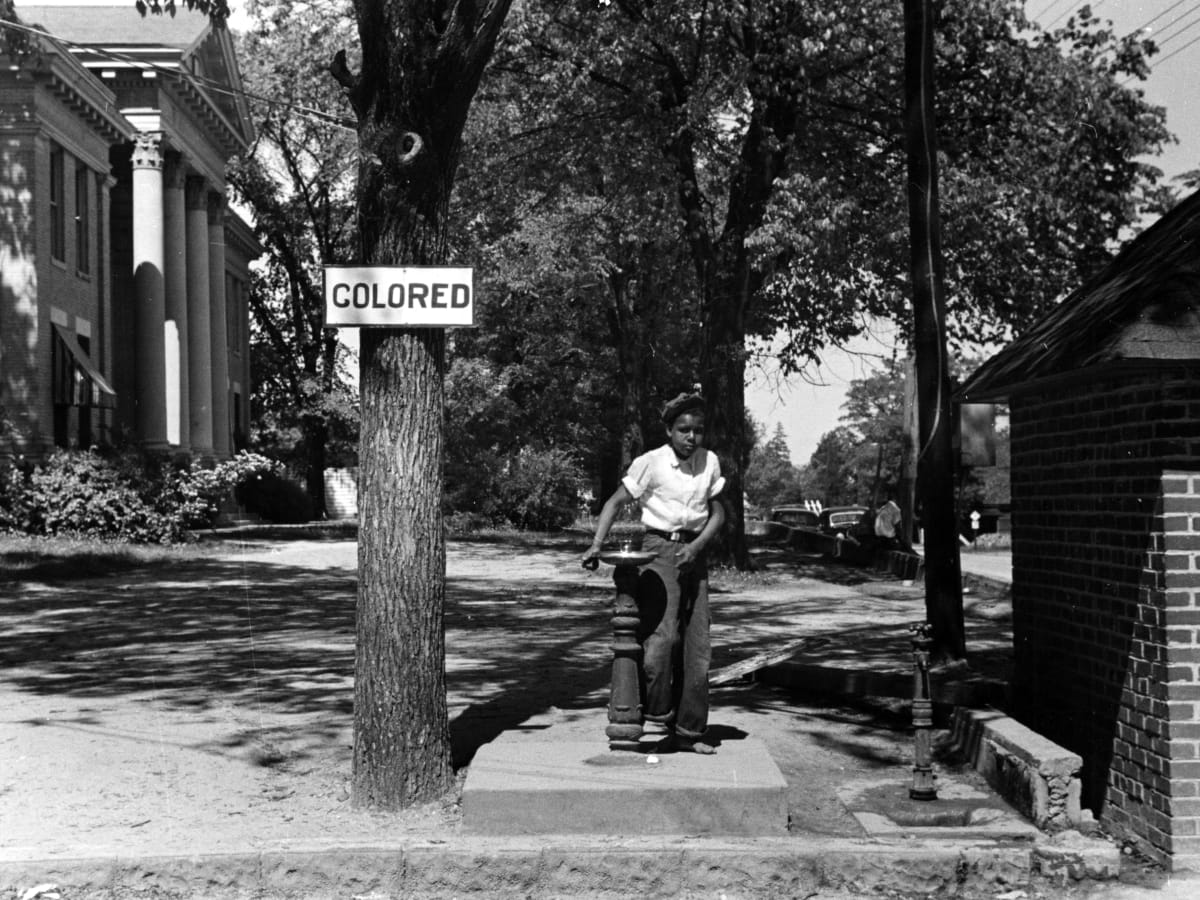


Jim crow segregation
John Vachon, Public domain, via Wikimedia Commons

Schools, parks, libraries, drinking fountains, restrooms, buses, trains, and restaurants were all segregated under the laws. There were frequent “Whites Only” signs and “Colored” signs reminding people of the enforced racial order throughout the city.

Although blacks received “separate but equal” treatment under the law, in reality, public facilities for blacks were almost always inferior to those for whites, if they existed at all. Moreover, blacks were systematically denied voting rights in most of the rural South through racially discriminatory literacy tests.

The Democratic Party and local governments, and President Andrew Johnson hindered the advancement of Black Americans. The Jim Crow system was upheld by local government officials and reinforced by acts of terror perpetrated by the Ku Klux Klan and other vigilantes.

African Americans faced a rising level of violence, making danger a regular part of their lives. White people attacked, tortured, and lynched Black citizens at night, while black schools were vandalised and destroyed. Across the South, families were attacked and forced off their land.

Many black activists protested the Jim Crow laws. NAACP (National Association for the Advancement of Colored People) was founded in 1909 to provide a genuinely effective civil rights organisation against Jim Crow laws.


Ida B. Wells became an activist against the laws after refusing to leave a first-class train car reserved for whites. A conductor forcibly removed her from her seat, and she bit him. She successfully sued the railroad, however, a higher court later reversed that decision.

On 17 May 1954, in Brown v Board of Education of Topeka, it was ruled unanimously that segregation in public schools was unconstitutional, opening the door to integration and the repeal of Jim Crow laws.

Share this:

  • Share on Facebook (Opens in new window) Facebook
  • Share on X (Opens in new window) X
  • Share on Reddit (Opens in new window) Reddit
  • Share on Pinterest (Opens in new window) Pinterest
  • Share on WhatsApp (Opens in new window) WhatsApp

Related

You May Also Like…

The Japanese occupation of Beiping (Beijing) in China

The rise and fall of the Japanese Empire

Rescuers and residents searching the rubble of the destroyed Shajareh Tayyebeh elementary school in Minab

The fracturing of the international order in an age of impunity

US ambassador to the UN, Eleanor Roosevelt, holding the Universal Declaration of Human Rights in 1949

The role and limitations of international law in world affairs

black people day of action new cross fire

Did the UK have a Black civil rights movement?


Reader Interactions

Leave a ReplyCancel reply

Sidebar

This Day In History

Events in History
On this day in 1965 Civil rights activists were brutally beaten by Alabama state troopers. This day is known as Bloody Sunday.

World history recent posts in

The Japanese occupation of Beiping (Beijing) in China

The rise and fall of the Japanese Empire

Rescuers and residents searching the rubble of the destroyed Shajareh Tayyebeh elementary school in Minab

The fracturing of the international order in an age of impunity

US ambassador to the UN, Eleanor Roosevelt, holding the Universal Declaration of Human Rights in 1949

The role and limitations of international law in world affairs

black people day of action new cross fire

Did the UK have a Black civil rights movement?

Trending

  • The rise and fall of the Persian Empire
    The rise and fall of the Persian Empire
  • Operation Ajax and the shadow of empire: The 1953 Iranian coup
    Operation Ajax and the shadow of empire: The 1953 Iranian coup
  • Ten times America created a moral panic
    Ten times America created a moral panic
  • Understanding Sharia Law: Principles, practice, and global context
    Understanding Sharia Law: Principles, practice, and global context
  • The rise and fall of the Ottoman Empire: Six centuries of imperial power
    The rise and fall of the Ottoman Empire: Six centuries of imperial power
  • The major branches of Islam: History, beliefs, and differences
    The major branches of Islam: History, beliefs, and differences
  • Holy Wars: The blood-soaked legacy of conflicts fought in the name of Christianity
    Holy Wars: The blood-soaked legacy of conflicts fought in the name of Christianity
  • The Great Game: Britain and Russia's strategic rivalry in Central Asia
    The Great Game: Britain and Russia's strategic rivalry in Central Asia
  • Gil Scott-Heron: The voice of revolution in music and poetry
    Gil Scott-Heron: The voice of revolution in music and poetry
  • The First Red Scare: America's post-WWI fear of Communism and radical change
    The First Red Scare: America's post-WWI fear of Communism and radical change

Connect

  • YouTube
  • TikTok
  • Bluesky

ABOUT

CONTACT

PRIVACY POLICY

COOKIES

Copyright © 2026 · Our History · All Rights Reserved