

The Broadway Theatre, Catford has had many names over the decades. It started out as a concert hall extension to Lewisham Town Hall called uninspiringly “Town Hall Extension”. In 1926, Lewisham Metropolitan Council decided to develop the site of an old fire station next to Catford’s Town Hall to build an auditorium for a variety of Civic, Social and Dramatic purposes.
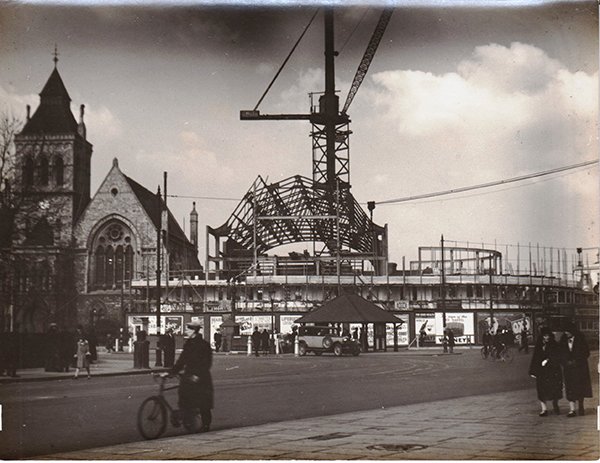
Work began in the spring of 1930. The extension was built to reflect the now demolished Gothic Revival Town Hall next door. The part of the building that curves round to Rushey Green was called Town Hall Chambers and had shops, halls and offices. The Town Hall Extension was opened on 22 June 1932 by the Duke of York, who later became King George VI.
Orchestral concerts and weekly dances were held during the 1930s. As Councils had no legal power to promote events, they were organised by local organisations who hired out the venue.
During the war years, the building was used as a ration book distribution centre, a telephone exchange and, after the auditorium floor was strengthened, as an emergency air-raid shelter.
Lewisham Arts Council was founded around 1946 and hired the theatre but it wasn’t until an act of Parliament in 1948 that Lewisham Metropolitan Council could start promoting entertainment.
Lewisham Concert Hall
Following the demolition of Frank Matcham’s magnificent Lewisham Hippodrome in 1960 the theatre assumed greater importance. The early 1960s saw the first professional pantomime and regular professional variety. When the old Deptford and Lewisham Boroughs amalgamated in 1965 a specialised Entertainment Department was set up and the pantomime season was extended to six weeks. The building was renamed Lewisham Concert Hall, the new name reflecting the fact that it was the only working theatre in the borough apart from the Albany in Deptford.
Lewisham Theatre
Following the introduction of raised stalls seating in 1984, the name was changed to Lewisham Theatre – a title more in keeping with the events staged and the venue image. The 80s saw sell-out audiences watching The Drifters, Gladys Knight and The Pips, The Four Tops, Frankie Valli and the Four Seasons.
The late 1980s saw remarkable developments in the theatre’s programme, marketing, technical facilities and use of computers in all areas. In 1987, the old small hall area was developed into a 120 capacity cabaret and performance area complete with raked seating, sound and lighting systems. This space has proved to be popular with a wide range of theatre groups.
A successful initiative in 1991 introduced Black Theatre to Lewisham which brought long sell-out runs and an extensive new audience to the venue.
Comedy also developed enormously through the 1990s with Eddie Izzard, Paul Merton and Alan Davies being just three of a wealth of talent that have appeared at the Lewisham Theatre.
Broadway Theatre
In 2001 there was a major refurbishment costing around £2.3 million, restoring many of the art deco features. It was then renamed the Broadway Theatre.
The building was given Grade II listed status in 1993. These are the technical specifications:
Architecturally it is a landmark curved stone building with a hipped tiled roof with 2 stage domed octagonal cupola surmounted by a weathervane. The Concert Hall has gothic style oak panelling, curved roof with coffered panels and walls featuring giant round-headed arches. The proscenium arch is flanked by panels surmounted by shields, flanked by heraldic beasts and metal scrollwork grilles as well as original Compton organ.
Although still splendid the theatre needs a lot of work. It’s estimated that basic repairs will cost about £530,000 over the next two years. Cleary it needs to generate more revenue hence initiatives such as the Shakespeare Festival called Catford Upon Avon Festival in March and the LGBT History month photography exhibition in February.


Leave a Reply