• Skip to main content
  • Skip to after header navigation
  • Skip to site footer
Our history archive

Our History

Documenting world history and civil rights

General

  • About
  • Cookies and your privacy
  • Privacy policy
  • Contact

Categories

  • Home
  • Colonisation
  • World History
  • Civil Rights
  • World cultures
  • Features
  • Wellbeing
  • Popular Culture
  • Home
  • Colonisation
  • World History
  • Civil Rights
  • World cultures
  • Features
  • Wellbeing
  • Popular Culture

Americans split over anti-transgender laws

Trans rights
Popular culture
17 April, 2021

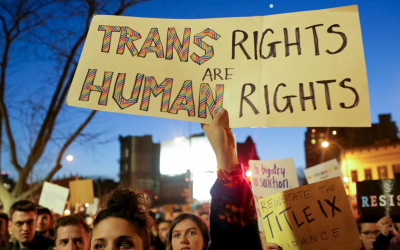
The United States is currently in a heated debate over transgender rights, specifically about which public restrooms transgender people should be allowed to use.

On one side of the debate are those who argue that transgender individuals should be allowed to use the restroom that corresponds with their gender identity, while on the other side are those who argue that transgender people should be required to use the restroom that matches the gender they were assigned at birth.

This debate has become particularly heated in recent months following North Carolina’s House Bill 2, which requires transgender people to use the restroom that matches the gender they were assigned at birth.


A recent poll shows that two-thirds of Americans are against laws that would limit transgender rights.

Supporters of transgender rights argue that it is important for transgender people to be able to use the restroom that corresponds with their gender identity in order to feel safe and comfortable. They argue that requiring transgender people to use the restroom that matches the gender they were assigned at birth denies them their dignity and exposes them to potential danger. For example, a transgender woman who is required to use the men’s restroom could be targeted for violence or harassment.

Opponents of transgender rights argue that allowing transgender people to use the restroom that corresponds with their gender identity could put other people at risk. They claim that it is not safe for someone who is not biologically female to use a women’s restroom. Male predators could take advantage of such a policy by dressing as women to gain access to women’s restrooms.

Supporters of transgender rights argue that there is no evidence that such a policy would put anyone at risk, and that restricting transgender people’s access to the restroom that corresponds with their gender identity only serves to isolate further and stigmatise them.

The National Center for Transgender Equality found that nearly half of transgender individuals have been harassed or attacked in a public bathroom. Transgender individuals are already at a high risk of violence, and these laws only make that worse.


Supporters say these laws are discriminatory. They target transgender individuals specifically and deny them the right to use the restroom that corresponds with their gender identity.

They say there is no evidence that transgender individuals pose a threat to other people in bathrooms. They just want to be able to use the restroom safely and without harassment. We should not be denying them that right.

Share this:

  • Share on Facebook (Opens in new window) Facebook
  • Share on X (Opens in new window) X
  • Share on Reddit (Opens in new window) Reddit
  • Share on Pinterest (Opens in new window) Pinterest
  • Share on WhatsApp (Opens in new window) WhatsApp

Related

You May Also Like…

Dr Carter G. Woodson, George Cleveland Hall and Alexander L. Jackson

A century of Black history commemorations: How Black History Month began and why it matters today

man in yellow sweater holding book beside woman in brown sweater

Top 10 most influential books in history

happy women s day box

International Women’s Day 2025: Accelerate action for equality

Black History Month UK 2024 Reclaiming Narratives

Celebrating 31 Days of Black History


Reader Interactions

Leave a ReplyCancel reply

Sidebar

This Day In History

Events in History
On this day in 1990 Nelson Mandela, who was the leader of the movement to end South African apartheid was released from prison after 27 years.

Recent posts

Dr Carter G. Woodson, George Cleveland Hall and Alexander L. Jackson

A century of Black history commemorations: How Black History Month began and why it matters today

man in yellow sweater holding book beside woman in brown sweater

Top 10 most influential books in history

happy women s day box

International Women’s Day 2025: Accelerate action for equality

Recent posts

Black History Month UK 2024 Reclaiming Narratives

Celebrating 31 Days of Black History

Black History Month UK 2024 Reclaiming Narratives

Reclaiming Narratives: The theme of Black History Month 2024

International Day for the Remembrance of the Slave Trade and Its Abolition: A day to reflect and educate

Trending

  • Understanding Sharia Law: Principles, practice, and global context
    Understanding Sharia Law: Principles, practice, and global context
  • Genghis Khan: The making of the Mongol Empire
    Genghis Khan: The making of the Mongol Empire
  • McCarthyism and the Cold War: America's Second Red Scare
    McCarthyism and the Cold War: America's Second Red Scare
  • Pancake Day: A tradition of faith and feasting
    Pancake Day: A tradition of faith and feasting
  • This John Hanson was not the first Black President of the United States
    This John Hanson was not the first Black President of the United States
  • What are British values?
    What are British values?
  • Women's suffrage movement in Britain
    Women's suffrage movement in Britain
  • Five countries that colonised the world
    Five countries that colonised the world
  • The rise and fall of the Ottoman Empire: Six centuries of imperial power
    The rise and fall of the Ottoman Empire: Six centuries of imperial power
  • The history of South Africa: From colonisation to independence
    The history of South Africa: From colonisation to independence

Connect

  • YouTube
  • TikTok
  • Bluesky
  • About
  • Cookies and your privacy
  • Privacy policy
  • Contact

Copyright © 2026 · Our History · All Rights Reserved