

From a sacred grove in ancient Greece to a global spectacle watched by billions — the improbable, glorious, contradictory story of the Olympic Games.
Every four years, a flame is lit at the ancient site of Olympia in southern Greece, carried by relay across the world, and used to ignite a cauldron in a stadium filled with athletes from nearly every nation on earth. It is a ritual at once deeply strange and utterly familiar; a bridge between a world that vanished more than fifteen centuries ago and the hyperconnected global village of today. That this bridge exists at all is one of history’s more remarkable accidents.
The Olympics did not simply survive through the ages. They died, were resurrected, were nearly killed again, survived wars and boycotts and scandals, and emerged — battered but recognisable — as the world’s most-watched sporting event. To understand why we have them, you have to understand where they came from.
Born in a sacred grove
776 BC — The ancient games
The first recorded Olympic Games took place in 776 BC, though the games almost certainly predate that year. They were held at Olympia, a religious sanctuary in the western Peloponnese, in honour of Zeus, the king of the Greek gods. The site was not a city; it was a precinct, dominated by a great temple housing a chryselephantine statue of Zeus, counted among the Seven Wonders of the Ancient World.
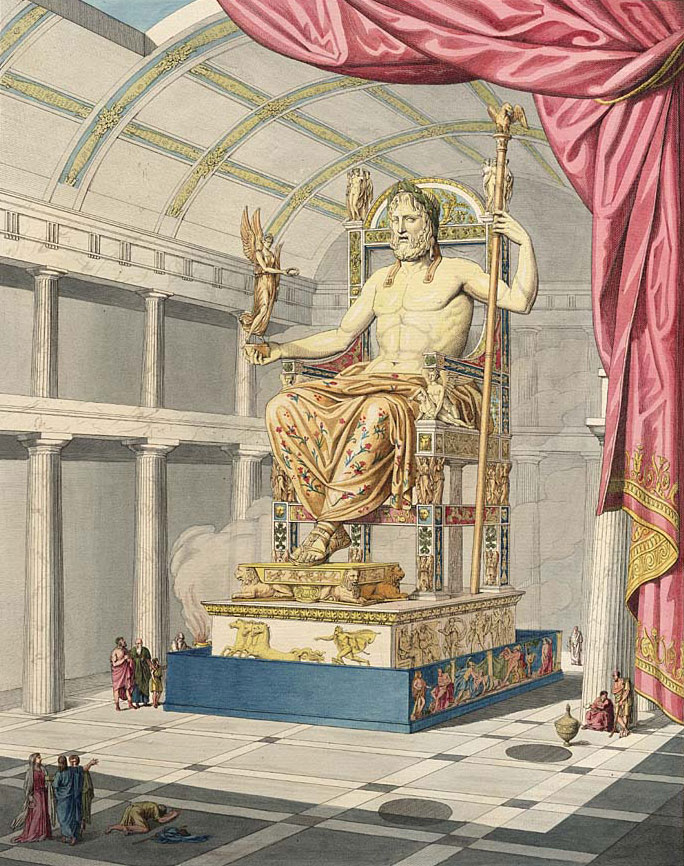
The early games were simple. The sole event for the first thirteen Olympiads was the stadion — a sprint of roughly 192 metres, the length of the stadium. From this single race, the games grew over centuries to include wrestling, the pentathlon, boxing, chariot racing, and the brutal pankration, a form of near-total-contact combat with almost no rules. Competitors were exclusively male, freeborn Greeks. Women were barred from even watching certain events, on pain of death.
The games created a rare moment of pan-Hellenic unity in a world defined by fractious city-states perpetually at war with one another.
The games continued for over a thousand years. They outlasted the classical city-states, survived Alexander’s conquests, and persisted through Roman rule, when they were opened to athletes from across the empire. It was, however, the Romans who eventually degraded what they had absorbed. The Emperor Nero famously competed at Olympia in AD 67, entered the chariot race with ten horses, fell off, failed to finish, and was declared the winner anyway.
The games limped on, increasingly hollow, until AD 393, when the Christian Emperor Theodosius I banned all pagan festivals. Olympia fell into ruin, its temples eventually toppled by earthquakes and floods, and the games were forgotten for fifteen centuries.
KEY DATES IN OLYMPIC HISTORY
| Year | Event |
| 776 BC | First recorded Olympic Games at Olympia. The sole event is the stadion sprint of 192 metres. |
| AD 393 | Emperor Theodosius I bans pagan festivals. The ancient games end after over 1,000 years. |
| 1896 | Pierre de Coubertin revives the games in Athens. 14 nations, 241 athletes, 43 events compete. |
| 1916/1940/1944 | Games cancelled due to the First and Second World Wars. |
| 1936 | Berlin Games. Jesse Owens wins four gold medals, confounding Nazi racial ideology. |
| 1972 | Munich massacre: eleven Israeli athletes and coaches killed by Palestinian militants. |
| 1980/1984 | Cold War boycotts split the games. The US boycotts Moscow; the Soviet bloc boycotts Los Angeles. |
| 1992 | Barcelona Games usher in the professional era. The USA sends its first NBA “Dream Team”. |
| 2024 | Paris hosts for the third time. Opening ceremony held on the River Seine. |
One man’s vision
1896 — The modern revival
The resurrection of the Olympics is almost entirely the story of one man: Pierre de Coubertin, a French aristocrat and educational reformer. Coubertin was obsessed with the idea that sport could build character and promote international understanding — an antidote, he believed, to the nationalist tensions tearing Europe apart in the late nineteenth century.
In 1892, he proposed reviving the Olympic Games at a meeting of the Union des Sports Athlétiques in Paris. The response was polite but unenthusiastic. He pressed on regardless. Two years later, he convened an international congress at the Sorbonne — ostensibly to discuss amateurism in sport — and managed to get the idea voted through. The International Olympic Committee was founded in June 1894.
The 1896 Athens Games were, by any measure, a triumph of improvisation. Some 241 athletes from 14 nations competed in 43 events. There were no gold medals for first place; winners received silver medals and olive branches. The marathon was won by a Greek water carrier named Spyridon Louis, prompting scenes of wild national jubilation.
Politics, war, and the weight of the world
From the beginning, the Olympic ideal of sport transcending politics was aspirational rather than actual. The games were cancelled in 1916 due to the First World War, and again in 1940 and 1944 because of the Second World War. Germany was barred from the games after each conflict. The Soviet Union did not participate until 1952. And then came the moments that crystallised just how political the Olympics could be.
The 1936 Berlin Games, hosted by Nazi Germany, were intended by the regime as a showcase for Aryan supremacy. What they became instead was an inadvertent monument to its opposite: Jesse Owens, a Black American athlete from Alabama, won four gold medals in sprinting and the long jump, and became one of the most celebrated Olympians in history.
The Olympics could reflect the world’s worst impulses and, sometimes in the very same moment, its finest.
The 1972 Munich Games ended in catastrophe when eleven Israeli athletes and coaches were taken hostage and killed by the Palestinian militant group Black September. The games continued — controversially — after a memorial service.
The Cold War most visibly split the games in 1980 and 1984. The United States led a 65-nation boycott of the Moscow Olympics to protest the Soviet invasion of Afghanistan; the Soviet bloc retaliated by boycotting the Los Angeles Games four years later.
THE GAMES TODAY
| 206 National Olympic Committees | 10,500+ Athletes at Paris 2024 | 3.2 billion TV viewers, Tokyo 2020 |
Why do we still have them?
After more than a century of the modern games, the Olympic project is both more successful and more contested than ever. Doping scandals, corruption within the IOC, the ruinous cost to host cities, the displacement of local communities to build stadiums — these are real and serious problems. The games have been accused of being a vehicle for corporate interests, national propaganda, and environmental degradation. These criticisms are not wrong.
And yet. Watch a swimmer from a country with no pool touch the wall in a new world record. Watch a gymnast from a nation in crisis land a perfect floor routine and weep on the podium. Watch athletes who have spent four years in near-total obscurity — shooters, weightlifters, rowers — compete at the absolute limit of human capacity in front of an audience of millions. Something happens at the Olympics that doesn’t happen elsewhere.
Coubertin’s original vision, that sport could build international understanding, that competition between individuals might substitute for competition between armies, was always more hope than reality. But hope, pursued with enough conviction across enough decades, has a way of creating something real.
The flame that burns at every opening ceremony is not really a connection to Zeus. It is a connection to the idea that human excellence deserves to be witnessed, that what a body can be pushed to do is worth gathering to see. That idea is old, and it has proved, against considerable odds, to be durable.


Leave a Reply