
For more than two decades, the people of Darfur have endured mass murder, systematic rape, and the destruction of their homeland. It’s a catastrophe illustrating the world’s repeated failures to prevent and halt genocide and its consequences.
In the vast, sun-scorched expanse of western Sudan, a region stretches between the Sahara and the savannah. Its name, Darfur, means “home of the Fur people” in Arabic — a testament to the dozens of African ethnic groups who have called this land home for centuries. In 2003, that home became the stage for one of the worst atrocities of the twenty-first century.
The crisis in Darfur was not a sudden tragedy. It stemmed from deeply rooted conflicts over land, identity, and power—conflicts that President Omar al-Bashir’s government escalated for political gain. This deliberate strategy resulted in genocide, killing an estimated 300,000 people, displacing nearly three million, and leaving societal wounds that endure today.
Darfur’s modern troubles cannot be understood without grasping its colonial inheritance. Under British and Egyptian rule, the region was administered as an afterthought — economically neglected, politically marginalised, left without the infrastructure and institutions that more strategically important parts of Sudan received. When independence came in 1956, Darfur remained on the periphery of a state centred in Khartoum and the Arab-dominated north.
The region’s population was, and is, enormously diverse. Fur, Zaghawa, Masalit, and dozens of other predominantly Black African farming communities shared the land with Arab pastoralist groups. Relations between farmers and herders had long required careful negotiation over water, grazing routes, and territory. Colonial administrators had displaced traditional systems of conflict resolution. By the 1980s, those systems were gone, and climate change was adding new pressure: the Sahara was advancing southward, shrinking arable land and forcing Arab herders further into areas settled by African farmers.
Violent clashes multiplied throughout the late 1980s and 1990s. Khartoum, preoccupied with its brutal civil war against the south, paid little attention — except when it found it convenient to arm Arab militias as proxies. The seeds of catastrophe were being sown.
300K+
Estimated deaths, 2003–2010
2.7M
People displaced from their homes
400+
Villages destroyed by Janjaweed
War comes to Darfur
In early 2003, two rebel groups — the Sudan Liberation Army (SLA) and the Justice and Equality Movement (JEM) — took up arms against the Khartoum government. Their grievances were familiar: decades of neglect, underdevelopment, and discrimination against non-Arab populations. They wanted power-sharing, resources, and recognition. This marked a shift from years of simmering tensions to open conflict.
The rebels achieved early military successes that embarrassed the Sudanese armed forces. Khartoum’s response was swift and catastrophic. Rather than engaging in dialogue, the government of Omar al-Bashir unleashed a strategy of collective punishment against the civilian populations from which the rebels drew support — the Fur, Zaghawa, and Masalit communities.
The instrument of that punishment was the Janjaweed: Arab militias recruited from pastoralist groups, armed by the government, and given virtual impunity to kill, rape, and pillage. The name, loosely translated, means “devils on horseback.” They rode into villages at dawn, often coordinating with Sudanese air force bombing runs. What followed was systematic destruction: men shot or hacked to death, women gang-raped, children burned alive, livestock slaughtered, wells poisoned, granaries torched.
“The attackers pursued us on horseback. They stopped us, beat us with dry bush
branches and took our clothes and then released us.”
The pattern was not random. Survivors consistently described how attackers would shout racial slurs, declaring that African tribes had no right to the land. Villages were not merely attacked — they were erased. And when survivors fled to camps, Janjaweed fighters would follow, attacking at camp perimeters, abducting women who ventured out to collect firewood.
Named but not stopped
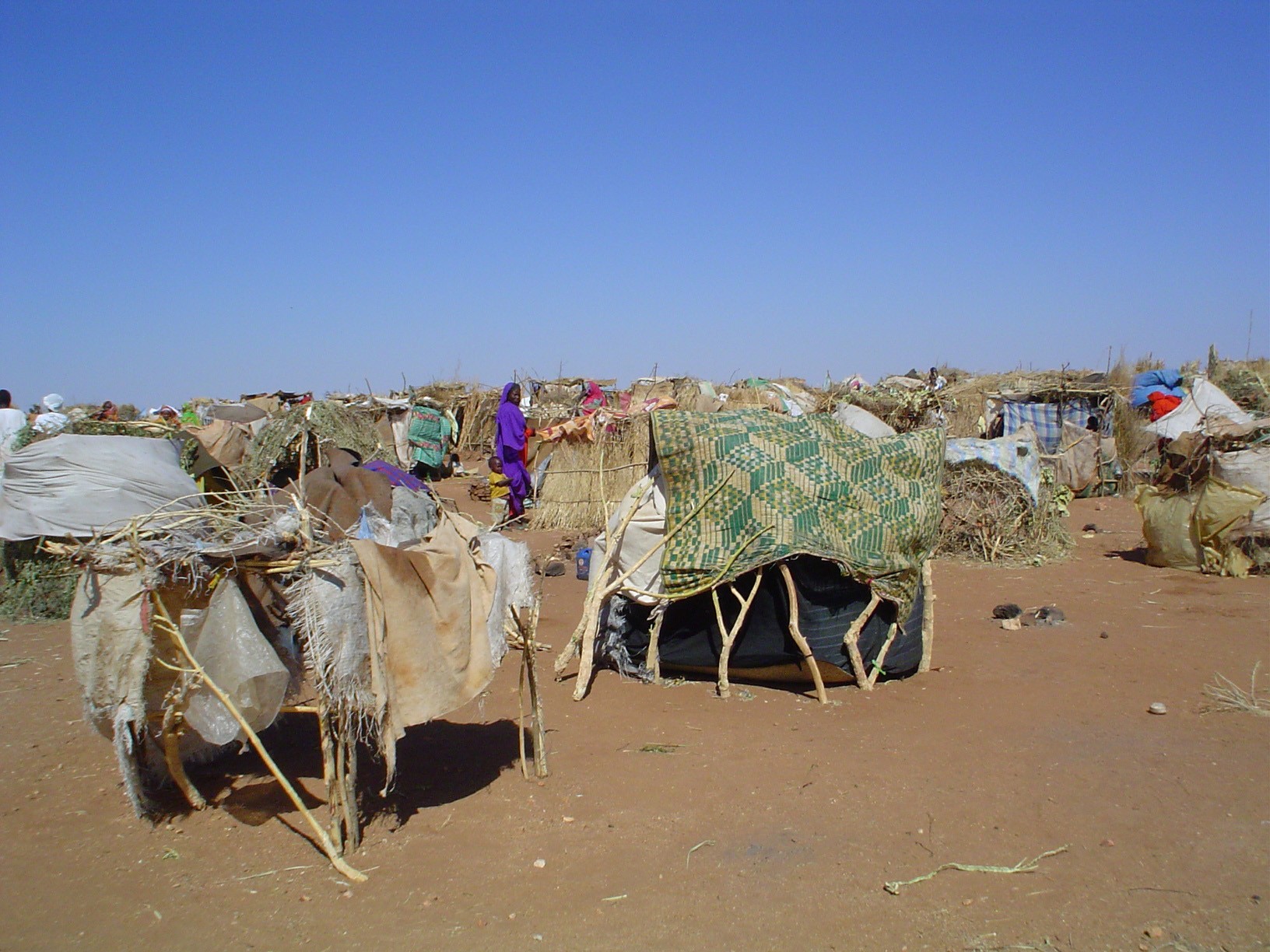
USAID, Public domain, via Wikimedia Commons
By 2004, the scale of the catastrophe was becoming undeniable. Humanitarian workers, journalists, and human rights investigators were filing harrowing accounts. In June 2004, the US Secretary of State Colin Powell travelled to refugee camps in neighbouring Chad, meeting with survivors. Three months later, he stood before the Senate Foreign Relations Committee and made a declaration that reverberated around the world: what was happening in Darfur, he said, constituted genocide.
For the first time, a sitting US official used that word for an ongoing conflict. The word carried enormous weight—and ultimately, changed almost nothing.
The United Nations Security Council remained paralysed. China, a major investor in Sudan’s oil sector, threatened to veto meaningful sanctions. Russia offered diplomatic cover. The African Union deployed a peacekeeping mission — AMIS — that was too small, too poorly equipped, and too restricted in its mandate to protect civilians. By 2006, when a peace agreement was signed by only one rebel faction and quickly collapsed, the killing had not stopped; it had evolved.
The International Criminal Court stepped in where diplomacy had failed. In 2009 and 2010, the ICC issued arrest warrants for Omar al-Bashir — the first time the court had charged a sitting head of state — on counts of genocide, crimes against humanity, and war crimes. Al-Bashir responded with contempt, expelling humanitarian organisations from Darfur and openly travelling to countries that refused to arrest him. He remained in power until 2019, when a popular uprising and a military coup finally removed him.
Timeline not found.
What was lost
Statistics convey the scale of the catastrophe but struggle to capture its texture. The genocide did not only kill people — it destroyed a civilisation’s connective tissue. Schools, mosques, markets, and wells were obliterated. Generations of oral history, local governance, and agricultural knowledge were killed along with the elders who held them. Children born in displacement camps know no other home; many have never seen the villages their parents describe with the aching specificity of the lost.
Sexual violence was deployed as a weapon of war with calculated precision. The UN and human rights organisations documented systematic rape — often carried out by multiple perpetrators, often in front of family members — as a tool of ethnic humiliation and demographic terror. Women who survived bore stigma as well as trauma. Many were cast out by families and communities that could not absorb what had happened to them. Some gave birth to children of rape, raising them in conditions of profound precarity.
The psychological wounds have never healed because the violence has never truly stopped. Even in the years of relative quiet between 2010 and 2019, attacks on civilians continued in Darfur, conflict over land remained lethal, and displaced people could not safely return. Justice remained a distant abstraction. Al-Bashir sat in a Khartoum prison after 2019 — held by Sudan’s transitional government but not transferred to the ICC, which continued to demand his extradition.
The nightmare returns
In April 2023, after several years under a transitional government following Al-Bashir’s ouster in 2019, Sudan’s fragile transition collapsed. War broke out between the Sudanese Armed Forces (SAF) and the Rapid Support Forces (RSF) — a paramilitary group that was the direct institutional successor of the Janjaweed, led by Mohamed Hamdan Dagalo, known as Hemedti, who had commanded Janjaweed forces during the original genocide.
In Darfur, the pattern of 2003 repeated with terrible fidelity. RSF fighters swept through El Geneina, the capital of West Darfur, killing civilians on ethnic lines, targeting the Masalit in particular. Witnesses described executions in the streets, mass graves, and the burning of homes. UN officials, human rights organisations, and scholars of genocide warned in unambiguous terms: this was genocide, again, in the same land, by the successors of the same perpetrators.
The world, overwhelmed by other crises, responded with a fraction of the attention Darfur had received two decades earlier — further underscoring the international community’s ongoing unwillingness or inability to stop genocide, despite past lessons.
For the survivors — those who fled in 2003 and 2004 and had spent twenty years in camps, those who had cautiously begun to rebuild, those who had never stopped mourning — the return of mass violence was not a surprise. It was a confirmation of what they had long feared: that without accountability, without justice, without a genuine political settlement, the fire never truly goes out. It only waits.
A verdict on the world
The history of Darfur is in part a history of international failure — of the gap between the word “genocide” and the will to stop one. The Genocide Convention of 1948, written in the shadow of the Holocaust, pledged that the world would “never again” permit systematic mass killing on the basis of ethnicity, race, or religion. Darfur demonstrated, as Rwanda had a decade earlier, how hollow that pledge could be when strategic interests, great-power rivalries, and organisational inertia intervene.
It is also, however, a history of survival. The people of Darfur — the Fur, Zaghawa, Masalit, and dozens of other communities — have endured. They have given testimony, organised in exile, raised children, and preserved their languages and stories. They have demanded accountability in international forums and local courts. They have refused to be forgotten, even when the world seemed determined to forget them.
Whether justice will ever come — real justice, not merely the distant promise of ICC indictments that may never be served — remains profoundly uncertain. What is certain is that the people of Darfur deserve it, that they have waited long enough, and that the moral weight of their suffering belongs not only to Sudan but to every government and institution that looked away.
The fire that was lit in Darfur in 2003 has never been extinguished. It continues to burn. And the measure of the world’s conscience is whether, this time, anyone will finally act to put it out.
Sources & Further Reading:
Human Rights Watch, Darfur in Flames (2004);
Amnesty International, Darfur Reports (2004–2024);
International Criminal Court, Prosecutor v. Al Bashir;
Mahmood Mamdani, Saviours and Survivors: Darfur, Politics, and the War on Terror (2009);
Eric Reeves, A Long Day’s Dying: Critical Moments in the Darfur Genocide (2007).


Leave a Reply