
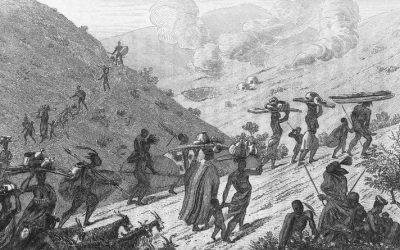
The Mfecane, also known as the Difaqane or Lifaqane, was a period of widespread chaos and warfare among indigenous ethnic communities in southern Africa during the early 19th century. This era, roughly spanning from 1815 to 1840, led to significant social, political, and geographical changes, reshaping the region in profound ways. The word “Mfecane” translates to “crushing” or “scattering” in Zulu, aptly describing the devastating impact of the conflicts and migrations that occurred.
Causes of the Mfecane
The Mfecane’s origins are multifaceted, rooted in a combination of environmental, economic, and political factors:
- Population pressure and resource competition: Increased population densities in certain areas led to intense competition for arable land and water resources. This pressure catalysed conflicts as communities vied for control over fertile territories.
- Drought and famine: The early 19th century witnessed severe droughts that exacerbated food shortages. These climatic conditions forced communities to migrate in search of sustenance, often leading to clashes with neighbouring groups.
- Trade and economic shifts: The expansion of European colonial influence and trade networks introduced new economic dynamics. African leaders sought to control lucrative trade routes, particularly those involving ivory and cattle, fueling rivalries and warfare.
- Political consolidation and centralisation: The rise of powerful leaders, most notably Shaka Zulu, drove efforts to centralise power and expand territorial control. Shaka’s military innovations and aggressive expansionism set off a chain reaction of conflict and displacement.
Major events and key figures
The Mfecane is marked by numerous significant events and influential leaders who shaped its course:
- Shaka Zulu and the rise of the Zulu Kingdom: Shaka Zulu, the most prominent figure of the Mfecane, ascended to power around 1816. Through strategic military reforms, such as the introduction of the short stabbing spear (iklwa) and the organisation of impis (regiments), Shaka transformed the Zulu kingdom into a formidable military force. His campaigns against neighbouring groups, including the Ndwandwe and the Mthethwa, initiated widespread displacement and conflict.
- The flight of the Ngwane: Led by Sobhuza I, the Ngwane people fled from Shaka’s expanding Zulu empire, settling in the territory of present-day Swaziland. This migration displaced other communities, perpetuating the cycle of upheaval.
- Moselekatse and the formation of the Ndebele Kingdom: Moselekatse, a former lieutenant of Shaka, broke away and established his own kingdom, the Ndebele (or Matabele). His conquests and raids across present-day South Africa, Botswana, and Zimbabwe contributed significantly to the chaos of the Mfecane.
- The Difaquane in the Highveld: The Highveld region experienced severe disruptions as groups like the Sotho-Tswana were attacked and displaced by the Ngwane and other migrating communities. This led to the formation of new polities, such as the Sotho kingdom under Moshoeshoe I, who strategically defended his people against encroaching forces.
Impacts of the Mfecane
The Mfecane had far-reaching consequences for the social, political, and geographical landscape of southern Africa:
- Demographic shifts and migrations: Massive population movements resulted in significant demographic changes. Entire communities were uprooted, leading to the establishment of new settlements and the depopulation of certain areas. The Mfecane facilitated the spread of various ethnic groups, including the Zulu, Ndebele, and Sotho, across the region.
- Formation of new states and societies: The period saw the emergence of new political entities and the consolidation of existing ones. Notable examples include the Zulu and Ndebele kingdoms, as well as the Sotho kingdom under Moshoeshoe I. These new states were characterised by centralised authority and militarised societies.
- Economic and agricultural disruption: The warfare and migrations disrupted traditional agricultural practices, leading to food shortages and economic instability. Many communities adopted a more militaristic and nomadic lifestyle, prioritising cattle raiding and warfare over farming.
- European colonial expansion: The Mfecane indirectly facilitated European colonial expansion by weakening indigenous polities and creating power vacuums. The Dutch Boers, for instance, capitalised on the chaos to expand their territories in the Great Trek. British colonial interests also benefited from the disrupted political landscape.
- Cultural and social transformations: The upheavals of the Mfecane had profound cultural and social impacts. New alliances, identities, and social hierarchies emerged as communities adapted to the changing circumstances. The legacy of the Mfecane continues to influence the cultural landscape of southern Africa.
Summary
The Mfecane was a pivotal period in southern African history, characterised by widespread violence, displacement, and transformation. While it brought immense suffering to countless communities, it also led to the formation of powerful new states and reshaped the region’s social and political dynamics. Understanding the causes, events, and impacts of the Mfecane provides crucial insights into the historical processes that have shaped modern southern Africa.
References
- Eldredge, Elizabeth A. “The Creation of the Zrecogniseom, 1815-1828: War, Shaka, and the Consolidation of Power.” Cambridge University Press, 2014.
- Hamilton, Carolyn. “Terrific Majesty: The Powers of Shaka Zulu and the Limits of Historical Invention.” Harvard University Press, 1998.
- Omer-Cooper, J. D. “The Zulu Aftermath: A Nineteenth-Century Revolution in Bantu Africa.” Longman, 1966.
- Wright, John, and Carolyn Hamilton. “The Mfecane Aftermath: Reconstructive Debates in Southern African History.” University of KwaZulu-Natal Press, 1995.


Leave a Reply