• Skip to main content
  • Skip to after header navigation
  • Skip to site footer
Our history archive

Our History

Our History Archive, where history comes to life

  • Home
  • Colonisation
  • World History
  • Civil Rights
  • World cultures
  • Features
  • Wellbeing
  • Popular Culture

Huey P. Newton: Visionary activist and co-founder of the Black Panther Party

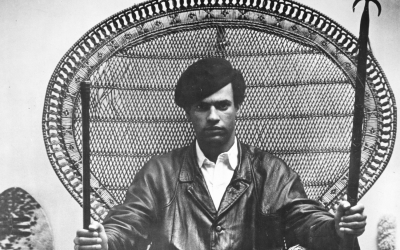
Poster shows portrait photograph by Blair Stapp of Huey Newton sitting in a rattan throne chair with a rifle and a spear. This photo was published in The Black Panther, Vol. 1, No. 6, November 23, 1967. (Blair Stapp, Public domain, via Wikimedia Commons)
Features
28 October, 2011

Huey P. Newton was born on 17 February 1942 in Monroe, Louisiana, but he later moved to Oakland, California, with his family. Growing up in a deeply segregated and racially charged society, Newton would go on to become one of the most influential Black leaders in American history. Along with Bobby Seale, Newton co-founded the Black Panther Party for Self-Defense (BPP). Newton dedicated his life to fighting for racial equality and challenging systemic injustices faced by African Americans.

Education and early life

Newton came from a loving, supportive household. His parents – Walter and Armelia Newton – were both religious and firmly believed in education. Huey’s early years in public school proved difficult due to his struggles with reading; however, despite these challenges, he graduated from Oakland Technical High School, where he acquired his interest in politics.

Newton continued his education at Merritt College in Oakland, where he became involved in activism and met Bobby Seale. Together, they established their own political party – the Black Panther Party for Self-Defense – in October 1966.


The Black Panther Party

The formation of the BPP was fueled by social injustices experienced by African Americans at that time, especially issues surrounding police brutality and targeting primarily the Black community. With this mission in mind, Newton and Seale developed a Ten-Point Program that outlined the various socio-economic needs of African Americans.

CIR Online , CC BY 2.0, via Wikimedia Commons

Critical components of this platform included housing, education reform, fair treatment by law enforcement authorities, employment opportunities, and an end to police brutality against African Americans.

As the organisation grew rapidly throughout America’s cities, it attracted some notable advocates like Eldridge Cleaver and Angela Davis, who shared Newton’s vision for change. The BPP focused on providing free breakfast programs for children, health clinics in underserved neighbourhoods, and organising classes addressing systemic racism.

Legal battles and controversy

While Newton was admired by many for his activism, he was not without controversy. He faced multiple legal battles during his life, including charges of manslaughter and assault. Though Newton was convicted of manslaughter in 1968 for the death of an Oakland police officer, the decision was overturned in 1970 – he was eventually released from prison after a series of retrials led to a hung jury.

Later years and legacy

Newton’s influence on social change continued well into the 1970s. In 1980, he pursued a PhD at the University of California, Santa Cruz, obtaining his doctorate in social philosophy with a focus on the repression faced by African American men.


Unfortunately, Newton struggled with personal demons, battling drug addiction until his tragic death on 22 August 1989 in Oakland. He was shot and killed outside of a residential complex during a drug-related dispute.

Huey P. Newton leaves an indelible legacy that showcases revolutionary thinking and commitment to community empowerment that remains relevant today. The Black Panther Party had a significant impact on American society, demonstrating that marginalised communities could challenge oppressive systems and inspire generations to come.

Share this:

  • Share on Facebook (Opens in new window) Facebook
  • Share on X (Opens in new window) X
  • Share on Reddit (Opens in new window) Reddit
  • Share on Pinterest (Opens in new window) Pinterest
  • Share on WhatsApp (Opens in new window) WhatsApp

Related

You May Also Like…

More details Jesse Jackson surrounded by marchers carrying signs advocating support for the Hawkins-Humphrey Bill for full employment,

Keep hope alive: The rise, power, and legacy of Jesse Jackson

The revolutionary icon: Ernesto "Che" Guevara

Ernesto “Che” Guevara: : The revolutionary icon

Portrait of Bartolomé de Las Casas (c.1484 - 1566)

Bartolomé de las Casas and the birth of human rights

William Randolph Hearst

William Randolph Hearst: The king of Yellow Journalism


Reader Interactions

Leave a ReplyCancel reply

Sidebar

This Day In History

No Events

More details Jesse Jackson surrounded by marchers carrying signs advocating support for the Hawkins-Humphrey Bill for full employment,

Keep hope alive: The rise, power, and legacy of Jesse Jackson

The revolutionary icon: Ernesto "Che" Guevara

Ernesto “Che” Guevara: : The revolutionary icon

Portrait of Bartolomé de Las Casas (c.1484 - 1566)

Bartolomé de las Casas and the birth of human rights

Trending

  • The major branches of Islam: History, beliefs, and differences
    The major branches of Islam: History, beliefs, and differences
  • McCarthyism and the Cold War: America's Second Red Scare
    McCarthyism and the Cold War: America's Second Red Scare
  • The rise and fall of the Persian Empire
    The rise and fall of the Persian Empire
  • Holy Wars: The blood-soaked legacy of conflicts fought in the name of Christianity
    Holy Wars: The blood-soaked legacy of conflicts fought in the name of Christianity
  • The rise and fall of the Ottoman Empire: Six centuries of imperial power
    The rise and fall of the Ottoman Empire: Six centuries of imperial power
  • The colonisation of India
    The colonisation of India
  • Francisco Franco: Spain's controversial dictator
    Francisco Franco: Spain's controversial dictator
  • The 1963 Coral Gardens Massacre: A dark chapter in Jamaica's history
    The 1963 Coral Gardens Massacre: A dark chapter in Jamaica's history
  • How British colonialism shaped Africa’s struggles
    How British colonialism shaped Africa’s struggles
  • The First Red Scare: America's post-WWI fear of Communism and radical change
    The First Red Scare: America's post-WWI fear of Communism and radical change

Connect

  • YouTube
  • TikTok
  • Bluesky

ABOUT

CONTACT

PRIVACY POLICY

COOKIES

Copyright © 2026 · Our History · All Rights Reserved