
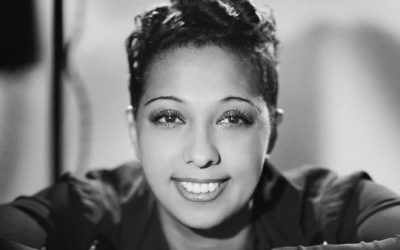
Actor Janelle Monaé (Hidden Figures) is set to star as the iconic entertainer Josephine Baker in a new TV series titled De La Resistance.
So who was Josephine Baker?
Exotic cabaret dancer, operatic singer, comedienne, first black movie star, and bisexual celebrity. Although all these titles frequently appear in searches connected to entertainer Josephine Baker, perhaps the one most often overlooked is the title of spy. Yet, working undercover to help the French Retaliation during World War II was by far the most adventuresome and brave role Baker ever played in her life.

Baker was born Freda Josephine McDonald in St. Louis, Missouri, on 3 June 1906. Her mother, Carrie McDonald, was a washerwoman. Her father, Eddie Carson, was a vaudeville drummer. Carson abandoned his family soon after Baker’s birth. Baker spent her early youth working odd jobs for wealthy white people. At the age of 13, Baker married Willie Wells. The marriage soon ended. A succession of other suitors followed, and Baker got married (and divorced) 3 additional times: Willie Baker in 1921 (whose last name she kept for life), Jean Lion in 1937, and Jo Bouillon in 1947.
As a vaudeville troupe performer, Baker travelled to France, where her career blossomed. By 1927, her star was shining in Europe, and she was considered a national treasure in France. But a return to her native USA in 1936 produced negative results because of the existing racial tensions. Baker remained in France after that.
Baker becomes a spy
During World War II, Baker played an important role in helping the French Resistance against the Axis powers. Knowing her celebrity status allowed her certain protection, she passed secret messages to the French authorities by writing them with invisible ink on her music sheets and on her body. She attached notes to her underwear and carried important information outright under the guarded watch of the enemies.
She hid refugees in her home and helped them escape to safer grounds. She also performed for the troops and served as a sub-lieutenant in the Women’s Auxiliary Air Force. For her service, Baker was awarded the Medal of the Resistance with Rosette and given the honour of being called a Chevalier of the Legion of Honour by France.

After serving France in World War II, Baker travelled back to her birthplace a few more times. She fought racism, took care of her 12 adopted children, and gave performances in places such as New York’s Carnegie Hall. She returned to her favourite city, Paris, and gave her last performance at the Bobino Theatre. Baker died on 12 April 1975 from a cerebral haemorrhage.
Baker’s legacy of bravery
Baker lived an extraordinary life. She was a brave woman and lived as such in every aspect of her life. It was bravery that helped her get past the abandonment of a negligent father. It was bravery that gave her wings to fly and rise above the brokenness of multiple failed marriages. It was bravery that gave her the heart to face racial injustices in her career and life. And it was bravery that gave her the courage to face life head-on; consequences be damned.


Leave a Reply