
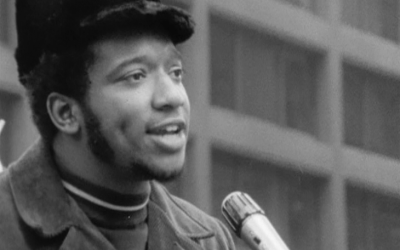
Fred Hampton was a political activist born August 30, 1948. He was killed as he lay in bed in his apartment by a tactical unit of the Cook County, Illinois State’s Attorney’s Office (SAO), in conjunction with the Chicago Police Department (CPD) and the Federal Bureau of Investigation (FBI).
The Murder of Fred Hampton is a 1971 documentary film that began with the intention of portraying Fred Hampton, and the Illinois Black Panther Party. During the production of the film, Hampton was killed by the Chicago Police Department.
Fred was the youngest child of Francis and Iberia Hampton. He was raised in the Chicago suburbs together with his brother and sister.
Fred’s mother, Iberia babysat a young black boy named Emmett Till. In 1955, when Till was a teenager visiting relatives in Mississippi, he was lynched by local white men.
The Hampton family’s connection with Till, coupled with their experiences of racial inequity in their community, made Fred acutely aware of racial injustice. During his attendance in high school in Maywood, Illinois, Hampton became active in the civil rights movement and organised a student section of the NAACP (National Association for the Advancement of Colored People).
He also served on his school’s Interracial Cross Section Committee (a club that helped white students confront their racist beliefs) and protested the unjust arrest of Eugene Moore, a classmate who would later become the area’s first Black state representative. Fred graduated from high school with honours and enrolled in a prelaw program at Triton College, a public community college near Maywood.
In the summer of 1967 Hampton took part in a series of rallies to demand the construction of a racially integrated public swimming pool in Maywood. The nearest public pool was about 2 miles away, in Melrose Park, only white swimmers were admitted. As a student, Hampton had organised trips for local Black children to the nearest integrated public pool, but it was about 5 miles away.
At one of the rallies, protesters clashed with local police when store windows were broken and a shed was set on fire. Responsibility for the damage was unclear, but Hampton and 17 others were charged with disorderly conduct and mob action. The rallies did eventually accomplish their goal when an integrated pool for Maywood was approved. Hampton did not live to see this as the pool had not yet been completed at the time of his death. However, the village board agreed to name the site the Fred Hampton Family Aquatic Center.
After experiencing a series of negative, occasionally violent, interactions with the police at rallies and demonstrations, in 1968 Hampton left the by-the-book NAACP and joined the Black Panther Party as one of the Illinois chapter’s original members. The party, founded two years earlier in Oakland, California, by Huey P. Newton and Bobby Seale, had originally been intended to arrange patrols of Black neighbourhoods and protect residents from police brutality. It quickly evolved into a Marxist revolutionary group that called for paying reparations to African Americans for the centuries of exploitation they had suffered, for excluding African Americans from the military draft, and for arming African American communities.
FBI director J. Edgar Hoover claimed that the Black Panthers were “the greatest threat to the internal security of the country.” No sooner had the Chicago Black Panthers begun than the FBI began monitoring their activity. Hampton was a possible suspect for what Hoover considered the threat of an emerging “messiah,” a leader who could “unify, and electrify, the militant black nationalist movement.”


Leave a Reply