
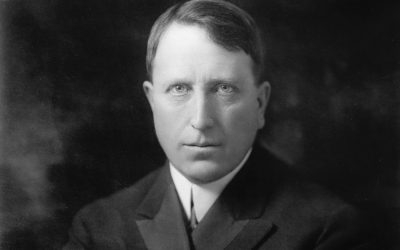
Few Americans have shaped the modern media landscape as profoundly, or as controversially, as William Randolph Hearst. He didn’t just publish newspapers; he weaponised them. He didn’t merely report the news; he manufactured spectacle. To admirers, Hearst was a visionary who democratised journalism and built a communications empire before “media mogul” was even a phrase. To critics, he was the godfather of sensationalism, a man who blurred truth and entertainment so thoroughly that facts sometimes didn’t stand a chance.
More than a century later, if you squint at today’s clickbait headlines, partisan networks, and outrage-driven news cycles, you can still see his fingerprints.
The boy who inherited a fortune — and wanted more
William Randolph Hearst was born in 1863 into wealth and power. His father, George Hearst, was a mining magnate turned US senator who handed his son something better than cash: influence. While studying at Harvard, young William developed a taste for disruption. He reportedly treated the Harvard Lampoon like a laboratory for attention-grabbing stunts — a preview of the career to come. He was eventually expelled for pranks and excess, but conventional paths were never going to contain him anyway.
In 1887, his father gave him control of the struggling San Francisco Examiner. Hearst didn’t run it like a sober civic institution. He turned it into a show. He slashed prices, hired bold writers and illustrators, and filled the pages with crime, scandal, and human drama. Circulation soared.
It was his first lesson in a principle he’d refine for the rest of his life: people don’t just want information — they want emotion.
Yellow journalism and the war that headlines helped sell
Hearst’s real stage was New York. In 1895, he bought the New York Journal and went head-to-head with Joseph Pulitzer’s World. What followed was one of the fiercest circulation wars in American history. Both men pushed headlines bigger, stories louder, and facts looser.
The result was “yellow journalism,” a style built on sensationalism, crusades, and spectacle. Murders became melodramas. Foreign crises became cliffhangers. Illustrations exploded across front pages. Accuracy often came second.
Nowhere was this more consequential than during tensions with Spain over Cuba. Hearst’s papers hammered readers with lurid tales of Spanish atrocities. After the battleship USS Maine exploded in Havana harbour, the Journal practically screamed for war. The famous and possibly apocryphal line attributed to Hearst, “You furnish the pictures and I’ll furnish the war,” captured the era’s mood, whether he said it or not.
When the Spanish–American War broke out in 1898, critics argued that papers like Hearst’s hadn’t just covered the conflict, they had helped create the public pressure that made it inevitable.
It was one of the first demonstrations of how mass media could steer national policy.
Building America’s first media empire
By the early 20th century, Hearst wasn’t just a newspaper man. He was becoming something new: a multimedia tycoon.
He acquired dozens of papers across the country and added magazines like Cosmopolitan and Good Housekeeping. He invested in film newsreels, radio stations, and later Hollywood studios. Long before modern conglomerates, Hearst understood synergy, the same stories, the same angles, echoed across multiple platforms.
Politically, his views were as theatrical as his headlines. He railed against monopolies and corruption but also flirted with demagoguery. He served in Congress, ran unsuccessfully for mayor and governor of New York, and used his papers to champion or savage candidates with unapologetic bias.
Objectivity was not his brand. Influence was.
If something angered Hearst, it became a crusade. If he liked you, expect glowing coverage. His empire blurred the line between journalism and advocacy in ways that feel startlingly modern.
The castle on the hill
Nothing symbolised Hearst’s ambition — or extravagance — more than his estate at San Simeon, now known as Hearst Castle.
Perched above the California coast, it was less a house than a fantasy kingdom. European ceilings, medieval tapestries, Roman columns, zoo animals roaming the grounds, Hollywood stars at dinner. Charlie Chaplin, Winston Churchill, and countless celebrities passed through its doors.
The castle was part playground, part power centre. Deals were struck, alliances formed, gossip traded. It embodied Hearst’s belief that media, politics, and celebrity all lived in the same ecosystem. Another idea that feels eerily familiar today.
But it also hinted at excess. The maintenance alone drained money. The empire’s profits, once limitless, would not always keep pace.
Power, backlash, and decline
By the 1930s, Hearst’s influence had begun to wobble. The Great Depression crushed advertising revenue. His expansion had been financed with heavy borrowing. Suddenly, the empire looked fragile.
At the same time, his politics shifted to the right, and he publicly admired European strongmen, a stance that alienated readers and advertisers. He attacked Franklin D. Roosevelt after initially supporting him, which didn’t help his standing in Washington either.
Then came a cultural gut punch: Orson Welles released Citizen Kane in 1941, widely interpreted as a thinly veiled portrait of Hearst. The film depicted a lonely tycoon whose wealth couldn’t buy happiness or love. Hearst tried to suppress it, banning mentions in his papers, but the damage was done. Kane became a legend, and so did the unflattering comparison.
For perhaps the first time, Hearst couldn’t control the narrative.
The complicated legacy of William Randolph Hearst
When Hearst died in 1951, he left behind something unprecedented: a nationwide communications empire that helped define how modern media works.
His influence cuts both ways. He professionalised mass-market journalism, invested in investigative reporting, and gave voice to working-class readers ignored by elite papers. But he also normalised sensationalism, blurred fact and fiction, and proved that outrage sells.
If today’s media landscape sometimes feels like a circus, headlines designed to provoke, politics treated like sport, truth competing with spectacle, Hearst didn’t invent it all. But he certainly wrote the playbook.
In that sense, William Randolph Hearst isn’t just a figure from the past. He’s a warning from it.


Leave a Reply