
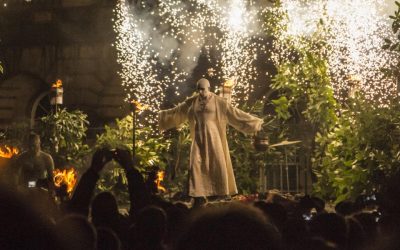
The Samhain festival (pronounced ‘sow’inn’) is a Gaelic festival marking the end of the harvest season and the beginning of winter. It has traditionally been observed across Ireland, Scotland, and the Isle of Man.
It is believed that Samhain has Celtic pagan origins and has been an important date since ancient times. This date marks the Feast of the Dead, a very important event in the Pagan calendar. It is also celebrated by many Pagans as the old Celtic New Year. Non-Pagans celebrate this festival as Halloween.
Watch the video below or read on.
Samhain has been celebrated in Britain for centuries and is rooted in pagan Celtic traditions. At that time of year, the Otherworld was most open, allowing the dead to mingle again with the living. As Christians adopted the holiday, they celebrated it as All Hallows’ Eve, followed by All Saints Day. However, it still included elements of remembering and honouring the dead.
Despite the festival’s central theme of death, most modern Pagans do not view it as a morbid event. The concept of death is not feared by Pagans. Old age is valued for its wisdom, and dying is accepted as a part of life as necessary and welcome as birth.
As with other faiths, Pagans always honour and respect their dead, but Samhain is significant. During the celebration feast, departed loved ones are often remembered and invited to join the living. This is also when those born during the past year are welcomed into the community. The Pagans often celebrate Samhain with traditional games such as apple-dooking (bobbing for apples) and feasting.
As death also symbolizes endings, Samhain is also a time to reflect on relationships, jobs, and other significant changes in life, as well as mortality. It is a time for taking stock of the past and coming to terms with it, so we can move forward and look forward to the future. In some ways, Samhain is similar to the Mexican Day of the Dead celebrations.
Ancient Celtic celebrations
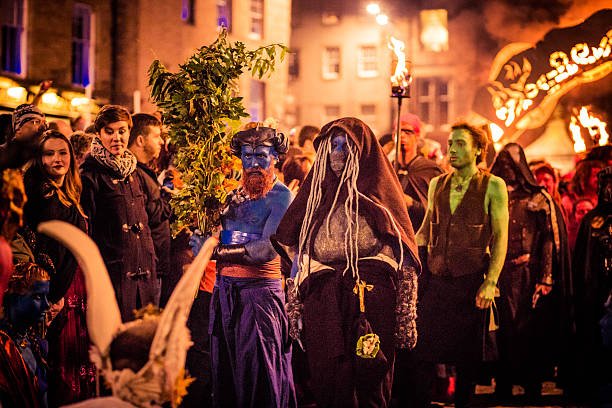
On this night, the Celts believed the boundary between the living and dead dissolved, as well as that the spirits helped their priests make future predictions.
Druids built huge sacred bonfires to celebrate Samhain. People brought harvest food and sacrificed animals for the festival and shared a communal dinner.
In celebration, the Celts wore costumes made of animal skins and heads.
After the festival, they re-lit the fires in their homes from the sacred bonfire to help protect them and keep them warm during the winter months.
All Saints’ Day was moved to 1 November by Western Christianity in the 9th century, while All Souls’ Day was celebrated on 2 November. Samhain and All Saints’/All Souls’ merged over time to become Halloween.
In the late 20th century, Celtic neopagans and Wiccans began observing Samhain as a religious holiday.


Leave a Reply