• Skip to main content
  • Skip to after header navigation
  • Skip to site footer
Our history archive

Our History

Our History Archive, where history comes to life

  • Home
  • Colonisation
  • World History
  • Civil Rights
  • World cultures
  • Features
  • Wellbeing
  • Popular Culture

Nanny of the Maroons

World history
5 March, 1999

Often referred to as Queen Nanny, Nanny of the Maroons stands out in history as the only woman among Jamaica’s National Heroes. She possessed that fierce fighting spirit generally associated with the courage of men. In fact, Nanny is described as a fearless Ashanti warrior who used militarist techniques to foul and beguile the English.

Nanny sold into slavery

What we know of Nanny is mostly oral history as there are very few historical texts about her. Nanny was born c. 1686 in Ghana, Western Africa, into the Ashanti people. It is believed that some of her family members were involved in an intertribal conflict and her village was captured. Nanny and several relatives were sold as slaves and sent to Jamaica.

Along with other defiant Jamaican slaves, Nanny escaped into the Blue Mountains area of northern Saint Thomas Parish and helped to form a community of free people called the Maroons. The Maroons were considered skilled fighters and hard to defeat.


More Maroon communities were set up across the island with the help of Nanny’s brothers (it is not known whether they were really related) Accompong, Cudjoe, Johnny and Quao (Kwau). Eventually, they split up to organise more communities across Jamaica. Cudjoe (Kojo) went to Saint James Parish and organised a village, which was later named Cudjoe Town; Accompong settled in Saint Elizabeth Parish, in a community known as Accompong Town; Nanny and Quao founded communities in Portland Parish.

Nanny Town

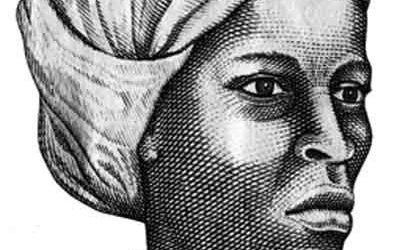
Drawing of Nanny of the Maroons
Nanny

By 1720, Nanny had taken control of the Blue Mountain rebel town that then became known as ‘Nanny Town’. Located on a ridge, it became a maroon stronghold with guards placed at look-out points. Maroon soldiers were called by the blowing of a horn of African origin called an abeng.

The Nanny Town Maroons survived by sending traders to the nearby market towns to exchange food for weapons and cloth. The community raised animals, hunted, and grew crops, and was organized very much like a typical Ashanti village in Africa.

The Maroons were also known for raiding plantations for weapons and food, burning the plantations, and freeing slaves. Nanny was very skilful at organising plans to free the slaves. For over 30 years, Nanny freed more than 800 slaves and helped them to resettle in the Maroon community.


For six years from 1728, the British fought Nanny and her forces. Using cannon, they captured Nanny Town, and in 1734, Captain Stoddard, the British commander, reported that ‘all the maroons had been killed’. But there were survivors – the British pursued them and destroyed all the crops in the region. In some reports, Nanny and some of her followers escaped and made a new hideout near the Rio Grande.

In 1739 Quao signed a peace treaty with the British. Soon after that he and Nanny parted ways. Nanny took her supporters east to what would later become Moore Town on the eastern fringes of the Blue Mountains, while Quao took his people west to central Jamaica, and formed a community in a town that later came to be known as Crawford’s Town.

Some claim that Queen Nanny lived to be an old woman, dying of natural causes in the 1760s. The exact date of her death remains a mystery, yet, the spirit of Nanny of the Maroons remains today as a symbol of that indomitable desire that will never yield to captivity.

Share this:

  • Share on Facebook (Opens in new window) Facebook
  • Share on X (Opens in new window) X
  • Share on Reddit (Opens in new window) Reddit
  • Share on Pinterest (Opens in new window) Pinterest
  • Share on WhatsApp (Opens in new window) WhatsApp


Related

You May Also Like…

More details Merida - Palacio de Gobierno - Murals by Fernando Castro Pacheco: The Spanish bishop Diego de Landa is burning figures of Mayan deities

The forgotten fire: A history of the Darfur Genocide

The Japanese occupation of Beiping (Beijing) in China

The rise and fall of the Japanese Empire

Rescuers and residents searching the rubble of the destroyed Shajareh Tayyebeh elementary school in Minab

The fracturing of the international order in an age of impunity

US ambassador to the UN, Eleanor Roosevelt, holding the Universal Declaration of Human Rights in 1949

The role and limitations of international law in world affairs


Reader Interactions

Comments

  1. Leah Arbeau

    28 September, 2019 at 12:15 pm

    A only Queen Nanny mi wha

    Reply

Leave a ReplyCancel reply

Sidebar

This Day In History

No Events

World history recent posts in

More details Merida - Palacio de Gobierno - Murals by Fernando Castro Pacheco: The Spanish bishop Diego de Landa is burning figures of Mayan deities

The forgotten fire: A history of the Darfur Genocide

The Japanese occupation of Beiping (Beijing) in China

The rise and fall of the Japanese Empire

Rescuers and residents searching the rubble of the destroyed Shajareh Tayyebeh elementary school in Minab

The fracturing of the international order in an age of impunity

US ambassador to the UN, Eleanor Roosevelt, holding the Universal Declaration of Human Rights in 1949

The role and limitations of international law in world affairs

Trending

  • The rise and fall of the Persian Empire
    The rise and fall of the Persian Empire
  • Mexican culture: A living mosaic of civilisations, faith, and tradition
    Mexican culture: A living mosaic of civilisations, faith, and tradition
  • The British Empire: An overview of empire and colonisation
    The British Empire: An overview of empire and colonisation
  • The 1972 Munich Olympics massacre
    The 1972 Munich Olympics massacre
  • Holy Wars: The blood-soaked legacy of conflicts fought in the name of Christianity
    Holy Wars: The blood-soaked legacy of conflicts fought in the name of Christianity
  • The history of South Africa: From colonisation to independence
    The history of South Africa: From colonisation to independence
  • The Arab slave trade
    The Arab slave trade
  • The forgotten fire: A history of the Darfur Genocide
    The forgotten fire: A history of the Darfur Genocide
  • History of Canada - From colonisation to independence
    History of Canada - From colonisation to independence
  • The rise and fall of the Ottoman Empire: Six centuries of imperial power
    The rise and fall of the Ottoman Empire: Six centuries of imperial power

Connect

  • YouTube
  • TikTok
  • Bluesky

ABOUT

CONTACT

PRIVACY POLICY

COOKIES

Copyright © 2026 · Our History · All Rights Reserved