
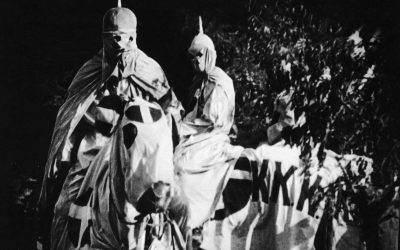
The Ku Klux Klan (KKK) is an American white supremacist terrorist hate group founded after the American Civil War to suppress and victimise newly freed African American slaves. Over the decades, their targets have grown to include Native Americans, Latinos, Asian Americans, Catholics, Jews, atheists and Muslims, as well as immigrants and homosexuals.
On 24 December 1865, in Pulaski, Tennessee, a group of ex-Confederate soldiers organised to form a secret society that they named the Ku Klux Klan. The society quickly grew from a secret social brotherhood to a paramilitary force whose aim was to reverse the federal government’s progressive Reconstruction efforts in the South, especially policies that elevated the rights of the local Black population.
In an effort to maintain white hegemonic control of the government, the KKK tried to overthrow the Republican state governments in the South by using voter intimidation and targeted violence against African-Americans. From Arkansas to Georgia, thousands of black people were killed. Each chapter was autonomous and highly secretive about membership and plans. Former Confederate General Nathan Bedford Forrest was the KKK’s first grand wizard. In 1869, he unsuccessfully tried to disband it after he grew critical of the Klan’s excessive violence. Despite this, local chapters of the KKK continued to be active.
Throughout black history, and since its inception, the KKK grew and was most prominent in counties where the races were equally balanced. They engaged in terrorist raids against African Americans and white Republicans at night, using intimidation, destruction of property, assault, and murder to achieve their aims and influence upcoming elections. Members made their own costumes consisting of robes, masks and conical hats, designed to be frightening and to hide their identities
In a few Southern states, Republicans organised militia units to break up the Klan. In 1871, through federal law enforcement, numerous KKK chapters across the South were suppressed. The Ku Klux Act passed Congress, authorising President Ulysses S Grant to use military force to suppress the KKK.
The Ku Klux Act resulted in nine South Carolina counties being placed under martial law and thousands of arrests. In 1882, the US Supreme Court declared the Ku Klux Act unconstitutional, but by that time, Reconstruction had ended, and the KKK diminished for the time being.
A KKK revival 1915-1920s
A small Klan revival started in Georgia in 1915. It grew after 1920 and flourished nationwide in the early and mid-1920s, including urban areas of the Midwest and West. Taking inspiration from D W Griffith’s 1915 silent film The Birth of a Nation, which mythologised the founding of the first Klan. Adapted from the book The Clansman by Thomas Dixon Jr, The Birth of a Nation portrayed Reconstruction as disastrous. It showed Radical Republicans encouraging equality for Black people, who in the film are represented as uncouth, intellectually inferior and predators of white women. And this racist narrative was widely accepted as a historical fact.
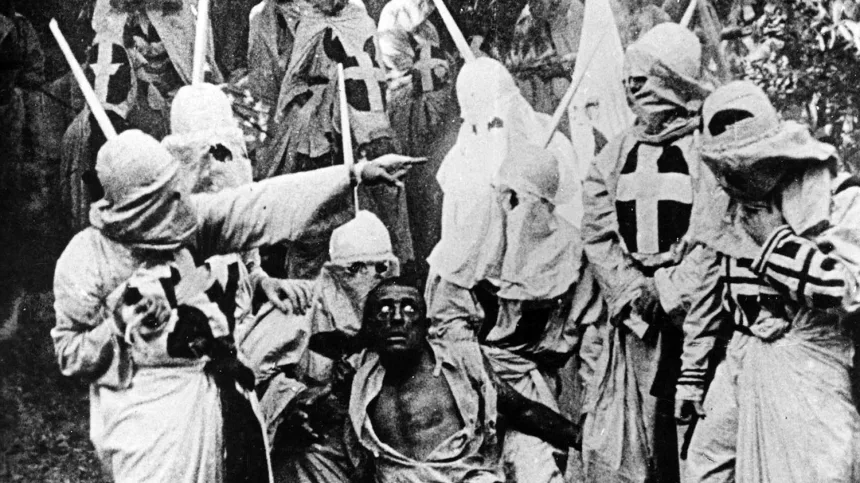
The KKK employed marketing techniques and a popular fraternal organisation structure. Rooted in local Protestant communities, it sought to maintain white supremacy, often took a pro-Prohibition stance, and opposed Catholics and Jews, while also stressing its opposition to the alleged political power of the pope and the Catholic Church. It rapidly declined in the latter half of the 1920s.
KKK today
Another revival happened in the 1950s and ’60s in response to the African American civil rights movement. This iteration of the KKK is made up of localised and isolated groups that use the KKK name. They have focused on opposition to the civil rights movement, often using violence and murder to suppress activists.
Various chapters of the KKK still exist in the 21st century. White supremacist violence, in general, is again on the rise in America. Several high profile events, including the 2015 Charleston church shooting, the 2017 “Unite the Right” rally in Charlottesville, Virginia, the 2018 Pittsburgh synagogue shooting, and the 2019 shooting in an El Paso, Texas Walmart, were all fuelled by white supremacy and racism.


Leave a Reply