
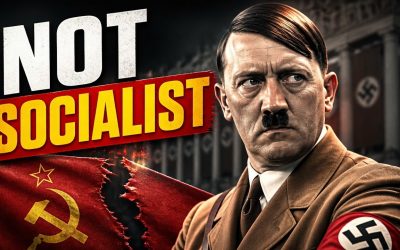
There is a persistent claim, often used for political effect, that Adolf Hitler was a socialist. This assertion is provocative by design, but it does not stand up to the fact-based historical record. From his actions in power to his stated ideology and policies, the evidence demonstrates decisively that Hitler was not a socialist. This is an examination of how the myth began, why it lingers, and what the history truly shows.
A name is not a policy
The argument usually begins — and often ends — with a name. The Nazi Party’s full title was the Nationalsozialistische Deutsche Arbeiterpartei: the National Socialist German Workers’ Party. There it is, the argument goes. “Socialist.” Case closed.
But names are not definitions. North Korea calls itself the Democratic People’s Republic of Korea, but no serious observer considers it democratic. The Soviet Union called itself a union of free republics, but it was neither free nor voluntary. Political movements have often used language intended to attract followers, and the Nazis did the same. The word “socialist” was stitched into the party’s name in the early 1920s as an appeal to Germany’s working class, at a time when left-wing politics were surging across Europe. It was a marketing strategy, not a governing philosophy.
The first people Hitler locked up
If you want to understand what someone believes, don’t read their branding, watch what they do with power. And what Hitler did, almost immediately upon seizing it in 1933, was go after socialists.
Communists, Marxists, and trade union leaders were among the very first prisoners sent to the early concentration camps. They were made to wear red triangles, a deliberate mark of political opposition. Independent trade unions, the institutional backbone of the working-class left, were abolished and replaced with the German Labour Front, a state-controlled body that answered to employers rather than workers. Socialist and communist parties were banned outright.
Then came the Night of the Long Knives in June 1934, one of the most revealing episodes in Nazi history. Ernst Röhm and the leadership of the SA — the party’s own paramilitary wing — had been pushing for a “second revolution,” one with genuinely socialist economic content. They wanted to break up the old aristocratic military establishment and redistribute power downward. Hitler had them murdered. In a single bloody purge, he eliminated the one faction within his own movement that had taken the socialist rhetoric even partially seriously. The message was unambiguous.
What Nazi economic policy actually looked like
To understand what the Nazis actually did with the German economy, you first need to know what they inherited. The Weimar Republic was the democratic government that ruled Germany from 1919 until Hitler abolished it in 1933. It was born out of the wreckage of World War One, Germany had lost, the Kaiser had abdicated, and a fragile parliamentary democracy was hastily assembled in the city of Weimar. It was a turbulent period: hyperinflation wiped out savings in the early 1920s, the Great Depression devastated the country in the early 1930s, and political violence between left and right was a feature of daily life. Faced with economic crisis, the Weimar government had nationalised certain industries, taking state stakes in steel, mining, and banking to stabilise them. It was this inheritance that Hitler then reversed.
Strip away the speeches and the slogans, and Nazi economic policy looks nothing like socialism. It looks, in fact, like almost its opposite.
Socialism — by any serious definition — means collective or state ownership of the means of production. The government owns the factories, mines, and banks. What the Nazis did instead was privatise them. The state-owned industries built by the Weimar government were sold back to private hands after 1933. This was not accidental; it was deliberate policy.
Meanwhile, Germany’s major industrial dynasties did not flee the Nazi regime. They funded it, collaborated with it, and grew rich from it. Consider who they were and what they made. Krupp was a colossal steel and armaments manufacturer, a family dynasty that had been forging weapons for the German military since the nineteenth century; their guns and cannon had equipped the Kaiser’s army in the First World War, and they now eagerly supplied Hitler’s rearmament programme. IG Farben was a vast chemical conglomerate, a merger of Germany’s leading chemical companies, that produced everything from synthetic rubber and petrol to pharmaceuticals, and, infamously, the Zyklon B gas used in the Nazi death camps. Thyssen was another steel and coal giant, whose patriarch, Fritz Thyssen, was one of Hitler’s earliest and most enthusiastic financial backers among the industrialist class. These were not small businesses quietly enduring the regime. They were the spine of German industrial capitalism, and they thrived under the Nazis. Rearmament contracts flowed to private firms. When the war began, and slave labour became available from the concentration camps, it was these private companies that used it.
These are not the actions of a socialist government seizing capital from the bourgeoisie. They are the actions of a state in explicit partnership with capital.
Hitler presided over large government spending on motorways, rearmament and public works. But spending public money is not socialism. Franklin D. Roosevelt did the same during the New Deal. The question is who owns the economy, not whether the government spends money in it. Under the Nazis, private owners kept their property, profits, and power. The state directed and incentivised; it did not own.
What Hitler actually thought of socialism
We do not have to guess at Hitler’s views on socialism. He told us, at length, in writing and in speeches, throughout his entire career.
In Mein Kampf, Hitler described Marxism as a tool of Jewish subversion, designed to destroy the natural racial community by setting class against class. He saw the socialist idea of class struggle as a poison — a deliberately introduced virus meant to weaken Germany from within. His entire ideological framework was built on the premise that national and racial unity had to overcome the divisions that socialism sought to exploit.
Anti-communism was not a peripheral feature of Nazism. It was one of its central organising principles and a primary reason why significant portions of the German establishment, the military, the aristocracy and the industrialists threw their support behind Hitler in the first place. They feared a Bolshevik revolution. Hitler promised to prevent one. That bargain was the foundation of the Nazi rise to power.
How the myth was made
If the historical case is so clear, how did the claim survive at all?
Part of the answer lies in the Cold War. As Western conservatives opposed Soviet communism after 1945, there was a political incentive to associate socialism with Nazism — to suggest that all collectivist politics led to the gas chambers. Friedrich Hayek, an Austrian-British economist, published The Road to Serfdom in 1944, arguing that central economic planning, Nazi or Soviet, led to tyranny. This intellectual argument was widely interpreted as blurring the lines between fascism and socialism. American conservative commentators advanced the idea, which eventually became a political talking point rather than a nuanced argument.
The Nazis had also used left-sounding language in their early years, references to a “people’s community,” criticism of “finance capital,” and anti-establishment rhetoric. This was a strategic move to attract left-leaning voters, not a reflection of actual economic intent. Once in power, the rhetoric faded, and the policies told the real story.
What the historians say
This is not, it should be said, a matter of serious scholarly debate. Historians across the political spectrum — conservative, liberal, and left-wing alike — classify Nazism as a form of far-right ultranationalist fascism. It sits at the extreme right of the political spectrum, characterised by hypernationalism, racial hierarchy, authoritarian leadership, and the violent suppression of the left. The classification is not contested in any major historical institution or encyclopaedia.
The confusion exists almost exclusively in popular political discourse, where it serves a rhetorical function rather than an analytical one.
The bottom line
Adolf Hitler imprisoned socialists, murdered the socialist wing of his own party, abolished trade unions, privatised industry, and built his regime on an alliance with Germany’s capitalist class. He described socialism as an existential enemy of the German people and devoted enormous energy to destroying it wherever he found it.
The word “socialist” in the Nazi Party’s name was a recruitment slogan, chosen to attract votes and abandoned in practice. Judging Hitler’s ideology by that label alone is a little like judging a wolf by the sheep’s clothing it wore to get into the flock.
The record is clear. Hitler was not a socialist. He was socialism’s executioner.


Leave a Reply