
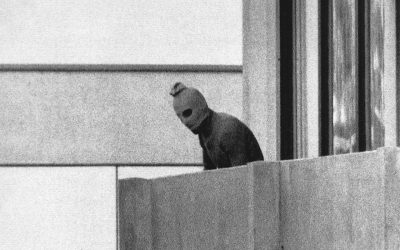
Background
The 1972 Summer Olympic Games, held in Munich, West Germany, were intended to project a new, open, and democratic image of Germany to the world — a deliberate contrast to the militaristic spectacle of the 1936 Berlin Olympics under the Nazi regime. Security was kept deliberately light-handed for this reason, with West German authorities wary of appearing authoritarian on the world stage.
The attack
In the early hours of 5 September 1972, eight members of Black September — a Palestinian militant organisation with ties to Yasser Arafat’s Fatah faction of the PLO — scaled the perimeter fence of the Olympic Village. Armed with assault rifles and grenades, they forced their way into the apartments housing the Israeli Olympic delegation at Connollystraße 31.
Two Israelis were killed immediately: wrestling coach Moshe Weinberg, who fought back and was shot in the doorway, and weightlifter Yossef Romano, who was killed trying to overpower the attackers. Nine others were taken hostage.
The attackers issued demands for the release of 234 Palestinian and other prisoners held in Israeli jails, as well as the release of two far-left German terrorists — Andreas Baader and Ulrike Meinhof — from West German custody. Israel’s government, led by Prime Minister Golda Meir, refused to negotiate.
The failed rescue and its aftermath
After a day-long standoff broadcast live on television to an estimated global audience of 900 million, the attackers and their hostages were transported by helicopter to the Fürstenfeldbruck NATO airbase on the pretext of flying to an Arab country. West German authorities attempted a rescue operation there, but it was critically under-resourced and poorly planned. Snipers were too few, no specialised counter-terrorism unit existed, and communications broke down badly.
In the chaotic gun battle that followed, all nine remaining hostages were killed — five shot by their captors, four killed in a grenade explosion inside one of the helicopters. Five of the eight attackers died in the firefight, and the three survivors were captured. A West German police officer, Anton Fliegerbauer, was also killed.
The three surviving attackers were freed less than two months later, in October 1972, when Black September hijacked a Lufthansa airliner and demanded their release. The West German government complied — a decision that drew sharp international criticism.
The victims
The eleven Israelis killed were:
- Moshe Weinberg, wrestling coach
- Yossef Romano, weightlifter
- Ze’ev Friedman, weightlifter
- David Berger, weightlifter
- Yakov Springer, weightlifting judge
- Eliezer Halfin, wrestler
- Yossef Gutfreund, wrestling referee
- Kehat Shorr, shooting coach
- Mark Slavin, wrestler
- Andre Spitzer, fencing coach
- Amitzur Shapira, athletics coach
Israel’s response: Operation Wrath of God
Following the massacre, the Israeli government authorised a long-running covert operation — known as Operation Wrath of God — to track down and assassinate those responsible for planning the attack. The operation, carried out by Mossad, continued for years and claimed the lives of numerous PLO figures across Europe and the Middle East. One of its most controversial episodes was the killing of an innocent Moroccan waiter, Ahmed Bouchiki, in Lillehammer, Norway, in 1973, after Israeli agents mistakenly identified him as a target.
Compensation of victims’ families
The families of the murdered athletes faced a long and painful struggle for acknowledgement and financial recognition from Germany. For decades, the German government resisted calls for substantial compensation, and the families felt that both Germany and the International Olympic Committee had failed to adequately address the tragedy or their suffering.
A breakthrough came in 2022, on the occasion of the 50th anniversary of the massacre. After prolonged negotiations, the German federal government, the state of Bavaria, and the city of Munich reached a compensation agreement with the victims’ families. Germany agreed to pay a total of €28 million (approximately £24 million) in compensation — a sum the families accepted, though some noted it came far too late and followed decades of insufficient prior payments and a lack of official accountability.
The deal also secured a formal apology from Germany, with then-President Frank-Walter Steinmeier delivering a speech at the memorial ceremony in Fürstenfeldbruck, acknowledging the failures of the rescue operation and the suffering of the families over the past 50 years.
Legacy
The Munich massacre had profound and lasting consequences. It accelerated the development of dedicated counter-terrorism capabilities in Western nations — Germany itself formed the elite GSG 9 unit in direct response to its failures at Fürstenfeldbruck. Airport security across the world was overhauled. The attack also brought the Palestinian cause to global attention in the most violent and internationally visible way.
For Israel, the event deepened the culture of intelligence-led pre-emption that shaped Mossad’s operations for decades. For the Olympic movement, it ended the era of minimal security at the Games. Every subsequent Olympics has been accompanied by massive security operations.
The victims were commemorated with a formal moment of silence at the Olympic opening ceremony for the first time in 2021 — nearly fifty years after the attack — following long advocacy by the families and the Israeli government. The IOC had previously resisted this stance, a position that drew sustained criticism.


Leave a Reply