• Skip to main content
  • Skip to after header navigation
  • Skip to site footer
Our history archive

Our History

Our History Archive, where history comes to life

  • Home
  • Colonisation
  • World History
  • Civil Rights
  • World cultures
  • Features
  • Wellbeing
  • Popular Culture

Ancient Semitic people: The Phoenicians

Ancient Semitic people: The Phoenicians
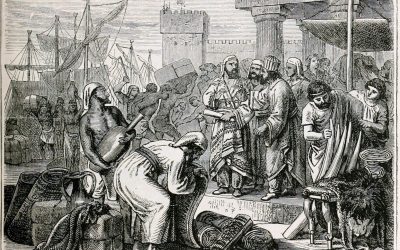
Publisher New York Ward, Lock, Public domain, via Wikimedia Commons
World history
18 January, 2019

The Phoenicians were an ancient Semitic-speaking people who emerged in the region of the Eastern Mediterranean, primarily along the coast of modern-day Lebanon, as well as parts of Syria and Israel. They are known for their seafaring skills, trade networks, and the development of the Phoenician alphabet, which is considered a precursor to most modern alphabets. The Phoenicians flourished from around 1500 BCE to 300 BCE, establishing colonies and trading posts across the Mediterranean Sea.

Origins and cities

The Phoenicians did not refer to themselves as “Phoenicians,” but rather by the names of their individual city-states, such as Tyre, Sidon, Byblos, and later Carthage. These city-states were independent entities, each with its own government, culture, and deity, but they shared a common language and cultural traits. The term “Phoenician” is a Greek designation derived from the word “phoinix,” possibly referring to the purple dye they traded or the mythical Phoenix bird associated with their region.

Trade and economy

The Phoenicians are best known for their skills in navigation and trade. They built fast and durable ships that sailed across the entire Mediterranean, venturing as far as the British Isles and the west coast of Africa to trade for tin. Their primary exports included timber, fine textiles (notably Tyrian purple dye made from the murex snail), glass, and metalwork. Through trade, they facilitated cultural exchanges between the civilisations of the ancient world.


The Phoenician alphabet

One of the most significant contributions of the Phoenicians to world civilisation was the development of the Phoenician alphabet. This was a major advancement in writing systems, as it was simpler and more accessible than the cuneiform and hieroglyphic scripts used in Mesopotamia and Egypt, respectively. The Phoenician alphabet consisted of 22 consonants and no vowels, and it became the foundation for many later writing systems, including Greek and Latin.

Colonisation

The Phoenicians established colonies and trading posts throughout the Mediterranean to secure trade routes and access to resources. The most famous of these colonies was Carthage (in modern-day Tunisia), which eventually grew into a major empire and rival to Rome. Other notable colonies included Gadir (Cadiz, Spain), Utica (in North Africa), and Kition (in Cyprus).

Religion and culture

Phoenician religion was polytheistic, with a pantheon of gods and goddesses worshipped at temples and through various rituals. Some of the major deities included Baal, Astarte, and Melqart. Religious practices and beliefs varied somewhat between city-states but shared common themes and deities with other Canaanite and Semitic peoples.

Decline

The decline of Phoenician power began in the late first millennium BCE, as the Assyrians, Babylonians, and Persians conquered the region. However, the rise of Alexander the Great and the subsequent spread of Hellenistic culture marked the end of Phoenician independence. Despite this, the legacy of the Phoenicians, notably their alphabet, continued to influence the Mediterranean world and beyond.

The Phoenicians left a lasting impact on history through their navigation, trade, and writing innovations. Their legacy is a testament to the interconnectedness of ancient civilisations and the spread of ideas and technologies across vast distances.


Share this:

  • Share on Facebook (Opens in new window) Facebook
  • Share on X (Opens in new window) X
  • Share on Reddit (Opens in new window) Reddit
  • Share on Pinterest (Opens in new window) Pinterest
  • Share on WhatsApp (Opens in new window) WhatsApp

Related

You May Also Like…

The Japanese occupation of Beiping (Beijing) in China

The rise and fall of the Japanese Empire

Rescuers and residents searching the rubble of the destroyed Shajareh Tayyebeh elementary school in Minab

The fracturing of the international order in an age of impunity

US ambassador to the UN, Eleanor Roosevelt, holding the Universal Declaration of Human Rights in 1949

The role and limitations of international law in world affairs

black people day of action new cross fire

Did the UK have a Black civil rights movement?


Reader Interactions

Leave a ReplyCancel reply

Sidebar

This Day In History

Person
On this day in 0461 St Patrick, the patron saint of Ireland, died.
On this day in 1806 Inventor Norbert Rillieux was born. He is famous for revolutionising the sugar industry.
On this day in 1919 Musician Nat King Cole was born.

World history recent posts in

The Japanese occupation of Beiping (Beijing) in China

The rise and fall of the Japanese Empire

Rescuers and residents searching the rubble of the destroyed Shajareh Tayyebeh elementary school in Minab

The fracturing of the international order in an age of impunity

US ambassador to the UN, Eleanor Roosevelt, holding the Universal Declaration of Human Rights in 1949

The role and limitations of international law in world affairs

black people day of action new cross fire

Did the UK have a Black civil rights movement?

Trending

  • What are British values?
    What are British values?
  • The rise and fall of the Persian Empire
    The rise and fall of the Persian Empire
  • The colonisation of India
    The colonisation of India
  • History of Canada - From colonisation to independence
    History of Canada - From colonisation to independence
  • The history of South Africa: From colonisation to independence
    The history of South Africa: From colonisation to independence
  • Operation Ajax and the shadow of empire: The 1953 Iranian coup
    Operation Ajax and the shadow of empire: The 1953 Iranian coup
  • The Grenada Revolution: A Caribbean island's brief socialist experiment
    The Grenada Revolution: A Caribbean island's brief socialist experiment
  • The major branches of Islam: History, beliefs, and differences
    The major branches of Islam: History, beliefs, and differences
  • Women's suffrage movement in Britain
    Women's suffrage movement in Britain
  • The rise and fall of the Ottoman Empire: Six centuries of imperial power
    The rise and fall of the Ottoman Empire: Six centuries of imperial power

Connect

  • YouTube
  • TikTok
  • Bluesky

ABOUT

CONTACT

PRIVACY POLICY

COOKIES

Copyright © 2026 · Our History · All Rights Reserved