
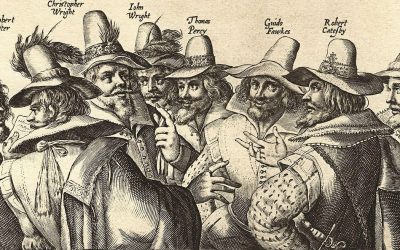
In the early 17th century, a group of disgruntled English Catholics conspired to assassinate King James I and the entire Parliament in a spectacular act of defiance. At the centre of this plan was Guy Fawkes, a man whose image has since become synonymous with anonymity and rebellion. This article aims to shed light on the principal characters involved in the iconic Gunpowder Plot, exploring their motivations for orchestrating such an audacious attack on the British monarchy.
Guy Fawkes, born in 1570, was a devout Catholic who joined the Spanish army to fight against Protestant England during the Eighty Years’ War. He became a competent military man well-versed in explosives, making him an indispensable asset to his fellow conspirators.
The leading figure behind the plot was Robert Catesby, a charismatic and radical Catholic who sought to replace King James with his daughter Princess Elizabeth as a potential Catholic regent. Other notable co-conspirators included Thomas Wintour, John Wright, Robert Keyes, Thomas Percy, Ambrose Rookwood, Francis Tresham, Sir Everard Digby, and Jesuit priest Father Edward Oldcorne. All men shared a common objective: to end decades of persecution against English Catholics by removing the Protestant king from power.
In 1603, King James I ascended to the throne and initially appeared willing to tolerate Catholics in his realm. However, when he failed to repeal Elizabeth I’s anti-Catholic legislation and intensified state sanctions against priests, hostility among Catholics grew. The continuous oppression inspired an increasingly desperate search for alternatives – including armed insurgency.
In May 1604, Robert Catesby initiated what would become known as the Gunpowder Plot by gathering his inner circle at his residence in London. By December of that year, they had secured a lease under the name John Johnson (an alias used by Fawkes) for a waterfront room adjacent to the House of Lords. Over the next nine months, the plotters discreetly stockpiled 600 kg of gunpowder in a cellar beneath the Parliamentary building.
Their plan was nothing short of extravagant: they intended to detonate the concealed explosives when King James, his family, and the entire House of Lords gathered for the State Opening of Parliament on 5 November 1605. With royal and political institutions decimated, Catesby and his comrades hoped to spark widespread Catholic uprisings that would ultimately overthrow Protestant rule.
However, on 26 October, an anonymous letter tipped off authorities about an impending plot against Parliament. Suspicion fell on Catholic sympathisers Fawkes and Percy; subsequently, a thorough search of the premises occurred. In the early hours of 5 November, Guy Fawkes was apprehended in the cellar while preparing the deadly cache for ignition.
Fawkes and his co-conspirators were swiftly rounded up, interrogated, and sentenced to death for their traitorous ambitions. On 31 January 1606, Fawkes jumped from the gallows to avoid a more agonising demise. Thus ended one of history’s most notorious assassination attempts.
The failure of the Gunpowder Plot consolidated Protestant governance in England and deepened suspicions against Catholics. Eventually, policies softened towards Catholics in subsequent centuries as religious tolerance improved. However, Guy Fawkes’s story has transcended its original context and today symbolises a universal desire for freedom from oppressive authorities – even as his association with Halloween remains as enigmatic as his legacy.


Leave a Reply