
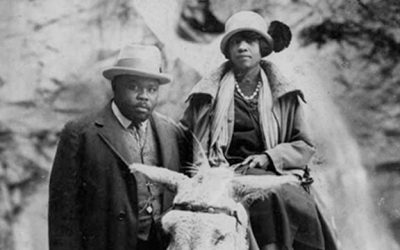
Amy Jacques Garvey, born on 31 December 1895 in Kingston, Jamaica, was a pioneering journalist, editor, feminist, and race activist. She was the second wife of Marcus Garvey, a prominent Jamaican political activist and founder of the Universal Negro Improvement Association (UNIA). Amy Jacques Garvey played a significant role in the UNIA movement and was a prominent advocate for black nationalism and African independence throughout her life.
Early life and education
Amy Euphemia Jacques was the eldest child of George Samuel and Charlotte Henrietta (née South) Jacques. Raised in a middle-class home, her mixed-race heritage heavily influenced her upbringing. Her father was a dark-skinned Black man, while her mother was half-white. According to Yvette Taylor’s account of Amy Jacques Garvey’s life, she was called a “mulatta.”
In her youth, Garvey attended Wolmer’s Schools, one of the few Jamaican high schools at the time. She was also taught to play the piano and took courses in music appreciation, as these were considered essential aspects of a girl’s education. Her father encouraged her to read periodicals and newspapers to enhance her knowledge of the world.
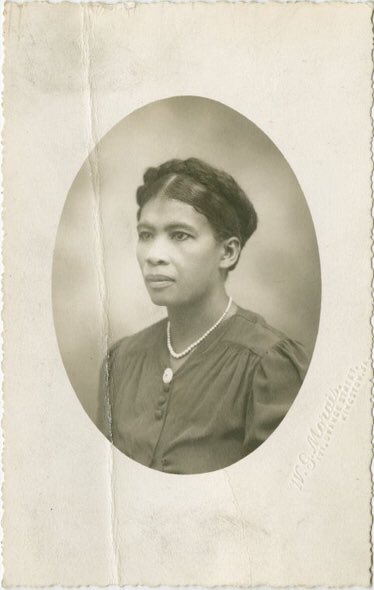
Upon graduating with high honours, Garvey was recruited to work at a law firm. Initially, her father opposed the idea of his daughter working in a male-dominated environment. However, after his passing, the lawyer overseeing his estate convinced Garvey’s mother to allow her to work in the clerical office, where she gained knowledge of the legal system over the next four years.
Journey to the United States and introduction to Garveyism
In 1917, Garvey migrated to the United States. Although she had promised to return within three months if conditions were unsuitable, she never did. Amy attended a conference held by Marcus Garvey and was moved by his words, leading her to assume the role of his private secretary. She worked closely with him and the UNIA and became involved in publishing the Negro World newspaper in Harlem from its inception in August 1918.
Marriage to Marcus Garvey
Amy Jacques married Marcus Garvey on 27 July 1922 in Baltimore, several months after his previous marriage to Amy Ashwood had ended. Interestingly, Jacques had been Ashwood’s chief bridesmaid at her wedding to Marcus. Ashwood attempted to have the second marriage annulled but was unsuccessful, leaving Amy Jacques as Garvey’s legitimate wife. The couple had two children, Marcus Mosiah Garvey Jr. and Julius Winston Garvey, born in 1930 and 1933, respectively.
Leadership of UNIA and advocacy for women’s rights
Amy Jacques Garvey was an excellent speaker and often toured the country with and without her husband. She became a prominent figure within the UNIA, despite the organisation’s commitment to sexual equality, which sometimes allowed sexism to thrive.
As a Black feminist, Garvey emphasised the importance of educating Black women in various aspects of life to ensure a brighter future for the next generation. She had her own segment in the UNIA’s official newspaper, The Negro World, titled “Our Women and What They Think.” The section touched on the struggles faced by Black women in America and featured poetry, profiles of leading Black women, and columns by and about members of the women’s auxiliaries.
Role during Marcus Garvey’s incarceration
When Marcus Garvey was convicted of mail fraud on 21 June 1922, Amy Jacques Garvey assumed interim leadership of the UNIA. She edited and published volume 2 of the Philosophy and Opinions of Marcus Garvey, two volumes of his poetry, The Tragedy of White Injustice, and Selections from the Poetic Meditations of Marcus Garvey. In addition, she worked tirelessly with lawyers to get her husband out of jail and kept UNIA moving forward by delivering speeches and meeting with the organisation’s leadership.
Life after UNIA and Marcus Garvey’s deportation
After her husband’s deportation in 1927, Garvey went with him to Jamaica, where they had two sons. She remained in Jamaica with their children when Marcus moved to England in 1934. Following Marcus Garvey’s death in 1940, Amy Jacques Garvey continued the struggle for black nationalism and African independence. In 1944, she wrote “A Memorandum Correlative of Africa, West Indies, and the Americas,” which she used to convince UN representatives to adopt an African Freedom Charter.
Trip to Nigeria and later works
In November 1963, Garvey visited Nigeria as a guest of Dr Nnamdi Azikiwe, the nation’s first President. She published her book, Garvey and Garveyism, in 1963 and a booklet, Black Power in America: The Power of the Human Spirit, in 1968. She also assisted John Henrik Clarke in editing Marcus Garvey and the Vision of Africa (1974). Her final work was the Philosophy and Opinions of Marcus Garvey Volume III, written in conjunction with E U Essien-Udom.
Awards and recognition
In recognition of her contributions, Garvey was awarded the Musgrave Medal in 1971.
Death and legacy
Amy Jacques Garvey passed away at the age of 77 on 25 July 1973 in her native Kingston, Jamaica. She was interred in the churchyard of Saint Andrew’s Parish Church. As a pioneering female Black journalist and publisher of the 20th century, Garvey’s legacy lives on in her contributions to the UNIA movement, feminism, and the fight for Black nationalism and African independence.


Leave a Reply