
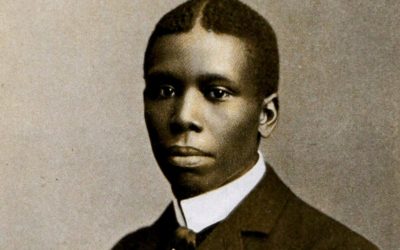
Today is World Poetry Day, and to celebrate, we’re highlighting a poet some may not have heard about in mainstream circles. Today, we feature Paul Laurence Dunbar, poet, novelist, and short-story writer. He was one of the first African American poets to gain national recognition.
Paul Laurence Dunbar was born on 27 June 1872 in Dayton, Ohio, to enslaved parents who had been freed due to the American Civil War.
His talent was apparent from a young age. In 1884, only the year of his birth, he entered a competition and won $10 for his poem, “Our Martyred President; Abraham Lincoln.”
Dunbar had his first poem published in the Dayton Herald at the age of fourteen. During high school, he edited the Dayton Tattler published by his classmate Orville Wright.
Dunbar was a fine student but could not attend college due to financial constraints. He took a job as an elevator operator instead. A former teacher invited him to read at a Western Association of Writers meeting in 1892; his work impressed the audience so much that the well-known poet James Whitcomb Riley wrote him a letter of encouragement. Dunbar self-published his first collection, Oak and Ivy, in 1893. The book was sold for a dollar to people riding in his elevator to pay for the publishing costs.

Dunbar moved to Chicago later that year in hopes of finding work at the first World’s Fair. As a result of his friendship with Frederick Douglass, he was hired as a clerk, and Douglass also arranged for him to read some of his poems. Douglas described Dunbar as “the most promising young coloured man in America.”
By 1895, Dunbar’s poems appeared in national newspapers and magazines, including The New York Times. Majors and Minors, his second collection, was published by Hadley & Hadley in 1895 with the help of friends.
The recognition that Dunbar received helped him gain national and international acclaim, and in 1897 he set out on a six-month reading tour of England. He also published Lyrics of Lowly Life (Dodd, Mead and Co., 1896). When Dunbar returned to America, he accepted a position at the Library of Congress in Washington, D.C. Soon after, he married the writer Alice Ruth Moore.
After Dunbar’s health deteriorated in 1898, he left his job to devote himself full time to writing and readings. He attributed his tuberculosis to the dust in the library. Three more novels and three short story collections would follow over the next five years. He suffered a nervous breakdown and contracted pneumonia shortly after separating from his wife in 1902. Despite his illness, Dunbar continued to write poetry. His collections from this period include Lyrics of Sunshine and Shadow (Dodd, Mead and Co., 1903), Lyrics of Love and Laughter (Dodd, Mead and Co., 1903) and, Howdy, Howdy, Howdy (Dodd, Mead and Co., 1905). As a result, he established himself as one of America’s foremost Black poets. Dunbar’s health steadily declined, forcing him to return to his mother’s house in Dayton, Ohio, where he died on 9 February 1906, at the age of 33.
You can buy The Complete Poems of Paul Laurence Dunbar on Amazon or wherever you like to buy books.


Leave a Reply