

It is often thought that World War I (WW1) was a European War fought exclusively by Europeans, but this couldn’t be further from the truth. Not often mentioned is the fact that there were Caribbean, Asian and African soldiers who served in the war.
Walter Tull is the most celebrated Black British soldier of the First World War. This could be attributed to the fact that he also played professional football before the war. Black servicemen and women from all over the world also played their part in the war, but their sacrifices and contributions were forgotten over time.
The Imperial War Museum’s 2009 exhibition From War to Windrush went some way to addressing the historical imbalance. The exhibition told the personal stories of West Indian people during the First and Second World Wars as well as their arrival to Britain on the Empire Windrush after the war.
The colonies
During WWI, the British called on over 3 million soldiers from all over their empire to fight.
Before WW1 began, Britain and France had colonies in the Caribbean, Africa and Asia, as well as many other places around the world. Germany also had colonies in Africa, and when the war began, these people in the colonies were called to fight.
British Caribbean soldiers
When war broke out, Black Britons volunteered at recruitment centres and were joined by Caribbean people from the colonies.
The British Caribbean people were relishing their freedom after centuries of slavery. Yet many still took pride in their loyalty to the “Mother Country”. When WW1 began, Caribbean people donated large sums of money to aid the war effort, and many volunteered to fight. They travelled to the ‘Mother Country’ at their own expense to support Britain against the Germans. There were Black recruits in all sections of the armed forces.

In 1915 a suggestion for a separate West India regiment to aid the war effort was approved. The British West Indies Regiment (BWIR) was created as a separate Black unit within the British Army. The first recruits sailed from Jamaica to Britain arriving in October 1915 to train at a camp near Seaford on the Sussex coast.
Over 16,000 Black people had joined the BWIR By the end of WW1 the majority came from Jamaica. Their military service took them across the globe to England, France, Italy, Egypt, Mesopotamia (Iraq), East Africa India, Belgium and Palestine.
The Black soldiers of the BWIR were paid less than their white counterparts and were mostly led by white officers and used as non-combatant soldiers. Most of their time was spent doing labouring work, such as laying telephone wires, loading ammunition, and digging trenches, but they were not permitted to fight as a battalion.
By the end of the war 185, BWIR soldiers had been killed or died of wounds. An additional 1,071 died of illness and 697 were wounded.
After the war many West Indian and African soldiers decided to make a life in Britain however, despite their service to the “Mother Country”, they were subjected to racism in some cities. This eventually culminated in race riots in 1919.
Asians in the British army
History has also forgotten the sacrifices made by Indian. At that time, India included Pakistan, Nepal, Bangladesh and Sri Lanka. Soldiers were from many ethnic backgrounds such as Pathans, Sikhs, Muslims and Hindus.

From October 1914, the British deployed the men of their British India Army on the European battlefield. This decision was made within days of the outbreak of hostilities. While the British were still recruiting and training their own forces, it was Indian jawans (junior soldiers) who stopped the German advance at Ypres in the autumn of 1914.
India contributed a number of divisions and contingents to the European, Mesopotamian, Mediterranean, North African and East African theatres of war. Indian soldiers were among the first victims who suffered the horrors of the trenches in Europe. They were killed in droves before the war was into its second year
Approximately 1.3 million Indian soldiers served in World War One – and more than 74,000 of them lost their lives.
In 1947, not long after the war, India gained independence from Britain, and it seems much of its colonial history was lost despite the great sacrifices and contributions that were made.
Africans in the French Army
Like Britain, France was a major colonial power. They assembled troops from all over the French colonies in Africa. France actually recruited more Africans than any other colonial power, sending 450,000 troops from West and North Africa to fight against the Germans on the front lines. France also had Colonies in South-East Asia.
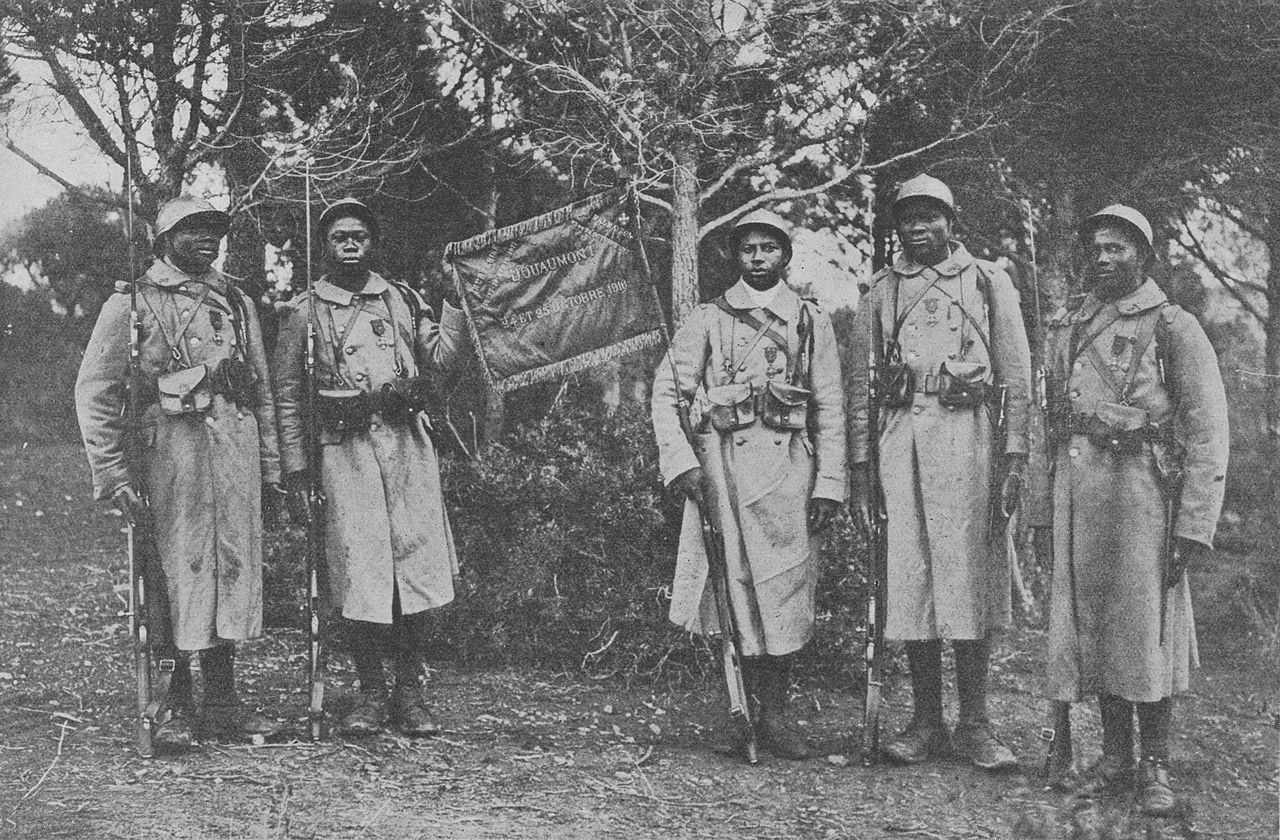
Many of the most decorated African soldiers serving in the French Army were the Tirailleurs Senegalais. The Tirailleurs Senegalais were comprised of soldiers recruited and conscripted from throughout French West Africa and not just from Senegal.
The German troops named the Tirailleurs Senegalais “Black devils”. They earned this label because it was said they fought like demons when they forced Kaiser Wilhelm II’s elite troops to retreat.
African Americans in World War One
Despite America being a racially segregated society, African Americans still served in the US armed forces.
After the United States declared war against Germany in April 1917, The US War Department realised that they would need more men to guarantee victory. They decided to allow African Americans to sign up. More than 20,000 Blacks enlisted in the military, and the numbers increased when the Selective Service Act was passed in May 1917. In some states, African Americans were forced to sign up and some were fraudulently arrested as draft dodgers.
By 5 July 1917 over 700,000 Black Americans had registered for military service. However, they were barred from the Marines and served only in menial roles in the Navy. Blacks were able to serve in all branches of the Army except for the aviation units.
By the end of the war, African Americans had served in various branches of the military including Cavalry, Infantry, Signal, medical, engineer, and artillery units, as well as serving as, surveyors, truck drivers, chemists, Chaplains and intelligence officers.

Some also served in French units. In early 1918, the 369th United States Infantry, a regiment of African American combat troops, arrived to help the French Army. They earned a reputation from the Germans as Hell Fighters and were nicknamed the “The Harlem Hell Fighters”. They were one of the most decorated units under the command of the French military.
In a first for African Americans, Eugene Bullard was the first African American military pilot to fly combat in World War One, although he didn’t fly for the United States. He was a highly decorated pilot in the French Flying corps.
Africans in the German Army
Not much is known about how many of Germany’s Pre WW1 black population served in the armed forces but some Afro-German men did serve in WW1. The First World War was not just fought in Europe. There were battlegrounds in Africa and Asia, as well as at Sea.
The war was after all an argument between these European colonists and Africa was swept up in it as Britain, France, Germany and Italy had carved up Africa between themselves over the centuries.
More than a million African soldiers were involved in these campaigns. Even more men, as well as women and children, were recruited, often forcibly, as carriers to support armies whose supplies could not be moved by normal methods such as road, rail or pack animal. Over 150,000 soldiers and carriers lost their lives during the war. Many more were wounded and disabled.
By the time the war ended, every country in Africa, with the exception of the small Spanish territories which remained neutral, had been formally committed to one side or the other. Belgian, British, French, Italian and Portuguese administrations were actively united against German colonies.
Black and Asians lost their lives in these “European” wars and their service and sacrifices should never be forgotten.


Leave a Reply