

When 20-year-old Sarah (also spelt Sara) Baartman got on a boat that was to take her from Cape Town to London in 1810, she could not have known that she would never see her home again. Nor, as she stood on the deck and saw her homeland disappear behind her, could she have known that she would become the icon of racial inferiority and black female sexuality for the next 100 years.
Sarah “Saartjie” Baartman was born to a Khoisan family in the vicinity of the Gamtoos River in what is now the Eastern Cape of South Africa. It is thought she was born in South Africa’s Eastern Cape in 1789, her mother died when she was two and her father, a cattle driver, died when she was an adolescent. A Dutch colonist murdered her partner, with whom she had had a baby, who died.
Sarah was a slave of Dutch farmers near Cape Town when Hendrick Cezar, the brother of her slave owner and British ship’s doctor William Dunlop, suggested that she travel to England for an exhibition, promising her that she would become wealthy. Lord Caledon, governor of the Cape, gave permission for the trip but later regretted it after he fully learned its purpose. She left for London in October 1810.
Sara Baartman had what was called “steatopygia”, resulting in unusually large buttocks and genitals due to a build-up of fat. This made her a ‘freak’ in the eyes of Europeans, who were arrogantly obsessed with their own superiority, and with proving that others, particularly blacks, were inferior and oversexed.
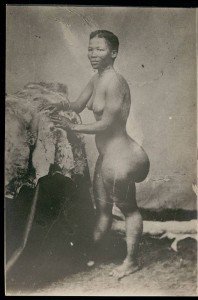
Baartman’s physical characteristics were not unusual for Khoisan women, although her features were larger than normal. European fascination with her was evidence of this prejudice, and she was treated like a freak exhibit in London. Sarah’s treatment is the epitome of colonial exploitation and racism.
It was during her time with Dunlop and Hendrik Cezar that the campaign against slavery in Britain was at its height, and as a consequence, Baartman’s treatment was questioned. Although her “employers” were brought to trial, they were not prosecuted or otherwise penalized. As evidence, they produced a document signed by Sara Baartman and her own testimony stating that she was not treated unfairly. Nevertheless, her contract was amended, so she became eligible for ‘better conditions’, a greater profit share, and warm clothing.
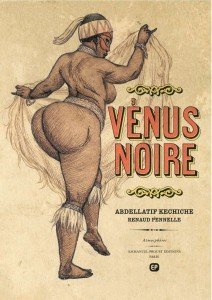
After four years in London, in September 1814, she was taken to France, where she was sold to Reaux, an animal exhibitor. He reaped financial benefits by exhibiting Sarah in Paris and taking advantage of the public’s fascination with her body. She was displayed in a cage alongside a baby rhinoceros. Her “trainer” would order her to sit or stand in the same way as circus animals.
Baartman was sometimes displayed almost naked, wearing only a loincloth and beads and feathers. She was only allowed that due to her insistence that she cover what was culturally sacred. She was nicknamed “Hottentot Venus”. Wealthy customers could pay for private demonstrations in their homes, allowing guests to touch her.
Sarah Baartman returns home
Sarah Baartman died on 29 December 1815 at the age of 26. It is unknown whether she died from alcoholism, smallpox or pneumonia. Cuvier obtained her remains from local police and dissected her body. He made a plaster cast of her body, pickled her brain and genitals and placed them into jars which were placed on display at the Musée del’ Homme (Museum of Man) until 1974.
Sarah Baartman was finally laid to rest properly 187 years after she left Cape Town for London. Her remains were buried on Women’s Day, 9 August 2002, in the area of her birth, the Gamtoos River Valley in the Eastern Cape.


Thank you for this. I am so grateful for woman like you, who make sure that our history is never forgotten. I agree. Knowledge is key.
As I was reading your blog, I thought about the first time that I heard about Ms. Baartman, her story was so sad and inhumane, I can’t for the life of me fathom how a human can mistreat another human being by treating them lower or lesser than a four legged creature. Then I look at my young sisters dressing scantily clad, and tweaking in front of a video camera amongst other things done in front of the camera, then I noticed how a black woman and white woman can pose in a tiny swimsuit, but the comments made on the white woman’s picture is marry me, and the comments on the black woman’s picture is I wanna f*$k you and other derogatory remarks. I have also talked to men from the Middle East, and multiples of them say black women are excellent for sex. This is the image that our young sisters are portraying, as being oversexed, and money hungry. This truly saddens my heart because I believe that they are better than what they are putting out there.
I’m a mother and grandma. Young lady I’m so proud of you for stating the truth about our young ladies. Fully clothed can be sexy too..
Well either it’s true or a perception but really that is not black peoples problems their problems are you see them in negative
Wow. I never that. Thank you so very much for that knowlege. Its such a shame for the things our people had to indure. How can humans treat other humans like that. I dont care what color you are. Its just such a shame.
I heard about this women. At first I thought, that how they (white people) treated black women but then you mentioned that they cute her into pieces then put her parts on display ?!!!!!. Wow. If I was white, I would be ashamed. To hear how sick and twisted my ancestors were. Yuck !