
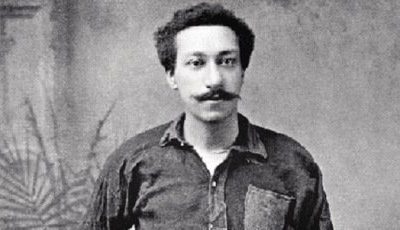
Arthur Wharton was the world’s first Black professional footballer. Despite his sporting prowess, he was never fully accepted and died a forgotten man.
Arthur was born on 28 October 1865 in Accra, formerly the Gold Coast, now the capital of Ghana, West Africa.
His father, Henry Wharton a famous Methodist Minister and Missionary from Grenada in the West Indies was half-Grenadian and half-Scottish. His mother, Annie Florence Egyriba was a half-Scottish member of the Fante Royal Family.
Both of Arthur’s paternal grandfather’s were Scottish traders. One of his great grandmothers was an African-Grenadian slave. Arthur’s uncle on his mothers’ side was a successful businessman and owner of the Gold Coast Times.
In 1884, aged 19, Arthur moved to the North East to train as a Methodist preacher at Cleveland College, Darlington. It was whilst at Cleveland College that he began his amazing sporting careers, competing at this stage as a ‘gentleman amateur’. He excelled at everything he tried (even setting a record time for cycling between Preston and Blackburn in 1887).

In 1886 Arthur became the fastest man in Britain winning the Amateur Athletics Association national 100 yards champion at Stamford Bridge, London – the first time the trophy was won by a Northerner. His sporting prowess was spotted at Darlington Football Club, where he was selected to play as a goalkeeper. Arthur became the first black professional footballer in Britain.
At Darlington, he was described as ‘magnificent’, ‘invincible’ and ‘superb’.
There was no league championship then and the FA Cup was the main competition, along with district and county matches.
In 1885/86 season, whilst still a Darlington player, Arthur was selected for the prestigious Newcastle and District team. At that time it was the best in the city and far superior to the West End and East End sides which later combined to form Newcastle United.

Like many other great goalkeepers before and after him, he gained a reputation for being eccentric! Apparently, he would wait in a crouching position at the side of the goal before rushing out to save the ball. His performance for Darlington came to the attention of the then mighty Preston North End, who signed him. He played in their FA Cup team of 1886/7, while continuing to turn out for Darlington.
In 1888 he left the region to become a professional runner in Sheffield but after a year he returned to football, signing for Rotherham, where he remained for six years before moving to Sheffield Utd for a season. A year at Stalybridge followed until he fell out of favour and joined rivals Ashton-under-Lyme, in 1897 until they went bankrupt in 1899. After another spell with Stalybridge, he returned to the Football League in 1901 with Stockport County at the age of 36. He retired in 1902.
In 1914 Arthur was offered a cricket-coaching job in County Durham, which he turned down due to lack of work to supplement his wages.
In 1915 he went to live in Edlington, Doncaster – possibly looking for work. He became a haulage hand at Yorkshire Main Colliery. He also joined the Home Guard of WW1 sometime between 1915 and 1918.
Arthur continued with his cricket and his running. Even in his 50’s, an eyewitness reported that ‘he could catch pigeons’.
Having developed a drinking problem, Wharton retired from football in 1902 and found employment as a colliery haulage worker at the Yorkshire Main Colliery in Edlington. By 1911 he was employed as a collier and living in a rented room in Moorthorpe, West Yorkshire.
In 1914 Arthur was offered a cricket-coaching job in County Durham, which he turned down due to lack of work to supplement his wages.
He also joined the Home Guard of WW1 sometime between 1915 and 1918.

Public domain, via Wikimedia Commons
In 1930, Arthur died penniless in the Springwell Sanitarium in Balby and was buried in an unmarked grave in Edlington Cemetery. The grave was given a headstone in 1997 after a campaign by anti-racism campaigners Football Unites, Racism Divides.
In 2003 Wharton was inducted into the English Football Hall of Fame in recognition of the impact he made on the game. On 16 October 2014, a statue honouring Wharton was unveiled at St George’s Park National Football Centre at Burton-upon-Trent, Staffordshire.


Leave a Reply